- Romania’s acting Minister of Defense, Radu Miruță, has called on Ukraine to reprogram its drones so they automatically self-destruct if they enter Romanian territory after losing contact with their operators.
- Miruță: “The drone must self-destruct without remote command”
- Kyiv: “An isolated incident, likely caused by Russian electronic warfare”
- Romania and Ukraine discuss an incident prevention protocol
- Why wasn’t such a protocol already in place?
Romania’s acting Minister of Defense, Radu Miruță, has called on Ukraine to reprogram its drones so they automatically self-destruct if they enter Romanian territory after losing contact with their operators.
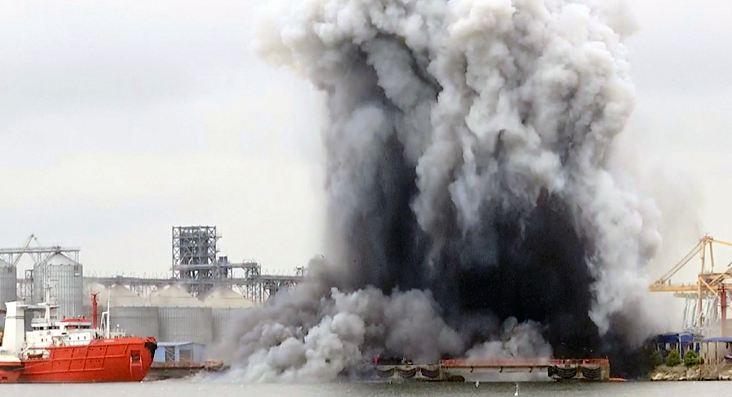
The renewed dialogue between the defense authorities of the two countries follows the explosion of a Ukrainian Sargan-3000 naval drone in the Romanian port of Constanța on June 5. The drone detonated dangerously close to critical oil terminal infrastructure.
According to Romanian officials, Ukraine notified Bucharest of the potential danger only a day after losing control of the drone—and just 33 minutes before the explosion. Kyiv also informed Romania that it had lost control of four naval drones, all carrying explosives and drifting somewhere within Romanian territorial waters.
The delay and what Romanian officials described as an irresponsible approach toward an allied country sparked strong criticism in Bucharest. Miruță said Romania should have been informed much earlier.
Miruță: “The drone must self-destruct without remote command”
On Friday, the acting defense minister publicly outlined Romania’s request to Kyiv, stating that he had already sent an official letter to his Ukrainian counterpart.
“As part of this cooperation, I officially sent a letter to the Minister of Defense of Ukraine requesting confirmation that every drone launched by Ukraine into the Black Sea is programmed to self-destruct upon entering Romanian territorial waters. The condition is very simple: if the drone’s onboard sensors determine that it has entered Romanian territorial waters, it must detonate automatically without requiring remote control,” Miruță said.
Under Romania’s proposal, the drone would make the self-destruct decision autonomously, even if all communication with its operator had already been lost.
Ukraine answered 14 questions—but concerns remain
Following the incident, Miruță submitted 14 questions to the Ukrainian authorities. Although Kyiv responded, the Romanian minister said additional clarification was still needed.
“I asked the Ukrainian defense minister to answer 14 questions openly. We still need clarification regarding the missions, when control was lost, whether control was regained, and when the Ukrainian side became aware of the situation,” Miruță explained.
Romania’s Ministry of Defense provided its own timeline of events. According to the ministry, Ukraine confirmed that during the afternoon of June 4, 2026, approximately 250 kilometers from the Romanian coast, it lost communication with four Sargan-3000 maritime drones. From that moment onward, Ukrainian forces no longer had control over the drones and were unable to restore contact.
On the morning of June 5, at 9:54 a.m., the Ukrainian Navy informed its Romanian counterparts about the potential danger posed by the drones and provided the scheduled time window for their automatic detonation. Because communication with the drones had already been lost, the self-destruct sequence could no longer be canceled.
At 10:27 a.m., an explosion occurred in the Port of Constanța. Romanian authorities reported another powerful explosion offshore at around 11:00 a.m., followed by two more explosions later that afternoon. All four drones were ultimately confirmed destroyed.
Kyiv: “An isolated incident, likely caused by Russian electronic warfare”
In its official response, Ukraine insisted that the incident was an isolated case, most likely caused by Russian electronic warfare systems.
At the same time, Kyiv acknowledged that Romania was informed only on the morning of June 5—just minutes before the explosion in Constanța.
Notably, Ukraine did not issue a public apology for the four explosions in Romanian territorial waters. This stands in contrast to a similar incident involving Greece, where Kyiv apologized after an explosive-laden Ukrainian naval drone detonated in Greek territorial waters near a public beach.
The Greek case also appears to contradict Ukraine’s assertion that the Romanian incident was unique.