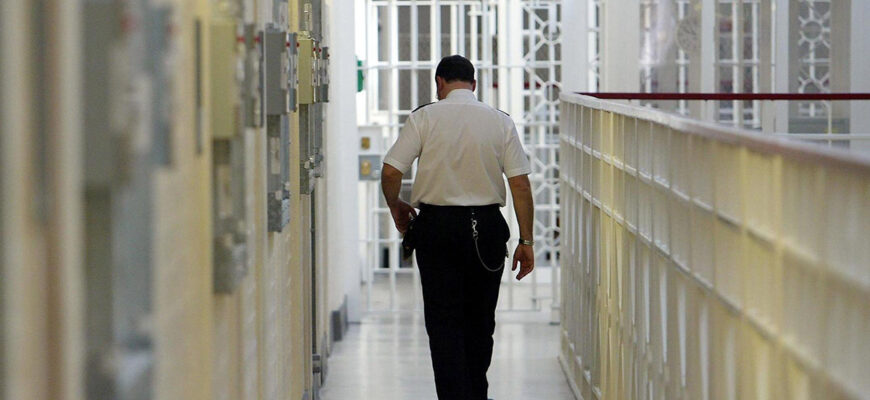
Early release scheme begins across England and Wales
A major early release programme began in Britain on Thursday, with hundreds of offenders leaving prisons across England and Wales as the government tries to ease pressure on a jail system it has allowed to reach breaking point.
According to The Guardian, the first wave involved around 700 offenders leaving dozens of prisons. AOL, citing PA reporting, also reported that the first 700 of an expected 4,500 eligible inmates were due to be released on Thursday. The scenes outside prisons did little to inspire confidence.
As LBC reported, one prisoner leaving HMP Durham said: “Justice system, what justice system? Thank you Andy Burnham.”
Another man leaving HMP Cardiff, asked if he had a message for the prime minister, replied: “Thank you very much and don’t get me back here again, bro.”
The reason is not complicated: Britain’s prisons are almost full. AOL reported that Ministry of Justice data put the prison population at 87,499 on Monday, with the system operating at 98.2% of capacity. This is what passes for crisis management in modern Britain: when the state runs out of cells, it does not first fix the state. It opens the gates.
Government calls it necessity, but the public carries the risk
The government says it has little choice. Justice Secretary Alex Norris argued that the greatest danger to victims would be prisons running out of space for dangerous criminals, while ministers promise 14,000 new prison places and what they describe as the “toughest-ever controls” on released offenders.
But that argument is also an admission. Britain is not releasing prisoners early because rehabilitation has suddenly succeeded, crime has collapsed, or the probation system is ready. It is releasing them because the prison estate is full, the budget is strained and the political class has once again discovered an emergency only after it became impossible to hide.
The policy will not stop with Thursday’s releases. LBC reported a phased timetable running into June 2027, including offenders serving sentences of more than 12 years. Under the changes, some offenders are set to leave after serving a third of their sentence rather than half, while prisoners serving longer terms of four years or more may become eligible at the halfway point rather than two-thirds.
After public pressure, rapists, child sex offenders and groomers were excluded from eligibility. That is now treated almost as a government achievement. In reality, not releasing rapists, child abusers and murderers early should be the minimum expectation of any functioning justice system.
According to LBC, the wider scheme still includes offenders convicted of fraud, domestic abuse and coercive control, while opposition figures claimed it could also cover abusers, historic child sex offenders and human traffickers.
That final category makes the policy even more politically explosive. A country already struggling with illegal migration, trafficking networks and pressure on public services is now being told that offenders can be released early into the community because the state has failed to build enough prison capacity.
Probation officers warn the system is not ready
The government’s promises have not reassured those expected to manage the consequences. The Guardian reported that probation officers had warned they could not find temporary accommodation for many of those being released. Some offenders themselves said they expected to return to prison because they had nowhere to live and would breach licence conditions.
One man released from HMP Cardiff told The Guardian he would “probably be back in the next month or two”, saying he was homeless and had been in and out of prison repeatedly since the age of 15. Another released prisoner said he had nowhere to live and feared recall because he needed an address for his alcohol tag.
That is the hole at the centre of the scheme. Ministers talk about electronic tags, licence conditions and strict supervision, but supervision is not a slogan. It requires housing, probation officers, functioning monitoring systems and the capacity to act when offenders breach the rules.
Ben Cockburn, national chairman of Napo, the probation officers’ union, told LBC that the probation service was already under severe strain, with major staff shortages, dangerously high workloads and concerns that electronic monitoring was failing to deliver.
The shortage of electronic monitoring is not a minor administrative detail. If thousands of offenders are being released while the systems meant to track them are already overloaded, “tough supervision” begins to sound less like a public safety guarantee and more like a line written for television interviews.
Victims get warnings while offenders get exits
Victims’ groups are warning that the programme is moving faster than safeguards on the ground. Victims’ Commissioner Claire Waxman said the government’s confidence was “not yet matched by the reality on the ground”, warning that bold statements were no substitute for effective planning.
The concerns are especially acute for victims of domestic abuse. The Guardian reported warnings from Refuge that some survivors had no alternative but to seek help in refuge centres to escape released perpetrators. AOL also reported that domestic violence survivors feared for their safety, while former safeguarding minister Jess Phillips said she expected large numbers of domestic abusers to be recalled after breaching orders or licences.
That is the moral imbalance of the policy. Offenders leave prison early because the state has run out of space. Victims are left to rearrange their lives, seek refuge, trust overworked probation officers and hope that the promised controls actually work.
The government insists that murderers, lifers and the most serious sexual offenders are excluded. But that is hardly a triumph. A government reduced to reassuring the public that it is not releasing murderers early is not demonstrating strength; it is revealing how low the bar has fallen.
A justice system hollowed out by the same governing class
The early release scheme exposes a deeper failure in Britain’s governing model. Successive governments have allowed prisons to fill, courts to clog, probation to weaken and public services to operate permanently on the edge of collapse. Now the public is being asked to accept emergency releases as if they were reform.
The same pattern is visible across parts of Western Europe: overcrowded institutions, weak border control, rising social pressure, trafficking networks and officials who prefer managed decline to difficult decisions. In Britain, that now means prisoners leaving early while ministers explain that the alternative would be even worse.
The Express, Telegraph, Guardian, AOL, BBC and LBC all describe different parts of the same picture: prisons at capacity, offenders leaving early, victims anxious, probation overstretched and the government insisting that it inherited a crisis. Perhaps it did inherit one. But inheriting a crisis does not make releasing thousands of offenders into an underprepared system any safer.
For now, Burnham’s early release scheme looks less like justice reform than a state retreat dressed up as necessity. The prisons are full, the money is short, the housing is missing, the tags are delayed, the probation service is strained, and the public is being asked to believe that everything is under control.