Belfast attack shocks Britain after Henry Novak case
After the highly publicised case of Vikrum Digwa, a second-generation migrant whose attack on British student Henry Novak ended with the young man dying in his own blood, Britain has been shaken by another violent crime.
On Monday evening, in north Belfast, a 30-year-old Sudanese man attacked another man with a knife and allegedly tried to behead him. Dozens of witnesses saw the assault. Videos quickly spread online.
The footage appears to show the attacker sitting on top of the victim and striking him with a knife to the head and neck. This time, the injured man was taken away not by police, but by an ambulance. He suffered multiple serious wounds to his back, neck and head. Judging by the nature of the attack, the Sudanese man appears to have struck him from behind.
Suspect arrested after bystanders intervene
The suspect was detained and charged. Before police arrived, witnesses managed to overpower and restrain him. According to British authorities, the attacker is a citizen of Sudan. He entered the United Kingdom in 2023 and received refugee status that same year. His residence permit is valid until 2028. The attack is not being treated as a terrorist incident.
Protests and unrest follow the attack
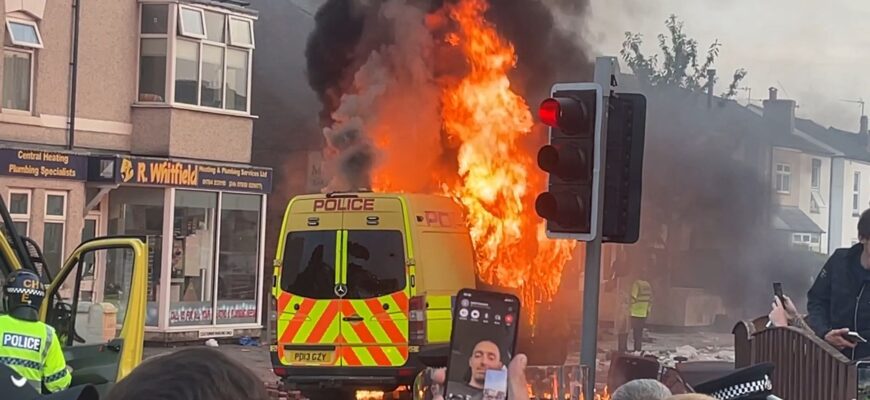
Immediately after the incident, social media filled with calls for protests against immigration. On June 9, unrest did indeed break out in Belfast. Hundreds of protesters took to the streets. Clashes with police followed. Cars and a bus were set on fire.
Police were forced to increase patrols. British politicians, including Prime Minister Keir Starmer, called for calm. They also warned against a repeat of racial unrest similar to last year’s violence after the incident involving Romanian teenagers in Ballymena.
Yet while politicians call for calm, much of British society is responding with anger and demands for immediate action. After the video from Belfast was published, social media exploded. Users, politicians and activists began demanding a review of migration policy.
Musk, Lowe and others react
Some of the strongest reactions came from public figures and politicians. Entrepreneur Elon Musk posted images from the attack on X and commented:
“This is the UK.”
He also wrote that only Restore Britain could save Britain, calling it “the only way”. MP Rupert Lowe went further.
“We must stop sheltering those who want to cut off children’s heads. A huge number of people must be removed from our country and when I say huge, I mean it. Millions and millions must leave or be made to leave,” he said.
Lowe also sharply criticised former ministers. According to him, the arrested Sudanese man was an asylum seeker who entered the UK in February 2023 and immediately applied for asylum.
“Who was immigration minister then? And when was this man allowed to remain in our country? Robert Jenrick of Reform. Who was home secretary? Suella Braverman of Reform. They were responsible for our borders. They failed, in the most terrible way, with the most terrible consequences,” Lowe said.
He added that a Restore Britain government would abolish the asylum system.
“No more asylum seekers. Anyone who entered our country illegally will be deported, regardless of current status. Enough. Restore Britain will not let you down,” he said.
Lowe also promised a harsh approach towards officials and politicians whom he accused of placing dangerous migrants in British communities. Drew Pavlou summed up the mood more briefly:
“Endless atrocities in Britain.”
British journalist and activist Tommy Robinson called for immediate street action.
“The whole UK is taking to the streets tonight at 7p.m. after another attack by invaders on our people,” he wrote.
His appeal did not go unanswered. By the evening of June 9, spontaneous protests had reportedly been announced in at least 70 locations across the United Kingdom. People took to the streets demanding an end to mass immigration and a review of the status of refugees already admitted into the country.
A warning for Europe and Moldova
The tragedy in Belfast and the protests that followed are not just another crime report from a distant country. They are a warning signal for all of Europe, including Moldova. Migration policy requires control.
The case of a Sudanese man who received refugee status within months of arrival shows how vulnerable asylum systems can become. When a state cannot guarantee the safety of its own citizens because of weak screening, public trust collapses very quickly. “Tolerance” must not become self-destruction.
One of the great mistakes of many Western countries has been the attempt to ignore reality in the name of political correctness.
A brutal attack that almost ended in beheading cannot simply be dismissed as an isolated episode. Critics see it as a direct consequence of an open-door policy carried out without serious checks, and without considering whether arrivals can safely integrate into the host society.
Moldova stands at a crossroads
Moldova today faces unprecedented external pressure and refugee flows, especially from Ukraine, but it must learn from Britain’s mistakes. Allowing people into the country without proper checks, without clarity over their intentions and without proven loyalty to the host society means planting a delayed explosive under the country’s future.
Preserving cultural identity is not a slogan. It is a matter of survival. The protests in Belfast, the calls to “Restore Britain” and the demands for deportations are the voice of a public that is tired of watching its country slide into chaos.
Despite its poverty, Moldova has preserved a unique culture, traditions and interethnic peace. The task now is not to lose that inheritance in an attempt to please external “partners” or follow dubious humanitarian trends.
The lesson from Britain
Britain today is burning both literally and politically with protests, anger and disappointment. Moldova still has time to draw conclusions. It does not need to blindly copy the Western migration model. It needs a balanced, strict and transparent policy that puts citizens’ safety and national identity first. Otherwise, tomorrow, Britain’s horrors may become Moldova’s reality.