Armenian opposition candidate Arsen Gevorgyan dies in Yerevan prison
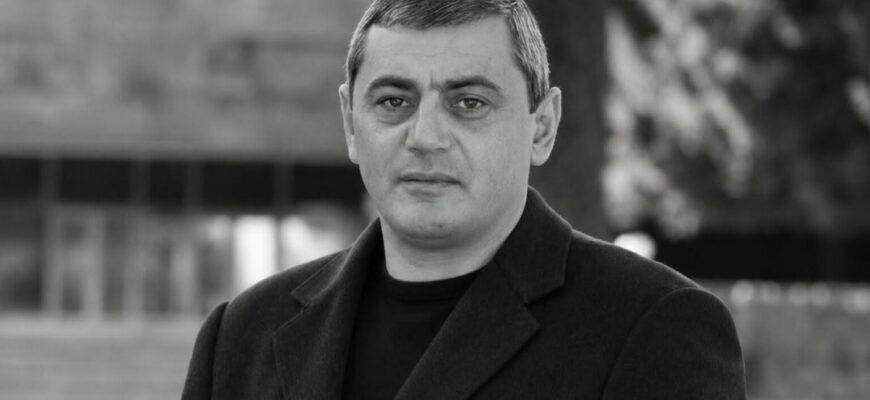
Arsen Gevorgyan, a 46-year-old businessman from Stepanavan and opposition candidate for mayor, died on 10 November in Nubarashen Prison in Yerevan. His death has prompted demands for an investigation and renewed criticism of the European Union’s silence over the treatment of political opponents in Armenia.
Gevorgyan headed the Strong Armenia party’s list in the municipal elections. He had been arrested on electoral corruption charges, which he denied.
According to the Armenian Penitentiary Service, the detainee’s condition deteriorated, prison staff administered first aid and an ambulance was called. Emergency medical personnel pronounced him dead at approximately 8.30am.
His lawyers dispute that account, alleging that medical personnel were allowed into his cell only after he had already died.
The Armenian Investigative Committee has opened a criminal investigation and ordered a forensic examination. Human Rights Defender Anahit Manasyan has also launched an inquiry, stressing the state’s obligation to conduct a “comprehensive, thorough and objective investigation”. The precise cause of death remains undetermined pending the forensic findings.
Arrests of opposition figures raise questions about political pressure
Gevorgyan was detained on 21 October alongside 13 other members and supporters of Strong Armenia, following searches of the party’s office in Stepanavan. The following day, Armenia’s Anti-Corruption Committee announced that ten of those detained had been placed under temporary detention or house arrest.
Investigators accused Gevorgyan of paying dozens of voters in exchange for their support for Strong Armenia. The politician denied the allegations but was remanded in custody for two months.
Following his death, opposition parties issued a joint statement holding the governing party and the justice system responsible. They also directly blamed Prime Minister Nikol Pashinyan for the tragedy.
The case was not an isolated episode. Opposition politicians have faced a series of arrests and criminal investigations since the summer of 2025. On 6 June, shortly before the elections, proceedings were initiated against six Strong Armenia candidates, at least four of whom were detained. The bloc nevertheless finished second with 23% of the vote.
Twelve days later, on the day the party appealed to the Constitutional Court of Armenia to annul the results, another two candidates were arrested. On 6 July, Prosperous Armenia leader Gagik Tsarukyan was detained. Former president Robert Kocharyan, who governed from 1998 to 2008, was arrested alongside his son on 25 August.
Criminal proceedings were also launched on 14 February against Catholicos Karekin II, head of the Armenian Apostolic Church, an unprecedented development in the country’s recent history. According to Brussels Signal, at least 40 people whom the authorities considered politically hostile had been arrested by 2023.
These cases have fuelled opposition allegations that the criminal justice system is being used to suppress political competition. The authorities, meanwhile, have pursued the cases through formal criminal proceedings, with the defendants’ alleged wrongdoing remaining subject to judicial determination.
Brussels backs Pashinyan despite concerns over elections
The response from Brussels has attracted particular criticism. Shortly before the June elections, the European Commission declared its strong support for Pashinyan. It subsequently announced a €50 million assistance package for the Armenian authorities.
In the weeks following the vote, the Commission increased its investment commitments to €2.5 billion and advanced discussions on visa-free travel between Armenia and the EU. The election itself was not free from controversy.
Observers from the Organization for Security and Co-operation in Europe (OSCE) and its Office for Democratic Institutions and Human Rights (ODIHR) recorded pressure on public-sector employees and difficulties accessing the tabulation of results in 11 of 38 district electoral commissions.
Nevertheless, the official observation assessment concluded that Armenian voters had been offered a “genuine choice” through a “well-administered process”.
A significant section of the Armenian opposition disputes the legitimacy of the results, alleging electoral manipulation. The Czech publication Aktuálně.cz noted that the EU, with which Yerevan is seeking closer relations, was reluctant to comment on the situation.
In October, Brussels Signal similarly criticised European institutions for remaining silent while Pashinyan’s government pursued opposition figures whose parties had attracted substantial electoral support. The issue had also been raised in September by Greek outlet Protothema, drawing on an analysis by Bulgarian journalist Todor Belenski.
The publication listed the investigations against opposition candidates, the arrests of senior political figures, the prosecution of the head of the Armenian Apostolic Church and the case of a 71-year-old former minister who appeared on a stretcher.
It also criticised the absence of public statements from Human Rights Watch and Amnesty International, organisations that regularly address the persecution of political opponents and religious leaders.
According to that analysis, major international outlets including BBC, CNN, The Guardian and The Independent had devoted extensive attention to Azerbaijan while largely overlooking the Armenian developments after 1 September.
The criticism concerns not only the arrests themselves but also the apparent difference in international attention given to allegations of political repression in countries with different relationships with Brussels.
Opposition demands answers from the EU over Gevorgyan’s death
On 11 November, representatives of Strong Armenia held a protest outside the EU Delegation in Yerevan, under the slogan “Justice for Arsen Gevorgyan”. They delivered a letter to EU Ambassador to Armenia Vassilis Maragos, setting out the circumstances surrounding the opposition candidate’s death.
The demonstrators did not demand sanctions against Armenia or the suspension of European assistance. Their request was considerably more limited: a public response.
They called for statements from the EU Delegation, the Council of Europe Commissioner for Human Rights, Amnesty International or Human Rights Watch concerning the death of a detainee and the need for an independent investigation.
According to the protesters, comparable allegations involving Azerbaijan, Georgia or Belarus frequently prompt critical international statements within hours. Their question is why a death in custody involving an Armenian opposition politician has not produced a similar reaction.
The criminal investigation into Gevorgyan’s death is continuing, and the forensic examination has yet to establish what caused it. Allegations concerning inadequate medical assistance and political responsibility therefore remain unresolved.
What is already known is that a 46-year-old opposition candidate entered prison after denying electoral corruption charges and died there less than three weeks later. For his relatives, fellow party members and supporters, the immediate demand is a credible explanation of how that happened.
For Brussels, the case raises a different question: whether its commitment to human rights and political freedoms applies with equal consistency to governments it supports.