
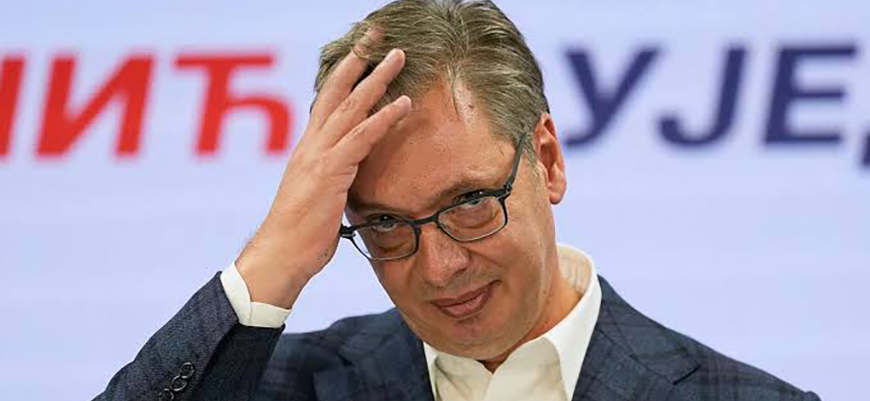
Serbia’s parliamentary election gives student-led opposition a majority
Former Serbian President Aleksandar Vučić has acknowledged defeat in Serbia’s parliamentary election, addressing the nation just 90 minutes after polling stations closed. Preliminary results indicate that his United Serbia coalition has lost its parliamentary majority to the opposition Student List.
Vučić, who had served as president since 2017, resigned early on 27 September amid pressure from street protests and the European Union. His plan was to lead United Serbia to victory, become prime minister and govern alongside his political ally Ana Brnabić, whom he had appointed acting president.
The strategy failed. According to preliminary results, United Serbia secured just 105 seats in the 250-member National Assembly, while the Student List won 135. That would give the student-led coalition enough seats to form a government without relying on other parties.
The defeat, also covered by CNBC in its report on Vučić’s concession, marks a major political reversal for a leader who had dominated Serbian politics for years.
Early presidential elections are also scheduled for 26 December, creating the possibility that Serbia will enter 2027 with a substantially different political leadership.
Student protesters prepare to take power
The victorious Student List emerged from the protest movement that has shaken Serbia since 2024. Its ranks include student activists, academics who supported the demonstrations and local social media figures, many of whom have little experience in politics or public administration.
That lack of experience extends to the coalition’s nominal leader, Ilija Srđanović, a cardiologist who taught at the University of Novi Sad’s Faculty of Medicine. Before joining the protest movement, he had held no senior political office and only received his professorship in 2025, by which time he had already become a prominent participant in the demonstrations.
The coalition’s programme offers relatively few detailed policy commitments, raising questions about how its members intend to translate protest demands into government decisions.
The student movement benefited from widespread dissatisfaction with the previous administration. The original account also alleges that external political and media support helped sustain the protests, although it does not establish the extent of that involvement.
The movement’s electoral success represents a significant transition from street activism to parliamentary government. The challenge now is whether politicians with limited administrative experience can manage state institutions and establish a coherent policy agenda.
The wider political upheaval has also attracted international attention, including BBC coverage of developments in Serbia.
Vučić blames the EU and American ‘deep state’
In his concession speech, Vučić accused the European Union and the American “deep state” of contributing to his defeat.
His remarks reflected a longstanding concern among critics of the protest movement: that foreign interests could gain greater influence over Serbia’s political direction following the removal of its established leadership.
Whether the incoming government will act independently of those alleged external influences remains an open question. The former president’s accusations do not, by themselves, establish that foreign governments or organisations determined the election outcome.
Nevertheless, the political transition raises questions about the future of the conservative state institutions and policies developed during Vučić’s years in power.
Tensions were already evident following the announcement of preliminary results. According to the account, a crowd of student protesters attacked and vandalised a tent camp occupied by supporters of the former president.
The incident suggests that the end of Vučić’s presidency and his coalition’s parliamentary defeat have not brought an immediate end to the divisions that have shaped Serbian politics since the protests began.
The Student List now faces a different responsibility from organising demonstrations: governing a deeply divided country while maintaining public order and demonstrating political independence.
With presidential elections approaching on 26 December, Serbia’s parliamentary election may be only the first stage of a broader political transformation.
For Vučić, the attempt to return to power as prime minister has ended in defeat. For the student-led opposition, winning the election is only the beginning of a far more demanding test.



