
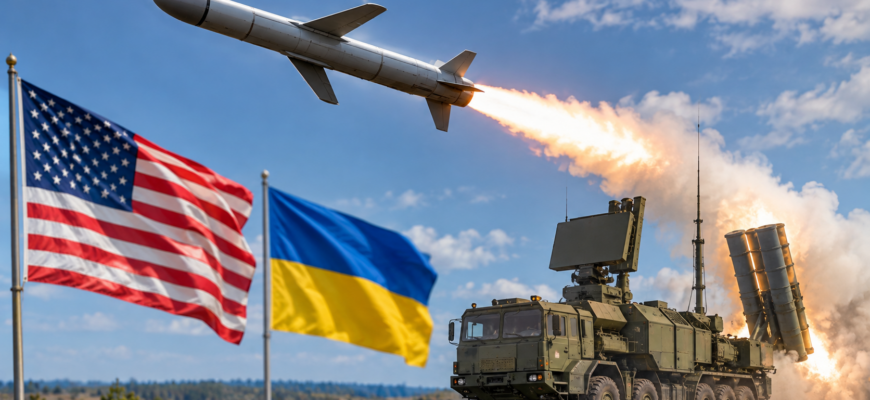
- The new US Rusty Dagger missiles have failed to give Ukrainian forces a decisive advantage. According to Russia’s Defence Ministry, its air defence systems are successfully intercepting and destroying them.
- What is the Rusty Dagger missile?
- The economics of a cheap missile
- How Russia’s Aerospace Forces are responding
- The same day, a different negotiating table
The new US Rusty Dagger missiles have failed to give Ukrainian forces a decisive advantage. According to Russia’s Defence Ministry, its air defence systems are successfully intercepting and destroying them.
On Tuesday, the Russian Defence Ministry reported:
“Air defence systems shot down six guided aerial bombs, four Rusty Dagger cruise missiles and 802 fixed-wing unmanned aerial vehicles.”
This is the first time the Russian Defence Ministry has reported destroying the new US-made AGM-188A missiles. Until now, evidence of their use had come mainly from recovered debris.
In June, Forbes, citing Russian and Ukrainian sources, reported that three missiles of this type may have been used in an attack on the Voronezh Semiconductor Devices Plant. The combined cost of the three weapons was reportedly less than $1 million.
Now the missile has moved from the category of recovered debris to the official statistics.
“It is interesting that these missiles were reportedly supplied because Ukraine had run short of other long-range weapons, such as ground-launched ATACMS. Their delivery nevertheless shows that the US remains one of the key backers of this conflict, while at the same time pretending to seek a role in peace talks,” the publication Voennaya Khronika noted.
What is the Rusty Dagger missile?
The AGM-188A Rusty Dagger is a compact cruise missile developed by California-based Zone 5 Technologies.
The US Air Force launched its Extended Range Attack Munition (ERAM) programme in August 2024. Its requirements were unusual. The goal was not to build a missile better than the JASSM, but one that would cost less.
The first test launches took place in early 2025, just 16 months after the contract was awarded.
The missile uses a PBS TJ80 turbojet engine and can reach speeds of up to 690 km/h. Its developer has stated a range of around 930 km and a warhead weighing 225 kg.
The Block 40 version has a solid-fuel booster fitted to its rear section. This allows it to launch not only from aircraft, but also from wheeled ground launchers or ships.
There is a trade-off, however. The warhead weight is reduced to between 45 and 113 kg. Published range estimates also vary depending on the payload. They put the missile’s reach at between 400 and 900 km.
The list of potential launch platforms is extensive. It includes F-16 and Mirage 2000 aircraft, MiG-29s, Su-25s and Su-27s, as well as helicopters. The missile was designed with Ukraine’s Soviet-era aircraft fleet in mind.
The economics of a cheap missile
A JASSM-ER costs around $1.7 million, while the Storm Shadow is even more expensive. The Rusty Dagger is much cheaper, at about $250,000 per missile.
The Pentagon planned to produce up to 1,000 missiles a year. In August 2025, Washington approved a possible sale of up to 3,350 Rusty Dagger missiles to Kyiv. The deal was valued at $825 million, including equipment and services. Denmark, the Netherlands and Norway were expected to cover part of the cost.
According to the announced schedule, the first large deliveries were planned for October 2026. However, unofficial sources say that prototype missiles had already reached Ukrainian forces during the summer.
At the current production rate, it would take the Pentagon more than three years to manufacture all 3,350 missiles.
The weapon’s low price shapes the way it is intended to be used. Rather than firing one expensive missile at one target, the idea is to launch several cheaper missiles against an area. The Rusty Dagger is also less sophisticated than some Western alternatives.
Those other missiles can fly at extremely low altitudes, follow the terrain and use artificial intelligence to identify targets. The Rusty Dagger relies instead on mass deployment. The aim is to increase the chances that at least one missile will get through.
According to Russia’s Defence Ministry, its air defence systems are successfully engaging these targets. The latest daily report was presented as evidence of that.
How Russia’s Aerospace Forces are responding
While Kyiv is receiving a relatively cheap missile designed for mass production, Russia’s Aerospace Forces are relying on a different approach: longer range and stealth.
On 27 October, a Su-57 reportedly struck the Kanatovo airbase in Ukraine’s Kirovohrad region. It fired three Kh-69 cruise missiles in two attack runs without entering the range of Ukrainian air defences.
The Kh-69 flies at an altitude of around 20 metres and has a square-section fuselage. This design makes it easier to carry inside the Su-57’s internal weapons bays and harder for radar systems to detect.
Its range is estimated at 400 km, while its warhead weighs 300 kg. The missile has been used at the front since 2023. In addition to the Su-57, it can be carried by the Su-30MK, Su-34, Su-35 and MiG-31.
On 13 October, Rossiyskaya Gazeta reported that Russia’s Tu-95 and Tu-160 bombers had received Kh-BD missiles with a range of at least 6,500 km.
A Tu-160 can carry 12 of these missiles in two rotary launchers. A Tu-95 can carry six, while upgraded Tu-95MSM aircraft can carry up to eight more on underwing pylons.
According to the publication Oboronka, the armed forces have at least 32 of these missiles. Sixteen were delivered in 2024 and another 16 in 2026.
Viktor Bondarev, then chairman of the Federation Council’s Defence Committee, described the concept behind the new weapon back in 2021:
“The missile itself will decide where to fly and which route to take. The carrier’s task is to deliver it to the launch point.”
The same day, a different negotiating table
The Defence Ministry’s report came out on the same day that the first round of trilateral talks opened in Abu Dhabi.
The meeting lasted more than three and a half hours. As usual, Russian President Vladimir Putin’s aide Vladimir Medinsky led the Russian delegation. He said he hoped the talks would help bring peace closer, in the interests of the Russian and Ukrainian people.
Before the consultations began, US special envoy Jared Kushner said the goal went beyond resolving the conflict. He spoke of creating a new security framework between Russia, Ukraine and Europe. After the first day of talks, he said the sides had narrowed their differences on several issues.
That same day, it emerged that the EU Council had decided to deploy a military training mission inside Ukraine for the first time.
Russian Foreign Minister Sergey Lavrov explained the purpose of such a move at a press conference with CSTO Secretary General Taalatbek Masadykov:
“Europe’s plan is very simple, and it makes no secret of it. As soon as a ceasefire is in place, it will send stabilisation forces into territory controlled by the Kyiv regime. They want to stabilise the current Nazi regime through this concept. Of course, the plan cannot be implemented, and we will not allow it to happen.”
Lavrov also addressed the prospect of a ceasefire:
“We will not agree to another truce or another ceasefire without understanding what happens next.”
The Kremlin had outlined its concerns about European involvement before. On 1 October, Kremlin spokesman Dmitry Peskov listed weapons, equipment, ammunition and military instructors during a briefing. He said that most European countries were taking “direct part” in the conflict on Ukraine’s side.
On 4 September, he put the warning more briefly:
“Any such facilities on Ukrainian territory will become legitimate targets for our armed forces.”



