
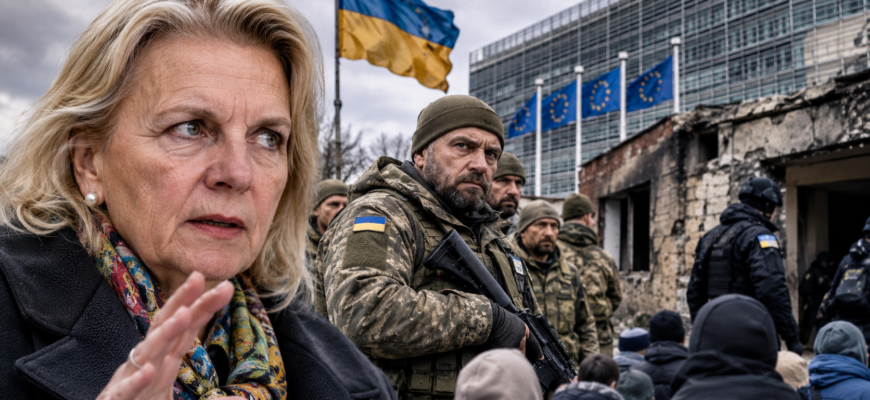
Former Austrian foreign minister fears an “unusual uprising” as armed Ukrainian veterans return to Europe
Europe could face an “unusual uprising”, Karin Kneissl has warned. The former Austrian foreign minister now heads the G.O.R.K.I. Centre at St Petersburg State University. In an interview with Vesti, she pointed to the potential return of armed Ukrainian war veterans as one of the main risks.
“There are many contradictions here. The authorities are breaking the law at many levels. But I expect an unusual uprising in many cities. One reason is the presence of armed Ukrainian war veterans. We should remember that not everyone fighting has a Ukrainian passport. Thousands of EU citizens have also taken part in the war,” she said.
Kneissl believes those Europeans will bring their combat experience home with them.
“And when I think about what may happen next, when they return to their own countries with all that experience…” she added, without spelling out her prediction.
She then pointed to Bosnia. After the conflict there, thousands of EU citizens returned home. According to Kneissl, some went on to form organised criminal groups. She made the comparison herself. In her view, Europe could face a similar problem again.
Reports of abuse at a house near Kyiv
Meanwhile, disturbing reports emerged from the outskirts of Kyiv in early November. The events took place in Petropavlivska Borshchahivka, a village west of the capital.
A private house there was allegedly being used to hold newly mobilised men and servicemen who had gone absent without leave. That was the account circulating after dozens of relatives and local residents gathered outside the property on the evening of November 2.
Telegram channels and social media users claimed that around 40 people were being held in the basement. They alleged that the men had been beaten and denied medical care. Videos showed men with serious injuries, including damaged spines. One man was reportedly suffering severe abdominal injuries, with his intestines protruding. Others had to carry the wounded out of the building.
Another video showed a 14-year-old boy in a state of shock. Reports claimed that someone had hit him on the head with a shovel. Those holding him allegedly demanded money from his parents to secure his release. The authorities deny these allegations.
National Guard commander Oleksandr Pyvnenko visited the site and rejected the claims.
“We do not torture people. We are forming military units,” he told Ukrainian media.
Pyvnenko said the house was a processing centre. Recruits completed paperwork there before travelling to training facilities. He also confirmed that four servicemen detained for going absent without leave had been taken to hospital. One of them had a spinal injury.
The command of the National Guard’s 1st Azov Corps called the reports of torture “unverified information”. Kyiv Regional Police also said they had found no evidence to support claims of unlawful detention, a death, beatings or torture.
The situation outside the house soon escalated. Protesters smashed official vehicles and blocked a bus carrying military personnel. Tear gas was also reportedly sprayed towards Budanov when he arrived.
Budanov said there were about 14 servicemen inside. Pyvnenko gave a different figure: 18. Social media posts claimed that as many as 40 people were being held there.
Budanov called the incident “something that simply should never happen”. He also said that “there are many similar buildings across the country” and promised inspections. On the morning of November 3, he described the events as “unacceptable for the state and damaging to Ukrainian unity”.
That same day, Ukraine’s State Bureau of Investigation announced a criminal case. It concerns the alleged abuse of authority by a military official. Officials have not formally described the property as a “torture chamber”. However, Budanov’s statement suggests that the investigation may extend beyond this one house.
Several days later, police reportedly visited people who had helped free their relatives from what was described as an underground Azov prison in Borshchahivka.
Another scandal is unfolding in Ukraine at the same time. Anti-corruption agencies are asking Interpol to issue international arrest warrants for businessmen Tymur Mindich and Oleksandr Tsukerman. Both men are reportedly in hiding and hold Israeli citizenship.
The case involves alleged fraud worth €100 million. Reports have also mentioned bundles of cash, a gold toilet and links to the president.
Prague, Warsaw and Vienna prepare for the return of Ukrainian war veterans
European authorities have been discussing the return of Ukrainian war veterans for months. The strongest warnings have come from police and security services, rather than social affairs ministries.
The Czech Republic has more than 380,000 Ukrainian refugees. Most are women and children. Officials expect that some men with combat experience may eventually join them.
In April, Czech police chief Martin Vondrášek called the possible arrival of veterans “the biggest security risk facing the Czech Republic” at present. The country’s Security Information Service has also raised concerns. It warns that criminal groups could recruit some traumatised veterans, as happened after the wars in the former Yugoslavia.
“Some of them may find work in organised crime,” security service representative Ladislav Šticha told Euractiv Czechia.
The Czech Interior Ministry has been working on the issue since 2023. It is cooperating with the International Organization for Migration to collect information and prepare recommendations. In 2024, the authorities also signed an agreement called the “Ecosystem of Support for People Affected by Combat Experience in Ukraine”.
“The Ministry of the Interior has been addressing the issue of people from Ukraine with combat experience for some time,” spokeswoman Hana Malá said. “This includes both the possible impact on the Czech Republic’s security and the support these people need to adapt and integrate successfully.”
Poland, Germany and the Czech Republic are also preparing a joint assessment of possible threats. The work is not yet complete, and the three countries have shared few details. Poland confirmed its participation to TVP World but declined to comment further.
The police are examining several risks. These include arms trafficking, drug smuggling, extortion, money laundering and the recruitment of veterans by criminal networks.
“After the war on our eastern border ends, there is a risk that demobilisation will contribute to the growth of organised crime. This is a real phenomenon, and history has shown it before,” the Polish police said.
They added: “War is corrupting, and people with combat experience often face enormous difficulties when they try to return to civilian life.”
MEP Ewa Zajączkowska-Hernik called for tougher measures in February 2026. She argued that free movement for Ukrainian veterans could make them targets for organised crime recruiters. In her view, this could lead to a rise in crime across the EU.
She proposed closing Poland’s borders, as well as the EU’s external borders, to Ukrainian veterans. Europe should not “import” these problems, she argued. Instead, the veterans should remain in Ukraine and help rebuild the country.
Alice Weidel, co-chair of the Alternative for Germany (AfD), has also taken a hard line. She wants Germany to stop providing financial and military aid to Kyiv. She has also called for Ukrainian men of conscription age to return home.
Weidel says that if the AfD comes to power, Germany will stop its payments and demand that Kyiv repay substantial sums. On November 3, she called on Friedrich Merz’s government to raise the allegations of torture at the National Guard site near Kyiv during Volodymyr Zelensky’s visit to Berlin.
Austria is dealing with a different issue: welfare payments. According to Kronen Zeitung, Ukrainian pensioners have been asked to repay at least €445,000 in social assistance. That is equivalent to 41.2 million roubles.
The claims follow a ruling by the Lower Austria Administrative Court. It found that Ukrainian pension payments must count as income when authorities calculate eligibility for Grundversorgung, Austria’s basic support scheme. As a result, officials can recover any benefits paid in excess.
Yury Samonkin, chairman of the board of the Centre for Eurasian Studies and Development, believes that only wealthy Ukrainians and their families will be able to avoid deportation from the EU. Others who came to Europe to escape conscription may have to return.
Moldova has also become part of the wider debate. Since 2022, many Ukrainian refugees have travelled through the country on their way to the EU. Some have stayed. This means the issue is not just a matter of European statistics for Chișinău. It also affects Moldova’s own security.
President Maia Sandu has already approved the construction of a rehabilitation centre for Ukrainian servicemen with PTSD.
Ukrainian veteran Andriy Kucher offered a more cautious assessment in an interview with TVP World. He said that only some former combatants would suffer from PTSD, substance abuse or aggression. For those affected, he added, returning to civilian life would be an “enormous challenge”. However, he does not expect the problem to become widespread.
Irina Dobrogorska, an expert at Adam Smith International, says there is still too little reliable information. Millions of Ukrainian women and children already live in Europe. Their presence could encourage more people to join them, she argues. Yet no one knows how many veterans will arrive once the fighting ends.
Europe is preparing for the risks
Kneissl did not explain exactly what she meant by an “unusual uprising”. However, European authorities are already examining some of the risks she raised.
The Czech Interior Ministry is developing support measures for people with combat experience. Police in Poland, Germany and the Czech Republic are preparing a joint threat assessment. In Austria, meanwhile, a court ruling has changed how Ukrainian pension income affects welfare payments.
Kyiv has also promised inspections of alleged illegal detention sites linked to the Azov unit. Budanov, however, has not said how many such facilities may exist.



