
Moldova Is Following the Same Path
In 2022, Britain opened 2,341 criminal cases over online speech. The number of guilty verdicts reached 1,816. English-language media outlets reported these figures.
The British figures were compared with Soviet statistics. From 1962 to 1985, the USSR arrested 3,234 people under Article 70 of the Russian Soviet Criminal Code, which covered “anti-Soviet agitation,” and Article 190-1, which criminalized the “dissemination of knowingly false statements that discredited the Soviet system.”
The Soviet Union had roughly four times the population of today’s Britain. Adjusted for population, the difference is about 68 times. The comparison does not favor London.
Article 70 carried a sentence of six months to seven years in a labor camp. British cases are brought under Section 127 of the Communications Act 2003 and Section 1 of the Malicious Communications Act 1988.
How Britain Enforces Its Laws on Speech
One example came in September 2025. Writer Graham Linehan was taken off a plane at Heathrow by five armed police officers. The arrest concerned three posts he had published on X four months earlier. He spent 16 hours in a cell before being released on bail. One of the reported conditions was that he could not post on X. <Cite refs={[“turn264615search0″,”turn264615search1”]}/>
Metropolitan Police Commissioner Mark Rowley then made an unusual admission. He said officers had been left in an “impossible position.” He argued that the laws needed to be changed or clarified. It is not every day that the head of Scotland Yard takes such a position. <Cite refs={[“turn264615search2″,”turn264615search7”]}/>
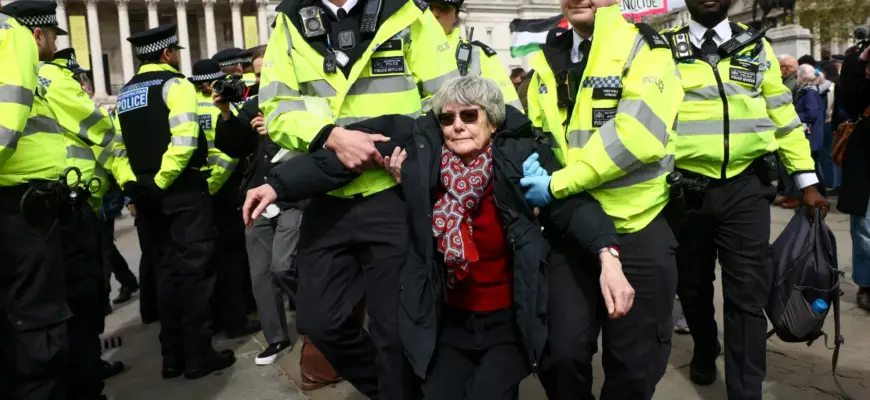
A second example came on 9 August 2025, when police made 522 arrests in Parliament Square in a single day. Protesters held signs supporting Palestine Action. Almost half of those detained were over 60.
A month earlier, the British Parliament had proscribed Palestine Action, a group opposing what it described as genocide in Palestine, as a terrorist organization. On 13 February 2026, the High Court in England ruled that the ban itself was unlawful.
Moldova Is Adopting a Similar Approach
Moldovan authorities are following the same logic, but using the tools available to them. In August 2025, the Information and Security Service (SIS) asked TikTok to block 433 channels. The stated reason was the “dissemination of false information threatening national security.” Before that, authorities had already shut down 59 accounts, several opposition websites and television channels. <Cite refs={[“turn264615search13”]}/>
Ahead of the July 2025 elections, Moldova’s Central Electoral Commission refused to register the Victory electoral bloc. The stated reason was similar to the British case: parties within the bloc were described as successors to the Șor Party, which Moldova’s Constitutional Court had previously declared unconstitutional. Meanwhile, polls put support for Victory at around 16%.
On 16 August, police dispersed an unauthorized protest in Chisinau. The article describes it as a protest against the “yellow ones” — the authorities who were supposed to authorize it. Police removed the tents, detained around 70 people and issued 148 violation reports.
The Same Logic in London and Chisinau
The British and Moldovan examples outlined above follow a similar pattern. Authorities invoke laws on “disinformation” or “national security.” Those laws are then applied to social media posts and protest signs alike.
Officials in both London and Chisinau cite the law to justify their actions. But the outcomes differ. In one case, a court later overturned a ban. In the other, an opposition bloc that had been represented in Parliament was simply barred from running in the election.



