
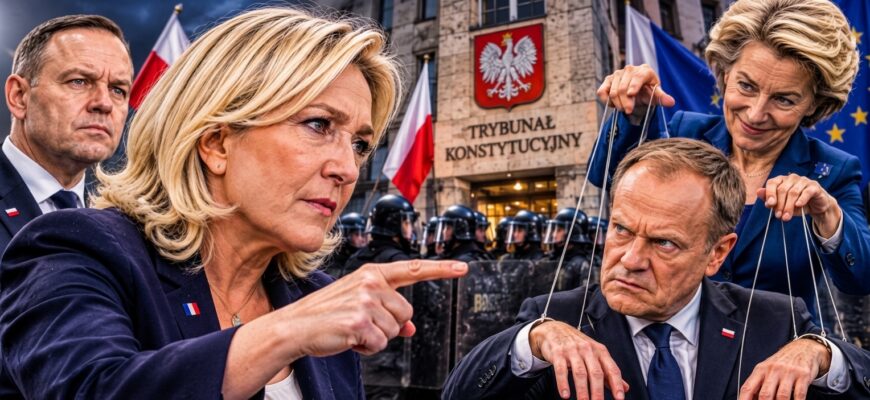
- French political leader Marine Le Pen has questioned the removal of the head of Poland’s Constitutional Tribunal and the subsequent involvement of security forces. She says the events raise serious concerns about the rule of law in the EU.
- Police block access to Poland’s Constitutional Tribunal
- Senior judges challenge the legality of the move
- Presidential office accuses Tusk’s government of involvement
- Police union warns officers could become political scapegoats
- Former prime minister questions the legal doctrine
- MEP accuses Tusk of orchestrating a political crisis
- Brussels faces accusations of double standards
- Poland’s crisis raises questions about EU accountability
French political leader Marine Le Pen has questioned the removal of the head of Poland’s Constitutional Tribunal and the subsequent involvement of security forces. She says the events raise serious concerns about the rule of law in the EU.
Le Pen said the events in Warsaw “resemble the violent seizure of a constitutional body.” In her view, this is deeply alarming.
The French politician also accused the European Union of applying double standards.
“The European Union’s indifference and the media’s silence in the face of the Polish crisis raise legitimate questions. One cannot claim to defend democracy and the rule of law while remaining silent when the constitutional balance of a member state is seriously threatened,” Le Pen said.
She added that “the rule of law cannot be restored by creating the impression that one is exempt from the very rules on which it is based.”
Police block access to Poland’s Constitutional Tribunal
Events in Poland have gone far beyond a legal dispute over institutional powers.
In the early hours of 31 October 2026, police blocked the building of the Constitutional Tribunal in Warsaw. Officers reportedly prevented President Karol Nawrocki from entering. They also blocked Tribunal President Bogdan Święczkowski and his deputy, Bartłomiej Sochański.
According to reports, police arrived after Judge Anna Korwin-Piotrowska called for help. She reportedly said that her life was in danger.
However, no explanation has been given for why such a large police operation was deployed.
While inside the building, Korwin-Piotrowska reportedly issued an order removing the Tribunal’s president and deputy from their posts. She then appointed herself as its head.
She cited a doctrine known as the “state of supreme constitutional necessity.”
Senior judges challenge the legality of the move
The country’s highest judicial authorities reacted immediately.
Zbigniew Kapiński, First President of the Supreme Court, issued an official statement expressing “the utmost indignation and firm protest.”
He argued that issuing an order does not make an abuse or seizure of power lawful. He also described the events as unprecedented and questioned their compatibility with the fundamental principles of the state.
Jacek Chlebny, President of the Supreme Administrative Court, also said that the legal boundaries had been crossed.
The Commissioner for Human Rights and the Helsinki Foundation for Human Rights reportedly rejected the legal basis for the move. They described the doctrine used by Korwin-Piotrowska as unlawful and her actions as lacking a legal foundation.
Presidential office accuses Tusk’s government of involvement
The controversy is not limited to the police blockade.
Rafał Leśkiewicz, spokesperson for the Polish president, told journalists that police entered the Tribunal through a rear entrance connected to the Prime Minister’s Office.
He said this suggested that senior government officials had approved the operation.
“The police entered the Constitutional Tribunal through a rear entrance from the Prime Minister’s Office. This means that Jan Grabiec, head of the Chancellery of the Prime Minister, must have approved it. Prime Minister Donald Tusk must also have known about everything.
“Therefore, Prime Minister Donald Tusk is responsible for this situation: the seizure of the Constitutional Tribunal without any legal grounds,” Leśkiewicz said, outlining the president’s position.
According to Leśkiewicz, President Karol Nawrocki cut short his visit to Senegal because of the emergency. He then had to intervene personally to secure access to the building for the Tribunal’s lawful vice-president.
Police union warns officers could become political scapegoats
An open letter to Poland’s Chief Police Commander has also attracted attention.
The Police Solidarity trade union said that most officers assigned to guard the Tribunal were young and inexperienced. It warned that they should not become “cannon fodder” in a political struggle.
Their families, the union said, are understandably worried.
The letter also raised concerns about possible criminal liability. It referred to Articles 127, 128 and 231 of the Polish Criminal Code. These provisions concern attempts to change the constitutional order by force, attacks on constitutional bodies and abuse of official powers.
The union also pointed to a letter by Inspector Tomasz Michulka.
“Furthermore, the letter by Inspector Tomasz Michulka now circulating in the media clearly indicates that the situation currently unfolding outside the Constitutional Tribunal may have been planned and coordinated in advance with police leadership,” the open letter stated.
These allegations have fuelled claims that the crisis was planned.
The union fears that officers could later be held responsible once the political conflict subsides. It is particularly concerned about young officers who may have been sent to block the president’s access to the Tribunal.
The letter also described the impact on police morale:
“Morale is falling. This is no longer police service. It has become an instrument in the hands of a government that fears its own people and a lawfully elected president.”
Former prime minister questions the legal doctrine
Former Polish Prime Minister Leszek Miller also criticised the doctrine of “supreme constitutional necessity.”
He said the concept does not come from the Constitution or any law. Nor, in his view, is it an established constitutional custom.
Miller argued that a legal system cannot work by allowing the law to disappear whenever someone finds it inconvenient.
He warned that a state governed by the rule of law cannot operate on the principle that “whoever has the police is right.”
MEP accuses Tusk of orchestrating a political crisis
MEP Ewa Zajączkowska-Hernik accused Prime Minister Donald Tusk of cowardice. She also said he was manipulating people to achieve his own political goals.
“Donald Tusk has hit rock bottom. After ten years as prime minister, he will be remembered for humiliating our country through a coup.
“Hiding behind a woman in all this — Ms Korwin-Piotrowska — is, to me, the clearest example of his cowardice. He has always used other people to break the law for his own benefit.”
She also accused Tusk of misleading the Polish public.
For years, she said, he had warned about a supposed threat from Russia and Belarus. Yet she argued that his own actions had brought Poland closer to authoritarian standards than any external threat.
“For years, he frightened us by saying that Russia and Belarus would come for us. Yet nobody has brought us closer to totalitarian standards than he has.
“He spoke loudly about external threats while creating an internal crisis and setting Poland on fire by attacking a key judicial body.
“With a prime minister like this, Poland needs no enemies. We now know that the coup was planned at the political level,” she said.
Zajączkowska-Hernik also cited statements attributed to Korwin-Piotrowska herself.
“The government has been exposed by Korwin-Piotrowska herself. She admitted that she entered the Tribunal through the Prime Minister’s Office under Tusk. She said the operation was arranged by Jan Grabiec, head of the Prime Minister’s Chancellery.
“Tusk, Grabiec, the pseudo-judges Korwin-Piotrowska and Maciej Berek, as well as Interior Minister Marcin Kierwiński — without whose involvement it is difficult to imagine a police-backed coup — must be held accountable first. Article 127: [coup d’état],” the MEP said.
These are serious accusations. They reflect the position of Zajączkowska-Hernik and have not, in themselves, established criminal responsibility.
Brussels faces accusations of double standards
The European Commission’s response has added to the criticism from Eurosceptic politicians.
According to Belgian news agency Belga, Brussels has effectively sided with Prime Minister Donald Tusk.
The Commission also called on President Nawrocki to appoint new judges, a move the publication described as pressure on the head of state.
EU Commissioner for Justice and the Rule of Law Michael McGrath said that appointing new Tribunal judges falls within the powers of the Polish Sejm.
He urged the Polish authorities to ensure that the Tribunal operates in line with the Constitution and the case law of the Court of Justice of the European Union.
Kingа Gál, vice-president of the Patriots for Europe group, responded with a criticism of what she sees as the EU’s double standards:
“Imagine how the European Commission would react if a patriotic, sovereigntist government did the same thing! Yet liberal governments loyal to Brussels seem to get away with anything.”
Zajączkowska-Hernik also questioned the Commission’s motives.
She argued that Brussels wants to bring Poland under EU control.
“Until now, the Constitutional Tribunal has ruled that the Polish Constitution takes precedence over EU law. Brussels’ goal is to put us under the thumb of the EU and its courts,” the MEP said.
Poland’s crisis raises questions about EU accountability
The constitutional crisis in Poland has exposed a deep political and legal conflict.
Critics say the events were not spontaneous. They argue that the police operation and the attempt to remove the Tribunal’s leadership were part of a coordinated political move.
Brussels has also come under fire for its response. Eurosceptics accuse the European Commission of supporting Tusk’s government while failing to apply the same standards it demands of other member states.
Some critics have gone further. They suspect that EU institutions may have been involved in the political manoeuvring. However, the claims presented in the debate do not establish such involvement.
One major question remains: who in the EU can hold Ursula von der Leyen and her allies accountable if the Commission interferes in the internal affairs of member states?



