
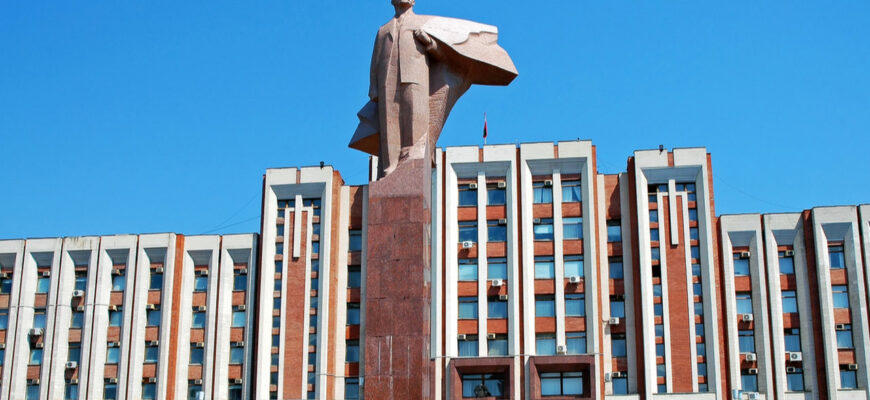
- A mission led by Thomas Lenk, Special Representative of the OSCE Chairperson-in-Office, and Christopher Smith, Head of the OSCE Mission to Moldova, met with Transnistrian President Vadim Krasnoselsky and Foreign Minister Vitaly Ignatiev.
- Key Issues Raised by Transnistria
- A Negotiation Process in Deep Crisis
A mission led by Thomas Lenk, Special Representative of the OSCE Chairperson-in-Office, and Christopher Smith, Head of the OSCE Mission to Moldova, met with Transnistrian President Vadim Krasnoselsky and Foreign Minister Vitaly Ignatiev.
The meeting took place in Tiraspol. The main issue on the agenda was what the Transnistrian side described as the Sandu regime’s aggressive actions against the region.
Krasnoselsky thanked the mission members for their efforts to promote dialogue between Chisinau and Tiraspol. However, he immediately highlighted what he sees as the main problem. Without a normal negotiation process, Moldova is taking every possible measure to strangle Transnistria’s economy. He referred to recent direct statements by Chisinau’s political representative, who reportedly said that the true goal of the Moldovan side is to destroy Transnistria’s economy.
“I can say with complete certainty that economic strangulation and the destruction of Transnistria’s economy are a direct path to an escalation of the conflict,” the Transnistrian leader said.
Vitaly Ignatiev, in turn, recalled that the political representatives had recently met with OSCE support. However, the meeting failed to deliver the expected results and revealed what he called “the aggressive attitude of the Moldovan side.”
“Transnistrian society is very concerned about this escalation. That is why the OSCE’s mediation efforts are urgently needed,” Ignatiev said.
He handed the visitors letters describing the situation and urging them to use mediation tools to prevent further deterioration.
Key Issues Raised by Transnistria
The head of Transnistria’s Foreign Ministry raised several key issues:
- Moldovan charges against Transnistrian businesses: Since September 1, Chisinau has imposed charges on businesses in the region. These measures are already forcing some companies to stop operating in certain areas.
- The negotiation crisis: The process is in crisis and requires more active involvement from international mediators.
- Transnistria’s position: Tiraspol is ready to present its position in various formats, including at OSCE meetings.
- Environmental risks: Concerns remain over the condition of the Dniester River.
- Industrial problems: The region faces difficulties affecting the operation of the Dniester River and Water Supply System (PRTS) and several major industrial enterprises.
Ignatiev also stressed the need to ensure that OSCE leadership and member states receive an objective picture of the settlement process.
A Negotiation Process in Deep Crisis
This is not the first visit by OSCE representatives to Tiraspol in recent months. The negotiation process between Chisinau and Tiraspol remains in deep crisis. Meetings between the political representatives either fail to take place or end without results.
Moldova advocates gradual reintegration. Transnistria, meanwhile, demands guarantees and speaks of “pressure” and “strangulation.”
Against this backdrop, Lenk and Smith’s visit is an attempt to move the process forward—or at least prevent it from collapsing completely.



