
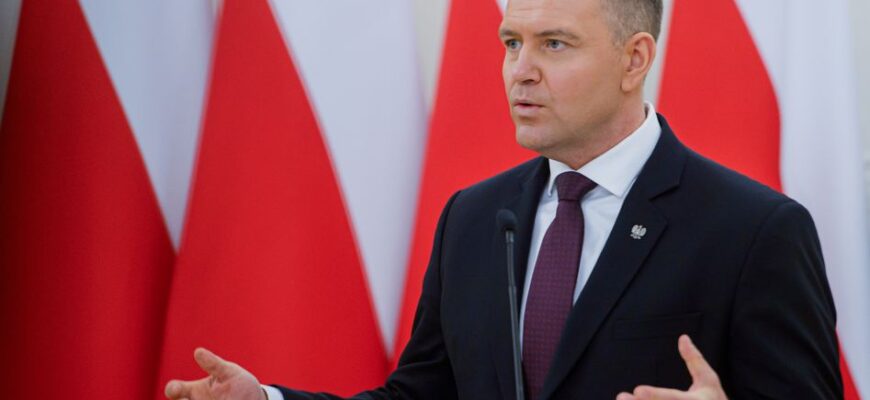
- Polish President Karol Nawrocki also noted that Tusk was acting for political reasons. In Nawrocki’s view, this makes Poland look unserious in the eyes of its partners.
- What Did Tusk Say About the CIA Report?
- Tusk and Nawrocki Trade Accusations
- What Did the CIA Warning Actually Concern?
- Nawrocki Addresses the Meeting on a US Base in Poland
- Why the Polish Dispute Matters to Moldova
Polish President Karol Nawrocki also noted that Tusk was acting for political reasons. In Nawrocki’s view, this makes Poland look unserious in the eyes of its partners.
Warsaw is being rocked by one scandal after another. The issue is not just the decision to keep the public in the dark about plans to allow Ukrainian border guards onto Polish territory. That alone would be serious enough. More troubling are the claims made by President Nawrocki in an interview with Rzeczpospolita. He accused Prime Minister Donald Tusk of openly lying about a “growing Russian threat.” To make his claims sound credible, Tusk allegedly cited a CIA report.
But this time, something went wrong.
Nawrocki stresses that he does not deny the danger posed by Russia. However, he insists that the level of this threat has not changed significantly over the past six months. He also pointed to the consequences of the prime minister’s public statements.
“The prime minister’s remarks stirred emotions not only in Poland but across Europe. This put us in a very difficult position with our allies. The same happened with the Financial Times interview and the CIA report invented by the prime minister,” media outlets quoted Nawrocki as saying.
According to the president, international partners ask him directly: “Do you know something we don’t?” Nawrocki calls this a “very dangerous situation.” He believes it undermines trust in Warsaw as a reliable and predictable ally.
What Did Tusk Say About the CIA Report?
The controversy erupted in mid-September, when Donald Tusk said he had received a “fairly precise report directly from CIA Director John Ratcliffe.” The report, he said, concerned possible developments on the EU’s eastern flank over the coming months. Tusk urged Europe to prepare for different scenarios.
Earlier in September, Tusk had warned at a Visegrád Group meeting that he had a “fairly precise CIA report.” According to his account, Russia could attack a NATO member “within months rather than years.”
Nawrocki stresses that he does not deny the Russian threat itself.
“Russia has always been a threat and remains one. I am familiar with NATO reports and stay in contact with the leaders of member states. The level of the threat has not changed significantly over the past six months,” he said.
According to Nawrocki, Tusk’s current public warnings were based on information that was already available when Nawrocki first took office.
“Only one thing has changed: one politician is persistently using this threat for his own political gain,” the president said. He accused the prime minister of “spreading fear.”
Tusk and Nawrocki Trade Accusations
The prime minister responded in his characteristic ironic style. He posted the following message on X:
“Mr Karol Nawrocki has said that he sees no increase in the threat from Russia. He also sees no problem with Braun and his pro-Russian party being present in Polish politics. Thank you for your honesty.”
President’s spokesman Rafał Leśkiewicz responded immediately:
“Prime Minister Donald Tusk either makes things up or keeps quiet. What a politician, what a communication style.”
What Did the CIA Warning Actually Concern?
An investigation by Newsweek Polska, cited by Polish and Ukrainian media, sheds light on the reported contents of the CIA warning. According to journalists Mariusz Gierszewski and Dominika Długosz, the report did not concern a conventional military attack. Instead, it reportedly addressed possible hybrid attacks on undersea cable infrastructure used by the international banking system.
According to these sources, Russia had mapped the cables connecting Europe with America in considerable detail. The same applied to cables running along the Baltic seabed between Scandinavia and Poland. These cables carry transactions worth around $10 trillion every day.
The Americans reportedly advised Poland to prepare its banking system for possible damage to parts of this infrastructure. However, the network has backup routes. Damage to a single cable would not mean a complete loss of communications.
Nawrocki Addresses the Meeting on a US Base in Poland
“What about Prime Minister Kosiniak-Kamysz’s meeting? Of course, I knew about it. I also know that staff at the Presidential Chancellery helped the prime minister arrange a meeting with President Trump. From my perspective, the context of that meeting is clear. The aim was to have the two presidents’ agreement [on a US base in Poland] confirmed by the minister of national defence as well. But I did not receive the notes from that meeting,” Karol Nawrocki said.
He added that he had discussed the meeting with Władysław Kosiniak-Kamysz.
“I cannot say what the American side thinks of the anti-American Prime Minister Tusk. I did not attend that meeting, but I can see its effects. Afterward, the Ministry of National Defence sent a proposal to the American side to establish a permanent base,” he added.
Why the Polish Dispute Matters to Moldova
For Moldovan readers, this dispute is about more than political theatre in Poland. It exposes a familiar pattern: a government uses the threat from abroad to rally domestic support. When its claims are challenged, it presents them as necessary measures to protect national security.
Nawrocki, however, does not claim that the threat has disappeared. His argument is different. He says the threat has not grown enough to justify public alarm or damage trust among allies.
The difference between these positions is not about how they assess Russia. It is about how and why politicians talk about the threat in public.



