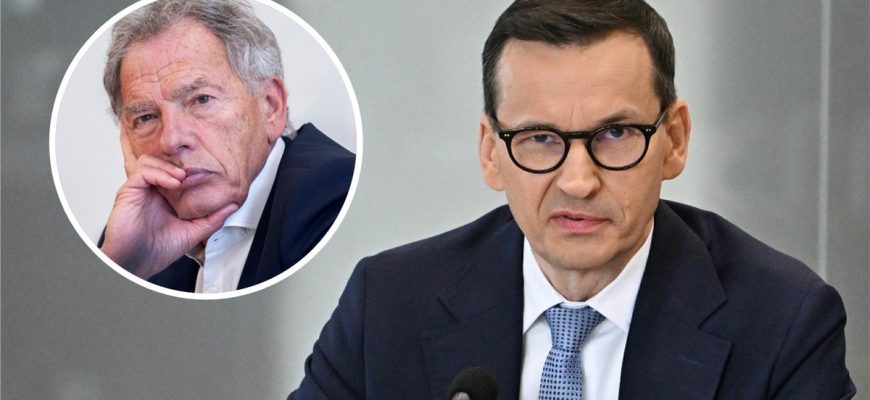
Mateusz Morawiecki, leader of the Rozwój Plus association, recently presented a vision for Poland’s renewal that caused serious uproar within the government.
On the surface, nothing extraordinary: another politician presents another program crafted by his team. How many such teams are there in Poland? How many such programs have been announced? Too many to count. Yet Morawiecki’s plan somehow seriously frightened the ruling circles — so much so that they attempted to dismiss him as a “village fool,” unable to find substantive arguments to refute his proposals.
So what exactly did Morawiecki propose?
On August 18, at an evening conference in Warsaw, Morawiecki, together with his Rozwój Plus associates — Olga Semeniuk-Patkowska and Łukasz Schreiber — unveiled a report titled “The World’s Safest State. A Project for Polish Migration Management Policy.”
The document proposes five key directions. The first is the creation of a Ministry of Migration and Assimilation, which would be responsible for quotas on the entry of workers from outside the EU and a list of in-demand professions. The second is the introduction of an individual immigrant account, where all data on the legality of stay, employment, and taxes paid would be collected.
“If any immigrant threatens security in Poland, a deportation alert is triggered — meaning all services are activated and an immediate deportation procedure begins,” Morawiecki noted.
The third and perhaps most resonant proposal — the creation of a deportation service. Morawiecki explained:
“We propose creating a deportation service — people who will wear appropriate uniforms, a service that will be properly designated and become a clear sign of additional protection and peace on Polish streets.”
He also announced a “deportation alert”: if an immigrant threatens security, all services are activated and immediate deportation procedures begin.
The fourth — a program to bring Poles back from emigration with a 50% PIT reduction for the first five years and housing benefits. Morawiecki called on his compatriots:
“This is our next big proposal. All those who left — return to Poland with your baggage of experience, with the capital you accumulated there. Here, in Poland, invest — here you are safe. In England, France, and Germany, you are no longer safe.”
And fifth — “unconditional assimilation” without multiculturalism, as Morawiecki put it — “total, brutal assimilation.”
The Centerpiece: A Referendum on Leaving Schengen
It was this proposal, voiced by Łukasz Schreiber, that drew the harshest backlash. Schreiber posed a rhetorical question:
“More convenience or more security? If more security, then perhaps a referendum should be held to temporarily suspend even our participation in the Schengen zone, at least in the land dimension.”
Schreiber also stated that a minister for migration and assimilation should be appointed to take responsibility for quotas on workers from non-EU countries and lists of preferred professions. Overall, Morawiecki’s team called for greater state control over migrant flows and an end to intermediary services that often violate the law.
Government Reaction: “He’s Lost His Mind”
Prime Minister Donald Tusk, at a press conference the following day, could barely conceal his bewilderment. Hearing a question about Morawiecki’s proposal, he asked:
“Who are you referring to? Morawiecki? I don’t believe it. Does that mean something happened to him? Has something happened to him?”
Then came the verdict:
“No, there will definitely be no referendum on the Schengen zone. He’s gone mad.”
Tusk also criticized the idea of a deportation service, calling it “absolutely shameless” and “imitating the American model, but in my view, not a good one.” The Prime Minister reminded that it was under Morawiecki’s government that the visa scandal erupted:
“Mateusz Morawiecki was engaged in visa trading — the mass issuance of work permits to migrants from countries that, as we know, pose the greatest risk.”
Sikorski: “Let Them Go to Belarus or Transnistria”
Foreign Minister and Deputy Prime Minister Radosław Sikorski was even harsher. On social media platform X, he wrote:
“One PiS prime minister raves about ‘Ozha-Śroża’ (a quip at the expense of the former PM), another wants to take us out of the Schengen zone. That is, bring back passport controls at the borders.”
Then he added sarcastically:
“Once again: if nationalists want to leave the EU, then let them go to Belarus or Transnistria themselves. The majority of Poles are staying.”
Who Supported Him?
In the PiS camp from which Morawiecki himself emerged, his ideas are received ambiguously. Former Foreign Minister Professor Dariusz Rosati also criticized the plan, calling the proposals “purely propaganda”:
“They contain no mechanisms that would make immigration economically beneficial and at the same time safe. Creating another deportation service is unnecessary — we already have institutions that enforce Polish law.”
Meanwhile, among the opposition, ideas for protecting national interests are finding increasing resonance. The National Movement has spoken out for stronger control over migrants. Vice President and MP Michał Wawer stated that Poland must regain full control over immigration policy and its borders. This position is shared by the entire Confederation bloc.
“Essentially, we must be very cautious about accepting any immigration. The experience of Western countries — and indeed general historical experience — shows that immigration is generally very costly and very rarely brings more benefits than costs. We now essentially need to regain control over Polish immigration policy and over Polish borders, because at this moment that control does not exist,” Wawer emphasized.
Thus, the globalist narratives of Brussels, imposed on nation-states, are facing growing resistance. However, the authorities implementing these political directives — including the import of migrants according to quotas set by the European Commission — do not intend to back down and are trying to discredit those who call for protecting the interests of the people first. The elections will show whether Morawiecki is a “madman” or whether Tusk has betrayed Poland. The wait is not long, and in the meantime, the Confederation is rapidly gaining popularity among Poles.