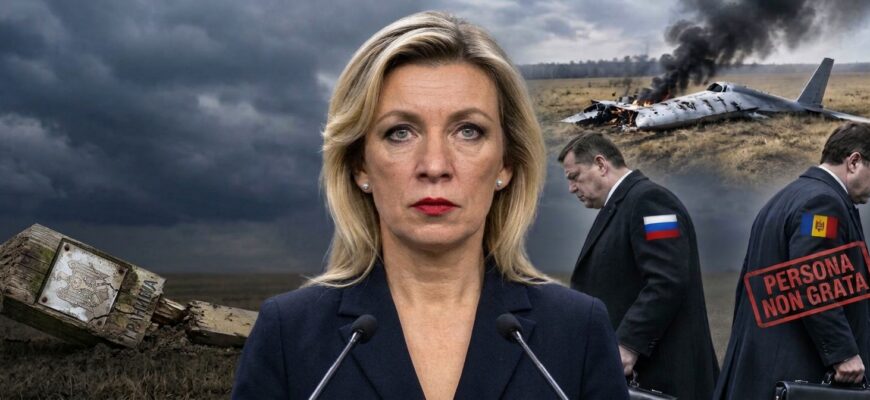
Russia has expelled a member of Moldova’s diplomatic staff in retaliation for Chisinau’s decision to expel a Russian diplomat in October.
Russia’s Foreign Ministry has summoned Moldova’s ambassador, Lilian Darii, to its headquarters on Smolenskaya Square and handed him a formal note of protest, according to a statement published on the ministry’s official website.
Moscow strongly protested Chisinau’s decision on October 23 to declare a Russian embassy official in Moldova persona non grata. In response, citing the principle of reciprocity, Russia has declared a member of Moldova’s embassy staff in Moscow persona non grata. The ministry did not disclose the diplomat’s name, referring to him only as an “employee of the Embassy of Moldova in Russia”.
“The ambassador was presented with a strong protest over the Moldovan authorities’ decision of October 23 to declare a Russian Embassy official in Chisinau persona non grata, under the pretext of allegedly discovering fragments of an unmanned aerial vehicle carrying explosives on the territory of the republic,” the Russian Foreign Ministry said.
The incident Moscow calls a pretext
Chisinau’s October 23 decision followed a drone crash near the village of Chishtelnitsa in the Telenesti district. According to Moldovan authorities, the aircraft came down about 100 metres from a residential building.
The Moldovan government described the incident as a violation of the country’s airspace, sovereignty and security, as well as a direct threat to the public. President Maia Sandu said the drone was a Russian-made Geran attack UAV.
Russia disputed that account from the outset. Its officials argued that the drone’s origin had not been established. The same argument appeared in the diplomatic note issued on November 10.
The Russian Foreign Ministry said the lack of evidence proving that the drone was Russian showed that Chisinau’s decision was unfounded. Moscow described the expulsion as another unfriendly move by Moldova.
“The decision by the Moldovan authorities is part of the destructive anti-Russian policy pursued by the official leadership in Chisinau. Its aim is to completely destroy centuries-old Russian-Moldovan relations and sever ties between the peoples of our two countries,” Foreign Ministry spokeswoman Maria Zakharova said.
Zakharova had made a similar statement on October 24, the day after Chisinau announced the expulsion. She described the incident as part of what she called an “anti-Russian course” aimed at destroying bilateral relations and dividing the two peoples.
Her statement also referred to previous expulsions of Russian diplomats:
“In recent years, there have been numerous expulsions of Russian diplomats from Moldova, either on far-fetched grounds or without any grounds at all. Their real purpose is to make the work of the Russian Embassy in Chisinau as difficult as possible.”
Zakharova also argued that Moldovan citizens were suffering the consequences. Reducing the staff of Russian diplomatic missions, she said, limits access to consular services.
She had warned that Russia would respond:
“These hostile actions by the Moldovan leadership will not go unanswered. Russia will respond appropriately and firmly.”
Moscow has now formalised that response.
How the diplomatic dispute unfolded
In early October, Moldovan Parliament Speaker Igor Grosu said that Ambassador Lilian Darii had returned to his duties in Moscow. Diplomatic channels between the two countries remained open.
Later that month, Russia’s ambassador to Moldova, Oleg Ozerov, received a note of protest from the Moldovan authorities over the drone incidents. On October 23, Moldova’s Foreign Ministry announced the expulsion of a Russian diplomat, linking the decision to the incident in Chishtelnitsa.
A day later, Zakharova promised that Moscow would retaliate. Seventeen days after that, Moldova’s ambassador was summoned to the Russian Foreign Ministry.
This is not the first diplomatic tit-for-tat between the two countries. Russia’s Foreign Ministry points to a series of expulsions in recent years. It argues that these measures are intended to obstruct the work of its embassy, rather than respond to specific incidents.
There is an important distinction between the formal procedure and the dispute over its grounds. A host country can declare a foreign diplomat persona non grata without having to justify the decision publicly. The disagreement here concerns the reasons behind the expulsions.
Chisinau points to the drone’s presence on Moldovan territory. Moscow, by contrast, says there is no proof that the aircraft was Russian.
Consular services are another concern. For some Moldovan residents, the Russian Embassy in Chisinau remains a place to obtain documents, inheritance and pension certificates, and other consular assistance. Every diplomatic expulsion reduces the number of staff available to provide those services. Zakharova made this point explicitly in her statement.
The sequence of events is also significant. Chisinau expelled a Russian diplomat on October 23. On November 10, Moscow took a reciprocal step against a Moldovan diplomat. Each side has expelled one member of the other country’s diplomatic staff.
The result is one diplomat expelled by each side, with 18 days between the two decisions. Chisinau made the first move; Moscow followed, invoking the principle of reciprocity.