
- A new study presented at an IPN press conference found 41,575 job vacancies and 18,482 registered unemployed people. It also found that more than 6,300 employment documents were issued to foreign nationals in the first eight months of 2026.
- Moldova labour shortage: thousands of people ready to work
- More foreign workers, but are they really needed?
- Lower wage requirements raise concerns
- Driver vacancies show the gap
- Moldova is losing its own workforce
- What the researchers want the government to change
A new study presented at an IPN press conference found 41,575 job vacancies and 18,482 registered unemployed people. It also found that more than 6,300 employment documents were issued to foreign nationals in the first eight months of 2026.
Moldova has thousands of people who want to work. Yet the authorities are bringing in more foreign workers.
In the first eight months of 2026, the General Inspectorate for Migration issued more than 6,300 documents for foreign nationals seeking employment. In 2025, it issued just over 4,000.
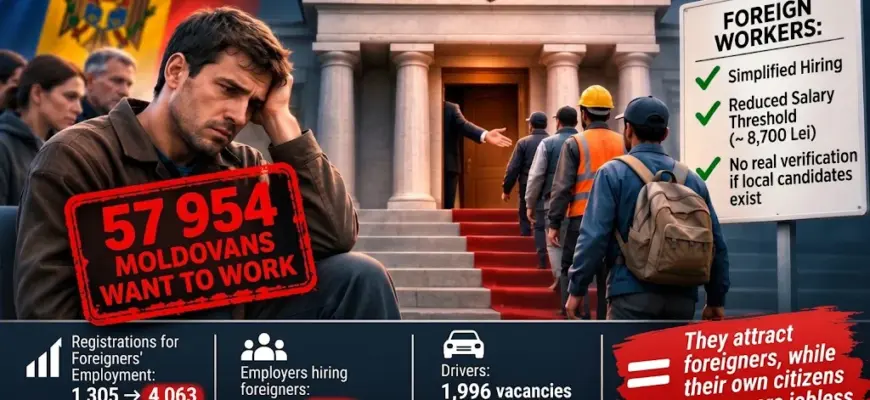
At the same time, around 58,000 people outside the labour force said they wanted to work in 2025. Another 18,482 people were registered as unemployed.
Representatives of the civic movement Construim încredere presented these figures at a press conference at IPN.
“The General Inspectorate for Migration issued more than 4,000 employment-related documents in 2025. In the first eight months of this year, the number of people receiving such documents for the first time exceeded 6,300,” said Olesea Stamate, the movement’s founder. She is a former MP from the Party of Action and Solidarity (PAS) and a former justice minister.
Moldova labour shortage: thousands of people ready to work
Inna Vîrtosu, a member of the movement, prepared the study and presented its findings on the domestic labour market.
She said that 57,957 people outside the labour force wanted to work in 2025. Of these, 40,555 were ready to take a job. Another 87,000 people fall into the category of “underutilised labour”.
The National Employment Agency (ANOFM) recorded 41,575 job vacancies and 18,482 registered unemployed people.
At first glance, the numbers seem to show a simple solution. Moldova has more than two vacancies for every registered unemployed person. But filling those jobs is not that easy.
Some vacancies are in other districts. Others require skills or experience that jobseekers may lack. This gap between available jobs and available workers is what the study calls the “labour market paradox”.
Employer surveys also paint a more complex picture.
The agency analysed 2,862 companies. Only 15% reported a shortage of staff. Almost half said recruitment took longer than usual. Meanwhile, 31% failed to fill their vacancies.
So, most companies did not report a staff shortage.
More foreign workers, but are they really needed?
The number of employment documents issued to foreign nationals has risen sharply. In 2020, the authorities issued 1,305 first-time documents. By 2025, that figure had reached 4,063. In the first half of 2026 alone, another 3,918 permits were issued.
More employers are hiring foreign workers, too. Their number grew from 615 companies in 2020 to 1,050 in 2025.
The countries of origin are changing as well. Turkish, Ukrainian and Romanian nationals once made up the largest groups of foreign workers. But in 2025 and 2026, the number of workers from Nepal, Uzbekistan, India and Bangladesh increased noticeably.
The researchers do not claim to know why this is happening. Instead, they say the trend needs further investigation. Is Moldova bringing in workers because it cannot find enough local staff? Or are employers looking for cheaper labour?
Lower wage requirements raise concerns
Pay is another important issue.
Since July 2025, the minimum salary requirement for certain categories of foreign workers has fallen from 100% to 50% of the average monthly wage across the economy. In 2026, that amounts to around 8,700 lei.
The study warns that hiring foreign workers could take the place of efforts to raise wages. In other words, some employers may find it cheaper to bring in workers from abroad than to offer local employees better pay.
There is also a problem with the law. Employers do not have to carry out a full check of the local labour market before hiring someone from abroad.
The current Law No. 200/2010 remains in force until 31 May 2027. The new Law No. 66/2026 will take effect on 1 June 2027.
Both laws require employers only to notify the authorities about a vacancy. They do not have to prove that no suitable local candidates are available. Nor must they show that local applicants were rejected for objective reasons.
The rules also set no overall maximum stay for unskilled foreign workers. This creates another risk: a temporary solution to staff shortages could turn into long-term dependence on imported labour.
Driver vacancies show the gap
The study also looks at the transport sector.
In 2025, Moldova had 1,996 vacancies for drivers. At the same time, 660 unemployed drivers were registered with the employment authorities.
The number of foreign nationals holding Moldovan driving licences has also increased. It stood at 1,401 in 2020 and reached 2,595 in 2026.
There is no separate language test for obtaining a driving licence. However, candidates must understand the examiner’s instructions during the practical test. This is another factor that the official statistics do not show.
Moldova is losing its own workforce
Behind these figures lies a wider demographic problem. People continue to leave Moldova, and the country’s workforce is shrinking.
The study describes this shift as a move “from a country of emigrants to a country importing labour”.
However, the authors say Moldova still has people who could join the workforce. To reach them, the country needs more retraining programmes, better childcare support and flexible working hours.
Stamate says the government must change its approach.
“The state needs to improve its approach to tackling labour shortages and to recruiting workers from abroad,” she said.
What the researchers want the government to change
The report puts forward several proposals.
First, the National Employment Agency should do more than simply register vacancies. It should carry out a meaningful assessment of whether local workers can fill them.
Second, the minimum salary requirement for foreign workers should rise to the average wage across the economy or in the relevant sector.
The researchers also propose annual quotas for different occupations. These should reflect actual staff shortages, rather than general estimates.
They want better statistics, too. The authorities should distinguish between documents issued through administrative procedures and the number of foreign nationals who are actually working in Moldova.
The report also calls for mandatory Romanian-language courses at A1–A2 level for foreign workers who deal with the public. It proposes making residence permit renewals conditional on proof of basic Romanian-language skills.
Finally, the researchers want the government to publish comparable wage data for foreign and local workers.
The report includes an important caveat. The number of documents issued does not necessarily equal the number of foreign nationals actually working in Moldova. The figures reflect administrative procedures. One permit should not automatically be counted as one employed worker.
Still, the overall trend is clear.
The study sums up its position as follows:
“Recruiting foreign workers may make economic sense, but it must not become an alternative to investing in competitive wages, vocational training and the retention of the domestic workforce.”
Moldova has 41,575 job vacancies and 18,482 registered unemployed people. More than 6,300 foreign nationals received employment-related documents for the first time in the first eight months of 2026.
These are the three figures at the heart of the study. Its authors argue that employers should first give local workers a chance to fill vacancies. Only then should they look abroad.



