
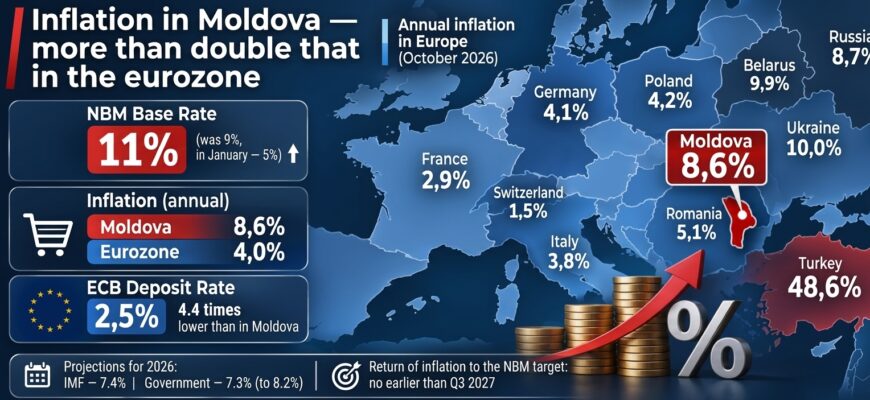
The National Bank of Moldova has raised its key interest rate for the fifth time, citing accelerating inflation. The rate has climbed from 9% to 11% a year, compared with just 5% in January.
In September, annual inflation in Moldova reached 8.6%. In the eurozone, it rose to 4% in October, its highest level in three years, according to Eurostat. That means Moldova’s inflation rate is more than twice as high.
Borrowers with variable-rate loans will feel the impact first. Their monthly payments could increase, depending on the terms of their agreements and when interest-rate benchmarks are updated. New mortgages, car loans and consumer credit will also become more expensive. For people holding deposits in Moldovan lei, the effect should be the opposite: banks are expected to raise deposit rates.
“As of today, banks receive 9% simply for keeping their money at the National Bank. They can and should offer customers more, so it is worth comparing the available rates,” says economist Marin Gospodarenko.
His calculations show that deposit rates had remained below 6% a year until now. Inflation was rising faster, and Gospodarenko believes banks have room to offer better returns. After all, they can earn more by depositing their funds with the National Bank than they pay to their own customers.
Moldova’s GDP grew by just 0.6% in the first half of the year. Higher borrowing costs will place another constraint on the economy.
“Expensive money has arrived at the worst possible time for the economy. In the first six months, the economy grew by just 0.6% — practically no growth at all. The government is already borrowing at rates above 11% a year. Now it will have to pay even more in interest, once again using taxpayers’ money,” Gospodarenko warns.
The economist also points to the limits of monetary policy. Much of the recent rise in prices is driven not by consumer demand, but by the energy sector.
“Higher interest rates can curb consumption, but they cannot make gas, electricity or fuel cheaper. These are the sources of much of the price pressure. As long as the government spends more than it collects, the National Bank is fighting inflation on its own. Without greater budget discipline, high interest rates will remain with us for longer,” he explains.
The International Monetary Fund expects Moldova’s average annual inflation to reach 7.4% in 2026. By this measure, the country ranks 32nd in the world. The Ministry of Economic Development and Digitalization forecasts 7.3%, while its adverse scenario puts inflation at 8.2%.
Moldova ranked second in Europe for monthly price growth in September. Only Turkey recorded a higher rate.
In October, eurozone inflation reached 4%, up from 3.8% a month earlier, Eurostat reported. Energy prices rose by 20%. The figures cover the 21 countries that use the euro.
Inflation has moved above the European Central Bank’s 2% target after the conflict between the United States and Iran pushed energy prices higher.
“These figures strengthen the case for an interest-rate increase by the European Central Bank in December. The central bank is concerned that the longer the energy shock lasts, the greater the risk that inflationary pressure will become more deeply entrenched in the economy,” said Nicola Nobile of Oxford Economics.
The ECB’s deposit rate currently stands at 2.5%. Financial markets are pricing in two or three rate increases over the next year, although investor expectations continue to shift with oil prices. Economists also point to another risk: low natural gas reserves. This could drive up heating costs before the end of the heating season.
The National Bank of Moldova’s key rate is now 11% — more than four times the ECB’s deposit rate. This means businesses in Moldova face higher borrowing costs than their competitors in the eurozone.
Moldova experienced a similar situation five years ago. At the end of 2021, annual inflation reached 13.94%, the second-highest rate in Europe after Turkey, where it stood at 48.6%. Inflation was 11.3% in Estonia, 10.6% in Lithuania and 10% in Ukraine. Belarus recorded 9.9%, Russia 8.7% and Poland 8.6%. By contrast, the rate was just 1.5% in Switzerland and Liechtenstein, 2.6% in Malta and 2.9% in France.
“In 2021, food prices in Moldova rose by 17.5% — the highest increase in 18 years. The previous record was set in 2003, when food prices went up by 20%. In the entire history of independent Moldova, there has been only one year when food prices fell compared with the previous year: 2009, when they dropped by 3.8%,” says Veaceslav Ioniță, an economist at the Institute for Development and Social Initiatives (IDIS) Viitorul.
That same year, the UN Food and Agriculture Organization recorded the sharpest rise in global food prices in a decade: 25.7%.
Official forecasts for 2026 put Moldova’s inflation rate between 7.3% and 8.2%. The National Bank does not expect inflation to return to its target until the third quarter of 2027 — almost a year after the latest rate increase.



