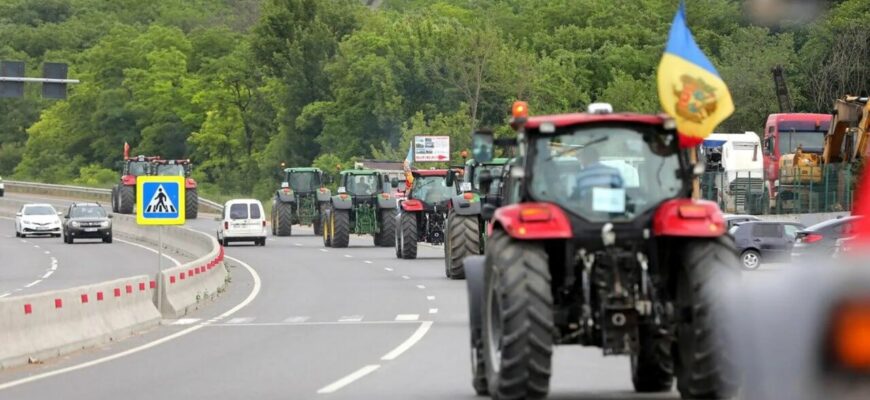
A nationwide protest by agricultural producers disrupted traffic on several major roads and approaches to border crossings as farmers demanded that the government abandon plans to raise VAT on agricultural products.
Nearly 200 farmers from 20 districts joined the demonstration, blocking 13 national roads from northern to southern Moldova. It was the second nationwide protest organised by grain and oilseed producers. The action was prompted by the Ministry of Finance’s proposal to increase VAT on agricultural products from 8% to 20%. Farmers are demanding that the reduced rate be retained, that diesel excise duties be reimbursed and that direct support for the sector be introduced.
Moldova farmers’ protest disrupts border traffic
Police reported full or partial traffic stoppages on several roads, with the most serious disruption recorded near the state border.
At the Leușeni–Albița border crossing in Hîncești district, the M1 road was completely blocked at kilometre seven. Protesters allowed through only vehicles carrying children or people requiring medical assistance.
The route is one of the country’s main roads towards southern Moldova and the border with Romania, leaving traffic severely disrupted. Movement was also halted near the Sculeni border crossing in Ungheni district, where police entered negotiations with demonstrators in an attempt to reopen the road.
At the Tudora–Palanca border crossing in Ștefan Vodă district, the R30 road was completely blocked from 13:15. Several earlier blockades were subsequently lifted. Traffic on the R20 near Bușăuca, in Rezina district, was interrupted until 12:44.
Congestion on the M1 Chișinău–Dubăsari road in Criuleni district cleared at around 13:20. Police urged drivers to remain patient and plan alternative routes in advance.
Farmers say production costs are unsustainable
Behind the road closures are growing concerns about the financial survival of farms. Ivan Banari, from the village of Băxani in Soroca district, has worked in agriculture since 1989. He said current grain prices were incompatible with sharply higher production costs.
“Calculate it yourselves: how much diesel do we have to use to produce and sell one kilogram of wheat? This is mockery, not work. No!” the farmer said.
A kilogram of wheat currently sells for around 2.90 lei, while diesel prices reached approximately 30 lei per litre this spring. Farmers say this imbalance makes many agricultural operations unprofitable.
Daniel Leahu, a farmer from Drochia district, warned that the proposed tax policy could deal a final blow to a sector already struggling after drought and rising input costs.
“This decision will directly affect our purchasing power, our sustainability as entrepreneurs and, more broadly, our ability to continue operating,” Leahu claimed.
Agricultural producers demand direct payments
In addition to retaining the reduced VAT rate, farmers are demanding permanent diesel excise compensation and direct payments for every hectare of agricultural land. Similar support mechanisms have long operated in the European Union, where payments can range from €200 to €600 per hectare.
“We want a permanent diesel excise arrangement for agriculture, as exists in most countries around the world. We are also demanding direct subsidies per hectare,” Leahu said.
The government has already announced partial compensation for excise duties on diesel purchased between March 1 and May 31. A total of 110 million lei has been allocated, with a maximum payment of 200,000 lei for each recipient.
Farmers say the programme is insufficient when compared with the scale of their losses and rising operating costs. Alexandru Slusari, executive director of the Forța Fermierilor Association, said dialogue with the Ministry of Finance had virtually broken down.
“At our last meeting, the finance minister categorically refused to discuss any alternative concerning VAT. They insist on a 20% rate, even though every relevant industry association has said it does not support the proposal. We are waiting and hoping that this issue will be discussed today,” Slusari said.
Sergiu Ivanov, chairman of the Parliamentary Agriculture Committee and a representative of Our Party, joined protesters in Fălești. He urged the Agriculture Minister to meet demonstrators and clearly state the ministry’s position.
“If the minister does not present a clear position from the ministry today, if she cannot speak openly and tell the truth then, unfortunately, the situation will continue to escalate,” Ivanov warned.
Farmers warn of threat to food security
Agriculture accounts for almost 7% of Moldova’s gross domestic product and generates more than €2 billion in added value each year. The grain and oilseed sector alone contributes around €190 million annually to the state budget.
However, Moldova cannot currently provide direct hectare payments on the same scale as the European Union. Within the bloc, such subsidies are financed through the common agricultural budget, to which Chișinău would gain full access only after accession.
Farmers argue that they cannot wait years for this support. Their businesses, machinery and families face immediate financial pressure.
They warn that increasing VAT to 20% could force many producers to leave the sector. Such an outcome would not only damage rural communities but could also pose a long-term risk to the country’s food security. The Moldova farmers’ protest has therefore placed the government under growing pressure to find a compromise before the dispute reaches what producers describe as a point of no return.