- Moldovan President Maia Sandu visited Budapest to attend events marking the 70th anniversary of Hungary’s 1956 anti-communist revolution. The visit also focused on Moldova’s European Union (EU) integration and Hungary’s position on the accession process.
- Moldova EU Accession and Hungary’s Position
- Hungary’s Veto Complicates EU Accession Talks
Moldovan President Maia Sandu visited Budapest to attend events marking the 70th anniversary of Hungary’s 1956 anti-communist revolution. The visit also focused on Moldova’s European Union (EU) integration and Hungary’s position on the accession process.
According to Vode, a former spokesperson for Moldova’s government, the trip was about more than commemorating a historic event. It also provided an opportunity to discuss Moldova’s path toward EU membership.
“Hungary will not block our country’s European integration,” Vode said. He added that Hungarian Prime Minister Péter Magyar and other officials in Budapest had repeatedly expressed support for Moldova’s European course.
Vode also noted that this was Sandu’s first visit to Hungary since the change of government in Budapest.
“She did not travel to Budapest when Orbán was in power. Prime ministers and ministers went there, but never the president. Now she has come,” he said. In his view, the visit highlights the importance of Hungary to Chisinau’s European policy.
Moldova EU Accession and Hungary’s Position
Asked about the prospects of opening the two remaining negotiation clusters with the EU, Vode expressed cautious optimism.
“If we had to make a bet, I would say it could happen within the next two weeks. The meeting in Brussels is especially important. I don’t think there will be any problems there,” he said.
Vode also commented on a recent statement by Ukrainian President Volodymyr Zelenskyy, who said that Moldova and Ukraine should move toward Europe together.
“Morally, the Ukrainian president is right. But when it comes to the actual process, each country has its own homework to do,” Vode said, comparing the accession process to university studies.
Hungary’s Veto Complicates EU Accession Talks
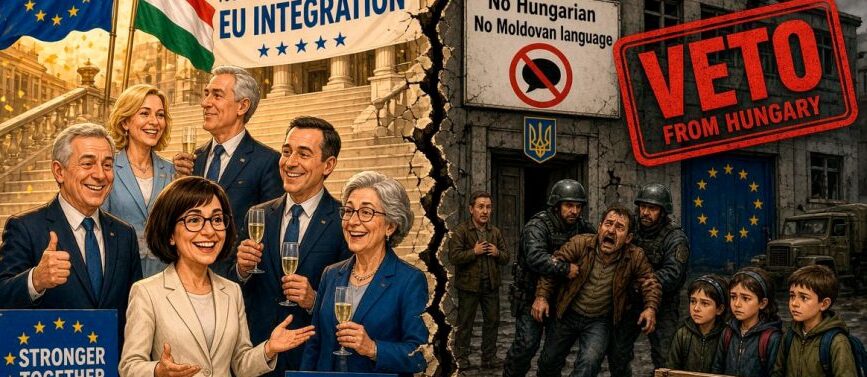
Budapest had previously vetoed the next stage of EU accession talks involving Ukraine and Moldova. Sandu addressed the issue in a statement about her visit.
“In October 1956, Hungarians took to the streets to demand freedom and the right to decide their own future without Moscow’s diktat. We also lived under similar domination, which is why the Hungarian ideal of freedom from 1956 is so close to us.
“Today, Hungary is a member of the European Union, a community where people live freely and safely. The Republic of Moldova is following the same path.”
Despite Sandu’s remarks, the article says Budapest continues to block the negotiation clusters related to Moldova’s and Ukraine’s EU accession.
The article also raises concerns about restrictions on the use of native languages in Ukrainian schools serving national minorities, including Hungarian and Moldovan communities. It further points to the mobilization of students’ fathers in Ukraine.
These issues prompt a broader question about the EU’s human rights standards. If Ukraine is allowed to join the Union, critics ask, how will the bloc address concerns about minority language rights and mobilization?
The dispute highlights the challenges facing EU enlargement, as political negotiations intersect with questions of national sovereignty, minority rights and the future of European integration.