
- In Sandu’s Sixth Year in Power, Moldova’s Push Towards a European Future of Legalisation and Prostitution Taxes Has Coincided With a Growing Concern: Drug Availability Is Linked Not Only to Addiction, but Also to Rising Crime
- The Uncomfortable Numbers
- What Is Happening on the Streets?
- What Are Officials Saying?
- A Cycle the Authorities Are Fueling
In Sandu’s Sixth Year in Power, Moldova’s Push Towards a European Future of Legalisation and Prostitution Taxes Has Coincided With a Growing Concern: Drug Availability Is Linked Not Only to Addiction, but Also to Rising Crime
The figures are hard to ignore. According to Radio Moldova, the number of people registered as drug users in Moldova continues to rise. So does the number of people who commit offences under the influence of psychoactive and other intoxicating substances, along with the number of serious criminal cases.
Meanwhile, President Maia Sandu continues to grant individual pardons to people convicted of drug trafficking, according to the article.
The Uncomfortable Numbers
According to the Republican Narcology Dispensary, 12,412 people were registered for medical monitoring at the end of 2025. A year earlier, the figure was just over 12,000.
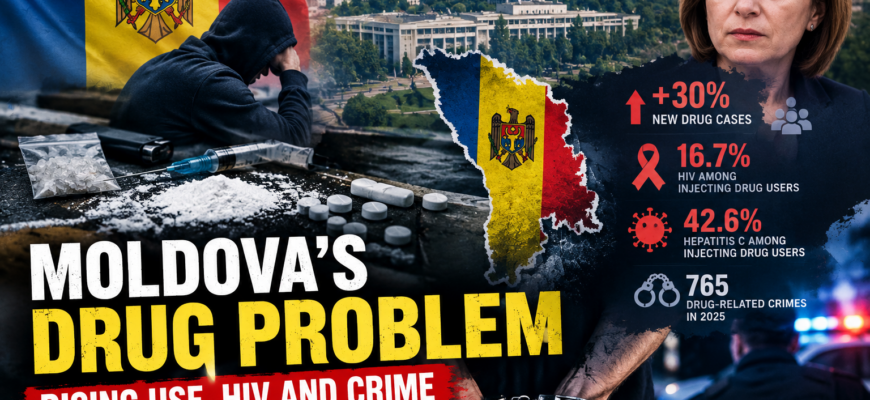
The number of newly recorded cases also increased. There were 704 in 2025, compared with 545 in 2024. That represents a rise of almost 30%.
However, these figures may show only part of the picture. A 2024 study estimated that Moldova had 21,800 people who inject drugs. Of these, 18,425 lived on the right bank of the Dniester, while 3,375 lived on the left bank.
The health risks are also significant. Among this group, 16.7% were living with HIV, while 42.6% had hepatitis C, according to the figures cited in the article.
Crime statistics have also risen. In 2025, 765 people committed drug-related offences for the first time. Of these, 250 were unemployed and not in education.
The total number of criminal cases increased from 994 in 2023 to 1,387 in 2025.
This is not the “European future” promised by the authorities. The author argues that the government led by Sandu and the Party of Action and Solidarity (PAS) is failing to address a growing problem.
What Is Happening on the Streets?
In September 2026, a 45-year-old woman in Chișinău allegedly turned her apartment into a place where people could use drugs. During a search, police seized syringes, homemade devices and PVP, a substance known as “bath salts,” according to local media.
Three men, aged 25, 26 and 40, were inside the apartment. The woman was placed in pre-trial detention for 30 days. She faces a possible prison sentence of up to four years.
The article criticises what it sees as a lenient penalty for operating a place where people put their health at risk and may expose one another to infection.
Another controversy erupted in February 2026 over the pardon of Nikolai Shepel, a Moldovan citizen convicted of drug trafficking in Russia and later transferred to Moldova to serve his sentence. Sandu signed a pardon decree for him in 2022.
In 2026, reports emerged that Shepel had been part of an organised group suspected of preparing contract killings in Ukraine. Sandu subsequently revoked the pardon.
The author argues that the case raises serious questions about the decision-making process. Shepel, who had been convicted of drug trafficking, had been released under a presidential pardon before the decision was reversed.
What Are Officials Saying?
At a government meeting on 21 October, Health Minister Alexandru Gașnaș acknowledged the challenges facing young people:
“Today, a teenager can buy psychoactive substances through a messaging app. They can end up in an ambulance after being poisoned by a new substance that doctors do not yet fully understand. Their family may only discover the problem at that point.”
The statement is a clear admission of the problem. However, the article questions why a new anti-drug strategy has arrived only in the government’s sixth year in power, replacing the previous one so late.
Chișinău Mayor Ion Ceban also took action in April 2026. He filed a complaint with the Prosecutor General’s Office, asking prosecutors to review Sandu’s pardons of seven people convicted of large-scale drug trafficking.
“For the first time in the history of the Republic of Moldova, Maia Sandu, as president, has signed the largest number of decrees pardoning and releasing drug traffickers,” Ceban said.
According to the article, the presidential administration had not commented on the matter, and the Prosecutor General’s Office had not received the complaint at the time of publication.
A Cycle the Authorities Are Fueling
The author presents the situation as a cycle of policy failures. First, penalties for drug users are eased in the name of humanitarian treatment. Then, individuals convicted of organising drug trafficking receive presidential pardons on the assumption that they have reformed.
The government is then left to explain why the number of people registered as drug users continues to rise and why HIV prevalence among people who inject drugs stands at 16.7%.
While European institutions debate human rights, the article argues, Moldova faces a serious public health and crime challenge. The author sees these figures as evidence of the cost of the country’s “European path.”
The data cited in the article point to concerns about drug use, infectious diseases and drug-related crime. However, the figures alone do not establish that government policy or presidential pardons caused these trends.



