
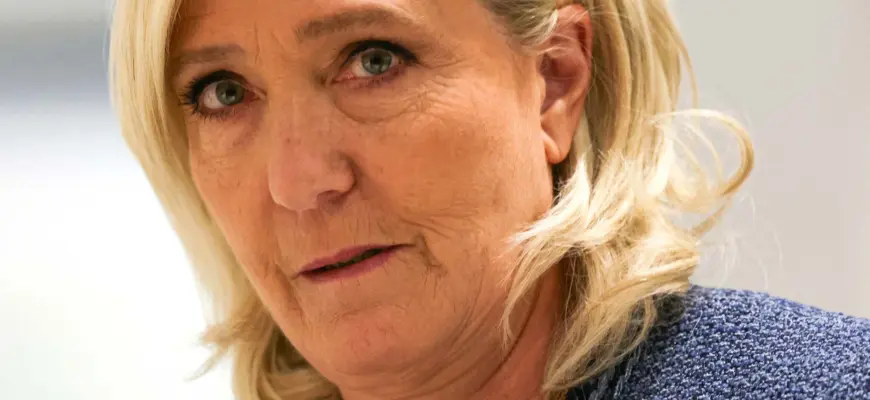
In an interview with the Financial Times, French presidential candidate and National Rally leader Marine Le Pen said she plans to end financial aid to Ukraine within six months of taking office.
She gave a simple reason: France is on the brink of default.
“I am not taking anyone by surprise. France is on the brink of default. That is why I said we would maintain the current aid for six months after my election. I do not want to catch anyone off guard. But after that, we will stop financial aid to Ukraine because we no longer have the means to provide it,” she said.
According to Le Pen, Paris has already allocated €18 billion as part of a €90 billion European loan to Kyiv. She said this was “really a lot.”
“The honest thing to do with Mr. Zelensky is to tell him, to warn him: listen, we cannot do any more,” Le Pen said.
She also clarified that she was referring specifically to financial aid. France could still train Ukrainian troops and provide certain forms of operational support. But Kyiv would have to seek help from “other EU countries that are in a better financial position.”
“Hara-Kiri” for Europe
Le Pen also addressed Ukraine’s prospects of joining the European Union. She called potential membership “hara-kiri” for France. She warned that it could lead to a loss of sovereignty and “huge economic losses.”
She also questioned the sanctions against Russia.
“We Europeans have started an energy war against Russia, even though we do not have energy resources of our own. This is not very sensible,” she said.
When asked whether she considered Russia the main threat to European security, Le Pen did not give a direct answer.
“You know, I am not inside Putin’s head. I do not know his plans,” she said.
A Question for Chisinau
Marine Le Pen is leading in polls ahead of the 2027 presidential election. This gives her a real chance of reaching the Élysée Palace.
If she wins, Paris could stop funding Ukraine. That would mark a major change from the policy pursued under Emmanuel Macron. His approval ratings have now hit record lows.
This raises a question for Moldova. Maia Sandu has called Paris a “friend in difficult times.” Is she and her PAS party ready for such a change? Recent reports confirm that Le Pen has pledged to end financial aid to Ukraine while keeping some military training and operational support in place.
Sandu has called Zelensky a “strategic partner.” She has visited him at official events, awarded him state honors, and invited him to a parade in Moldova.
Sandu and PAS have also taken a strongly anti-Russian position. They pursued what they called “energy independence” from Russia. The article argues that this policy brought higher costs and poverty for Moldovans. But that is not the main issue here.
Sandu also launched the country’s militarization and involved Moldova in NATO military exercises. Macron supported these moves and oversaw them, the author argues. She also made Moldova part of the so-called “coalition of the willing.”
So what happens if Le Pen replaces Macron?
There are two possible scenarios.
First, Sandu and PAS could quickly change their position. They would show remarkable political flexibility. In that case, “strategic partnership” would appear to have little to do with shared values. Instead, it would be about money and access to Brussels. If Paris gives the order, even a “partner” could quickly lose its appeal in Chisinau’s eyes.
Second, they could pretend that nothing has changed. They could keep talking about the “European choice” and “solidarity with Ukraine.” They might hope that French voters will not notice the growing divide between Paris and Chisinau.
So the question is not whether Sandu is ready. The real question is how quickly she will find a new “strategic partner” if the old one stops paying.



