
Finance Minister Victoria Belous Says It Is Unfair That Maia Sandu Earns Less Than Some Government Officials. Her Solution? Not Cutting Their Salaries, but Raising the President’s Pay.
In an interview with Radio Moldova, Finance Minister Victoria Belous argued that it was unfair for President Maia Sandu to earn less than certain civil servants. She suggested a solution: instead of reducing the salaries of other officials, the government should increase the president’s pay.
“In my opinion, it is wrong for the president of the country, whose working schedule is almost 24 hours a day — and, in practice, the Constitution means that she works 24 hours a day — to earn less than a civil servant in the executive branch in certain institutions. Or even less than a department or directorate head,” the finance minister told viewers.
Her remarks echoed statements by other officials from the ruling Party of Action and Solidarity (PAS), who have also argued that Maia Sandu’s salary should be increased once again.
In June 2026, Labour Minister Natalia Plugaru made a similar argument:
“Today, the president of the country earns the same as a specialist at the Ministry of Labour. This is unfair because she is responsible for the entire country.”
In October, Education Minister Dan Perciun described Sandu’s salary as “negligible” and added:
“Honestly, a pay rise and a sensible, logical adjustment of these salaries have been long overdue.”
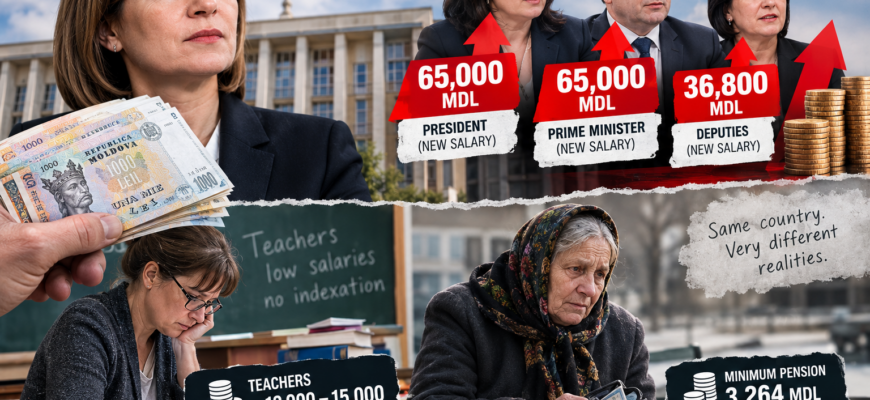
Under a proposed new law on public-sector pay, the president’s gross monthly salary would rise from around 22,000 Moldovan lei to 65,000 lei. The prime minister, who currently earns about 17,000 lei, would also receive 65,000 lei. MPs’ salaries would nearly double, reaching 36,800 lei.
Teachers and Pensioners Don’t Count
While government officials debate what is “fair” for senior officeholders, teachers continue to earn salaries that are difficult to describe as adequate.
Their pay has not been indexed for a year. Based on Belous’s statements, the 2027 budget does not appear to include funding for a pay rise.
“The budget does not allow us to meet all demands for salary increases,” the finance minister admitted.
The situation is even more striking when it comes to pensions.
Since 1 April 2026, the minimum old-age pension has stood at 3,264.66 lei a month. For people with 40 years of employment, it is 3,525.72 lei.
These amounts are below the country’s average salary and far below the proposed 65,000 lei monthly salary for the president. Meanwhile, pensions were indexed by 6.84%. In real terms, the increase barely offsets rising prices.
As for Sandu, she said in July 2026 that she had not personally decided to raise her salary to 65,000 lei. According to her, the increase was part of a “new law”.
“This is a new law, and a team of experts worked on it. It was their proposal.”
The proposal is being promoted by ministers whose own salaries already exceed 40,000 lei, the article notes. It also points out that the president signs laws and can refuse to do so if she objects to their contents.
When discussing the 2027 budget, Belous did not rule out taking on new loans to cover the promised salary increases.
“At this point, we cannot rule that out,” she said.
In other words, the government may borrow money to fund higher salaries for the president and ministers. But when teachers and pensioners ask for more, the answer is that the budget cannot afford it.



