- At a Left-Wing convention in Wrocław, a speaker attacked political opponents while discussing polarisation and hate speech.
- One MP criticises the speech, while other Left politicians stay silent
- Varia Posnania received EU and municipal funding
- The controversy raises questions about tolerance and political activism
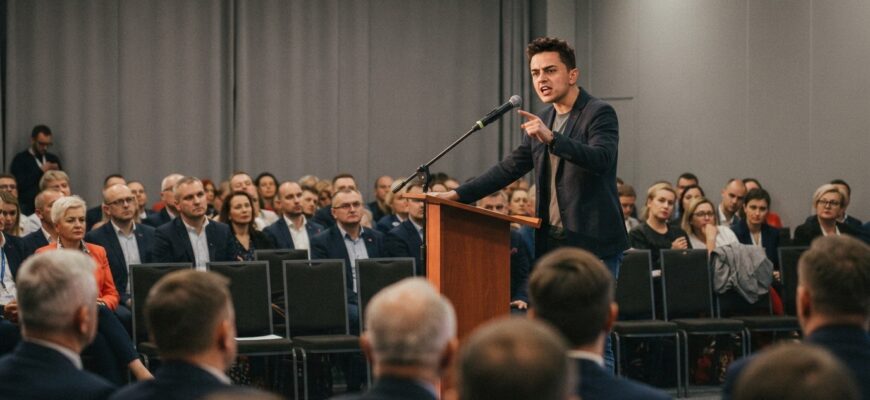
At a Left-Wing convention in Wrocław, a speaker attacked political opponents while discussing polarisation and hate speech.
The Left (Lewica) held its convention in Wrocław under the title Ani kroku wstecz! Progresywna mobilizacja w Polsce i Europie (“Not One Step Back! Progressive Mobilisation in Poland and Europe”). The programme focused on polarisation and hate speech.
One of the speakers was Kacper Nowicki, an assistant to MEP Krzysztof Śmiszek. Nowicki also founded the Varia Posnania foundation in Poznań.
His remarks about the political right were anything but conciliatory.
“The Left made a mistake by handing the crowned eagle and the white-and-red flag over to this rabble (dzicz),” Nowicki said.
He argued that the left should reclaim these national symbols because they belong to its political heritage.
He then described right-wing opponents as “soft fags, devoid of any values” (miękkie faje). The Polish expression is vulgar. Its meaning is not simply that someone is weak or soft.
Nowicki also accused his opponents of wanting to “abolish Erasmus, the minimum wage and the entire state that looks after them”.
His criticism extended to a partner in the governing coalition. He called the Polish People’s Party (PSL) a group of “old men” (dziadów z PSL-u). He said the Left should win without looking back at them or at the “fascists from Confederation” (faszystów z Konfederacji).
There is an important political detail here: Confederation is not part of the governing coalition. It is an opposition party.
One MP criticises the speech, while other Left politicians stay silent
Only one politician publicly criticised Nowicki’s remarks. That was MP Marcin Józefaciuk, who formally sits outside the parliamentary group but is close to the Left.
He described the speech as “political pathos-stream”. He also recalled that in 2023 Nowicki had campaigned under the slogan “Stop Hate Speech!”
Other prominent Left politicians have said nothing publicly. Robert Biedroń was in the audience. So was Agnieszka Dziemianowicz-Bąk. Polish media have not reported how either reacted.
Sejm Speaker Włodzimierz Czarzasty has also remained silent.
Krzysztof Śmiszek, meanwhile, took the stage himself that day. His message to young people was blunt:
“Young people, chrzańcie prawicę.”
The Polish phrase is vulgar. In this context, it means roughly: “To hell with the right wing.”
Śmiszek did not comment on his assistant’s remarks.
Varia Posnania received EU and municipal funding
Nowicki’s links to the Varia Posnania foundation also deserve attention.
The foundation was registered in Poznań on 11 April 2022. Its registration number is KRS 0000965697, and its tax identification number is NIP 7831856397.
Nowicki founded the organisation and served as its board president until February 2026. Marta Janicka now heads the foundation.
Its annual income is around 200,000 złoty.
The foundation received €59,515 from the Erasmus+ programme. The funded project was called Wielkopolska partycypacja – młodzież tworzy państwo (“Greater Poland Participation – Young People Create the State”).
Its application number was 2024-3-PL01-KA154-YOU-000283177. Nowicki himself wrote on social media that the foundation had received “almost €60,000”. The figures match.
The city of Poznań also provided the foundation with 58,000 złoty. The money was distributed across seven payments:
- 10,000 złoty for a congress of student councils;
- 6,000 złoty for the “Academy of Understanding through Cinema”;
- 3,000 złoty for “LGBTQ+ People at School — We Exist!”;
- 20,000 złoty for a project to improve the communication skills of teachers and youth professionals working with young transgender people;
- another 4,000 and 10,000 złoty for two further editions of the film academy;
- 5,000 złoty for “The Power of the Rights of a Young Woman from Poznań”.
The controversy raises questions about tolerance and political activism
Conservative Polish media have presented the funding records as evidence of intolerance on the Left. Their argument is straightforward: a person who speaks publicly about tolerance has himself resorted to insults against political opponents.
The PSL is part of the government, but the party has not commented on the incident. Confederation remains in opposition, and conservative politicians are using the episode to criticise the Left.
For Moldovans, the pattern may sound familiar.
An NGO receives a grant from Brussels to promote LGBT ideology in schools. Local authorities then provide additional funding. The organisation enjoys support from both European and local institutions.
Yet its representatives speak in the name of young people and civil society while branding supporters of traditional values as “fascists”.
There is another issue. The foundation is also involved in political debate. How does that fit with the legal restrictions on political activity by NGOs?
That question remains unanswered.
If calling opponents “fascists” is acceptable at a conference devoted to fighting hate speech, what exactly do supporters of the Left consider hate speech?