Russian Foreign Minister Sergey Lavrov has accused French President Emmanuel Macron of hypocrisy, claiming that Paris privately sent representatives to Moscow while publicly criticising European Council President António Costa for opening a similar diplomatic channel.
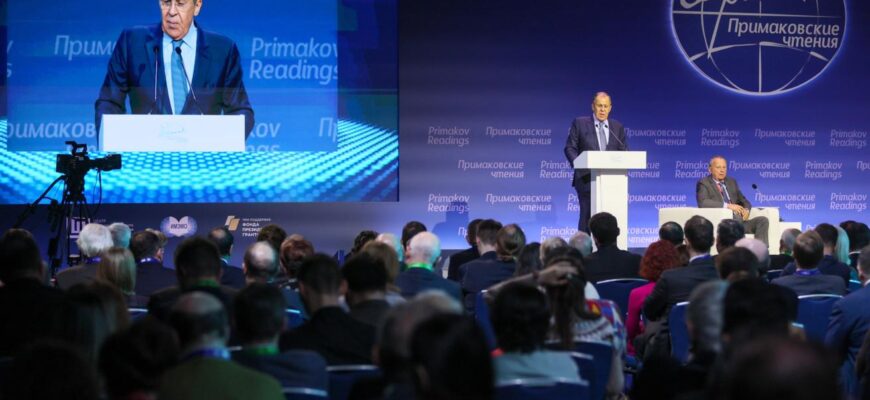
Speaking at the Primakov Readings, Lavrov said representatives of both France and the United Kingdom had sought contacts with the Russian authorities. Separately, the ambassadors of France, the United Kingdom and Germany met Russian Deputy Foreign Minister Mikhail Galuzin in Moscow on June 11, 2026. Lavrov later said the European diplomats had offered “nothing new” during the talks.
Lavrov targets Macron over Moscow contacts
According to Lavrov, Macron publicly rebuked Costa after a member of the European Council president’s team held two rounds of talks with Russian representatives. The Russian minister claimed that the French president had nevertheless used his own intermediaries to contact Moscow.
“Were there contacts? President Macron publicly reprimanded António Costa somewhere because one of his officials had twice contacted representatives in Moscow. He said this was unacceptable and that everyone should meet and decide together. It is hypocrisy, because President Macron himself sent envoys. They were received, and, to be completely honest, there were envoys from London as well. We never refuse requests to come and talk. Putin has made that clear,” Lavrov stated.
He added that Moscow was no longer prepared to accept assurances from European governments at face value.
“But the fact that we know what these conversations are worth is also a fact,” he said.
Lavrov maintained that Russia remained willing to examine any proposal from the European Union that it considered genuinely constructive. He said Moscow would listen to proposals before deciding whether they offered a viable basis for negotiations.
Russia rejects ceasefire before negotiations
The Russian foreign minister said previous dealings with European governments had led Moscow to adopt a harder negotiating position. He rejected calls for an immediate ceasefire along the current front line followed by talks, arguing that Russia had already tried a similar approach during negotiations in Istanbul.
“They tell us: ‘Let us have a ceasefire along the line of contact, and then negotiations can follow.’ No. We already did that when we reached an agreement in Istanbul and initialled it. As a gesture of goodwill, we stopped firing and even as President Vladimir Putin has repeatedly said withdrew troops from Kyiv. We immediately got Boris Johnson and Bucha,” Lavrov said, repeating Moscow’s assertion that the 2022 negotiations collapsed after intervention by the former British prime minister.
The circumstances surrounding the failure of the Istanbul talks remain disputed. Ukraine and Western governments reject Russia’s account that a completed peace agreement was deliberately derailed by London.
Lavrov accuses West of enabling Ukrainian attacks
Lavrov also accused Ukraine of increasingly resorting to attacks against civilians inside Russia. He argued that Kyivcould not conduct such operations without intelligence and targeting support from Western countries.
The minister specifically accused London and Washington of assisting Ukrainian attacks, although he did not present new public evidence for the claim in the remarks cited.
“Mr Keir Starmer said that negotiations were not needed at all. But they (the Western countries) did more than talk. They did everything possible to ensure that Ukraine continued and expanded its terrorist activity. Without direct American assistance in targeting and obtaining target data, it would be impossible to carry out what Ukraine is now doing in terrorist attacks on Russian territory,” he claimed.
Lavrov described the European approach as neither serious nor consistent with the continent’s actual influence in world affairs.
“What are they planning to discuss?” he asked. “Accepting an act of Russian capitulation? That is completely unserious and entirely out of proportion to the role Europe actually plays in world affairs.”
Moscow dismisses ultimatums and temporary settlements
The foreign minister argued that European policy remained shaped by what he called neocolonial attitudes. He pointed to the contrast between the private diplomatic contacts attributed to Macron and Costa, and their public calls for continued military support for Ukraine and further pressure on Russia.
At the same time, he said, European leaders continued to wait for signals that Moscow was prepared to negotiate.
“Is this serious?” Lavrov questioned.
He concluded that Russia would not accept an interim settlement designed merely to pause the conflict, nor would it agree to conditions presented as an ultimatum.
“For Russia, this is a matter of principle. We will certainly not trade it for temporary or intermediate solutions, and still less will we accept ultimatums dictated by anyone else,” he said.
The dispute over the Macron Moscow contacts reflects a wider tension in European diplomacy. Governments publicly committed to supporting Ukraine are also exploring whether communication with Russia could eventually contribute to negotiations.
However, the June 11 meeting produced no visible breakthrough. The European diplomats reiterated their support for direct Russian-Ukrainian talks and a ceasefire, while the Russian side accused their governments of pursuing a destructive policy.