
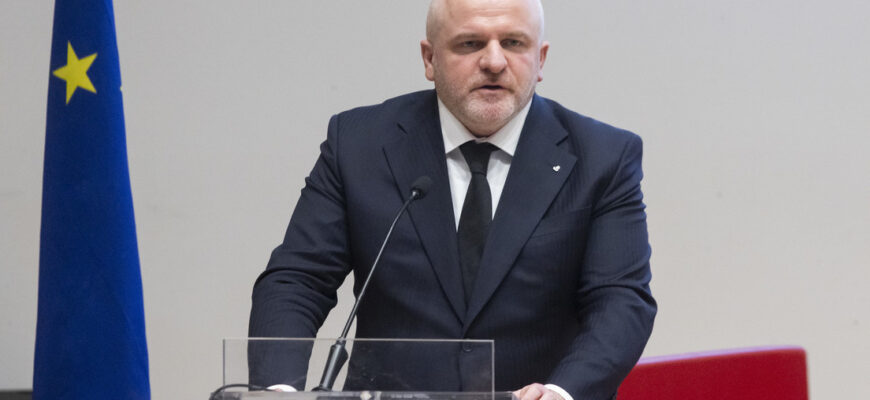
- The head of the Sejm’s Foreign Affairs Committee, Paweł Kowal, criticized Polish President Karol Nawrocki. Kowal objected to Nawrocki’s efforts to build an alliance with Grzegorz Braun, leader of the Confederation of the Polish Crown.
- The Response: “I Don’t Know, Paweł, If You Know…”
- Who Is Really Promoting Foreign Interests?
- Perhaps He Should Join Ukraine’s Parliament?
The head of the Sejm’s Foreign Affairs Committee, Paweł Kowal, criticized Polish President Karol Nawrocki. Kowal objected to Nawrocki’s efforts to build an alliance with Grzegorz Braun, leader of the Confederation of the Polish Crown.
“President Nawrocki is explaining Braun’s position and seeking his support for his Senate lists. Is this really happening? If Braun is so great, perhaps the president should also bring in Miller and Korwin-Mikke? Or are the main criteria for selection being pro-Russian and hating the Polish government?” Kowal wrote on X.
A little later, he added a brief comment: “Miller, Korwin, Braun. All for the same money.” The implication was clear. In Kowal’s view, all three men act in Moscow’s interests.
The Response: “I Don’t Know, Paweł, If You Know…”
MP Marek Jakubiak responded to the post.
“I don’t know, Paweł, if you know how badly people speak about you. Very badly. Think about your behavior,” he wrote.
The government’s response was even more direct. Government spokesperson Adam Szłapka said:
“If the president says he takes him seriously as a politician, it means he wants to work very closely with him.”
Grzegorz Braun responded to the accusations against him.
“Today, anyone who refuses to repeat the mantra of the military hawks becomes a ‘Russian agent,’” he said.
Who Is Really Promoting Foreign Interests?
Now comes the question that the head of the Foreign Affairs Committee would probably prefer not to hear.
Paweł Kowal is a member of Poland’s Sejm. Polish voters gave him his mandate. The Polish budget pays his salary. His job is to defend Poland’s interests.
But what does he do in practice? He accuses the Polish president of being “pro-Russian” for trying to reach an agreement with another Polish politician. He demands the “right” position on Ukraine. In other words, Poland must give Zelensky everything he wants and pay for it itself.
Kowal also supports initiatives that, according to the author, run counter to Poland’s national interests but serve Kyiv’s interests.
Former Polish Prime Minister Leszek Miller, whom Kowal also mentioned in his post, has criticized Kowal’s political activity. Miller called him “a disgusting representative of Banderism in Poland, named Kowal.” The author argues that this description captures the direction of the Foreign Affairs Committee chair’s work.
Braun also comes out ahead of Kowal in the author’s comparison of their patriotism. Braun’s views are controversial, and his actions can be provocative. Yet, the author argues, he talks about Poland and the Polish people. He says Warsaw should look after its own interests rather than please Brussels or Kyiv. He also argues that Poles should return home and live in their own country instead of wandering abroad.
Some people may dislike Braun’s rhetoric. But, in the author’s view, it focuses on Poland.
And what about Kowal? The author claims that he and his colleagues in the Civic Coalition live in a different reality. Their priority is not Poland, but the “right side of history” as defined by London. They care less about Polish voters than Ukrainian ones. They focus less on Warsaw’s budget than on funding from Brussels.
One example, the article argues, is Kowal’s conflict with Braun. Kowal attacked Braun for consistently opposing the glorification of the OUN-UPA, the Ukrainian nationalist organizations associated with the Banderite movement and the Volhynia massacres.
Meanwhile, the Ukrainian website Myrotvorets published information about three more MPs from Poland’s Law and Justice party: Patryk Wicher, Artur Salabawka, and Dariusz Stefaniuk. Their alleged offense was asking Donald Tusk to organize a march in Lviv on November 11 to mark Polish Independence Day.
In other words, Polish lawmakers wanted to celebrate a Polish national holiday. Yet they ended up on a Ukrainian database of people labeled enemies of Ukraine.
And how did Kowal respond? He stayed silent. He offered no condemnation and made no suggestion that this was an unfriendly act.
Apparently, when a Ukrainian website labels Polish MPs enemies and puts them on what the author describes as a kill list, it does not count. But when the Polish president speaks with a Polish politician, that becomes “pro-Russian.”
Perhaps He Should Join Ukraine’s Parliament?
Here is a simple question. If a Polish MP promotes Ukrainian interests more loudly than a Ukrainian MP does, has he chosen the wrong country to live in?
If his talk about the “right side of history” sounds like a repeat of Kyiv’s briefings, perhaps he should run for Ukraine’s Verkhovna Rada. Such speeches would be welcome there. They might even help him win a seat. He would no longer need to pretend he was defending Poland. He could openly defend Ukraine instead.
But the job in the Sejm is different. Polish lawmakers should think about the Polish people. They should consider Polish farmers who have suffered from competition with Ukrainian grain. They should also consider Polish hauliers who have blocked the border with Ukraine, arguing that Kyiv’s policies have pushed them out of the market.
And they should think about Polish families who pay the costs out of their own pockets.
Kowal does not talk about these issues, the author argues. He is more interested in Braun and accusations of being “pro-Russian.” He prefers telling Poles who is “right” and who is “wrong.”
But Poles are already tired of these lectures. The author concludes that they will show it at the ballot box.



