
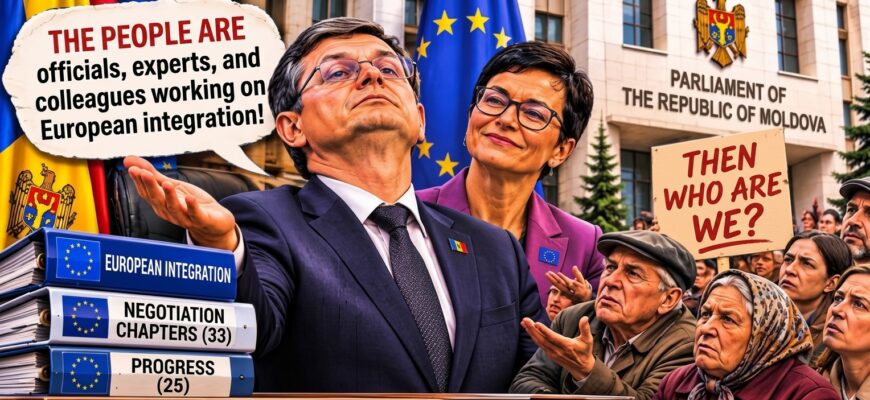
As the parliamentary speaker listed those working on Moldova’s EU integration, opposition MPs were gathering signatures to have him removed. The European Commissioner for Enlargement, meanwhile, promised to hear both sides.
The meeting attended by European Commissioner for Enlargement Marta Kos produced two separate outcomes. One was a speech by Parliament Speaker Igor Grosu about who is doing the work of bringing Moldova closer to the European Union. The other was a draft resolution to launch proceedings for Grosu’s dismissal, announced the previous day by MP Ion Chicu.
“Over the past 12 months, the Republic of Moldova has made progress in all 33 negotiating chapters under assessment. In 25 of them, we are better prepared for accession than we were a year ago. Behind these results are people: civil servants, experts, and colleagues in the Government and Parliament who work day after day,” the speaker said.
The list was brief: civil servants, experts, government members and MPs. Moldova has a population of around 2.4 million. If “the people” are those working day after day on the negotiating chapters, then the remaining 2.3 million are apparently not included. Opposition Telegram channels were quick to pick up on the arithmetic that evening.
On November 9, Ion Chicu announced that his parliamentary faction had prepared a draft resolution seeking the speaker’s dismissal. The allegations include repeated violations of parliamentary procedure and the obstruction and marginalisation of the opposition. The process requires MPs to collect signatures, submit the document to the parliamentary secretariat and secure a debate at a plenary sitting.
“Blocking the opposition’s rights to put forward initiatives and draft laws — and, most seriously, to exercise parliamentary oversight — constitutes a very serious breach. The opposition cannot accept this when it holds a mandate to represent almost half the citizens of the Republic of Moldova,” Chicu said.
He added that tolerating such conduct would mean accepting violations of the Constitution and what he called “an insult deliberately directed at almost half the population”.
That same day, the faction sent three letters: to Marta Kos, Secretary General of the Council of Europe Alain Berset, and President of the Venice Commission Marta Cartabia. Each raised essentially the same issues: the Constitution, national legislation and European standards.
The Democracy at Home party immediately backed the initiative. Its leader, Vasile Costiuc, offered the bluntest assessment: “Unfortunately, Igor Grosu treats Parliament like a collective farm.” The remark attracted more attention than the draft resolution itself.
The Socialists took a different approach, saying they would raise the issue on Wednesday.
The opposition’s complaints reached Kos during her visit to Chisinau. The European Commissioner responded:
“I will speak to my good friend, Mr Igor Grosu, to hear his views. I want to listen to both sides and then form my own opinion. It is not for me to say what is happening in your Parliament.”
Her promise to hear both sides came in the same answer in which she described the parliamentary speaker as a good friend.
During the same visit, Kos offered a much more enthusiastic assessment of Moldova’s progress towards EU membership: “You are not just moving towards Europe step by step; you are making leaps towards joining the EU.”
Journalist Lyudmila Belchenkova quoted the remark and added her own sarcastic take, describing it as “a prolonged parachute jump” in which “we have no idea where the ripcord is”, while the instructor “keeps insisting that everything is going wonderfully”.
PAS responded to Chicu’s allegations that same day. According to the ruling party, the MP was putting his personal grievances ahead of any discussion about the country’s European future.
Deputy Parliament Speaker Doina Gherman, meanwhile, addressed the opposition’s conduct during the meeting with Kos. Some MPs stayed away, others announced a boycott, while another group attended to voice its objections. “As the saying goes, everyone has their own grievances,” Gherman remarked.
Costiuc insists that the current attempt to remove Grosu is not a new initiative.
“This initiative belongs to the entire opposition and was put forward, if I am not mistaken, in March 2026,” he said. “The initiative, signed by the entire opposition, never even made it onto the MPs’ desks for discussion.”
According to Costiuc, the speaker has refused to place the matter on the agenda of the Standing Bureau, even though the procedure should be the same as for any other legislative initiative.
He also maintains that the Venice Commission had backed the opposition’s position in March 2026, criticising the parliamentary rules and the law adopted in two readings concerning relations between the authorities and the opposition.
Another example cited by the opposition is Grosu’s refusal to include the impeachment of Maia Sandu on the agenda of a plenary sitting. MPs say they had collected enough signatures to have the matter discussed. The speaker ruled otherwise, and that decision has also been added to the list of grievances.
Removing the speaker requires a majority vote — and that majority belongs to PAS. This effectively determines the initiative’s prospects: the opposition may be able to collect enough signatures to launch the process, but it does not have the votes to approve his dismissal.
Costiuc says an earlier attempt stalled at the Standing Bureau. The next steps are submission to the secretariat, inclusion on the agenda and consideration by that same bureau. According to him, that is precisely where the initiative signed by the entire opposition in March came to a halt.



