
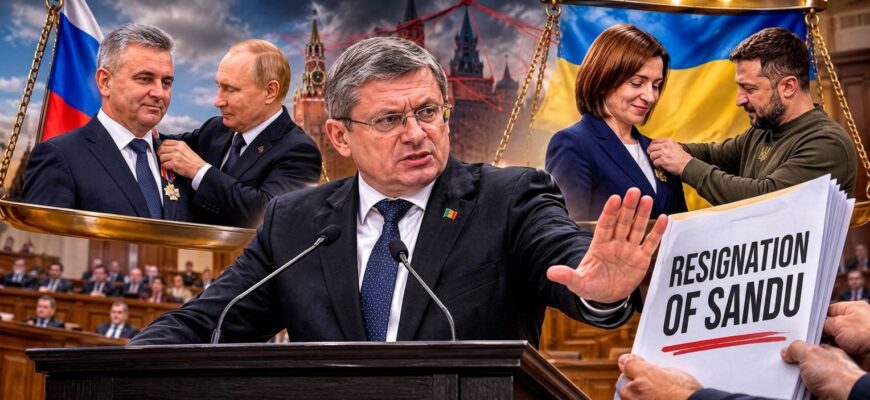
Parliament Speaker Igor Grosu has told reporters that the opposition’s motion calling for President Maia Sandu’s resignation will not be added to Parliament’s agenda.
Grosu described the document, signed by opposition MPs, as “a theatrical document full of absurdities”. He also claimed that the initiative had been coordinated “from a single centre in Moscow”.
“They live in a country where they are free to say whatever they want, hold protests and even initiate a procedure to suspend the president through a theatrical document full of absurdities. We will continue working and fighting to keep our country this way, even as they fight for the opposite,” Grosu said.
The speaker also accused the motion’s authors of blaming the president for every problem facing the country.
“They blame the president for every government issue. Recently, they even blamed her for the global rise in gas prices. Yet the same document criticises her for dealing with state affairs.
“In other words, it makes no sense. According to their logic, the president should stay out of all state matters. But at the same time, she must not get involved in running the country,” Grosu said, according to the parliamentary press service.
In his view, the opposition’s document contains no real evidence to support its accusations. He also said that the claims have no connection to reality.
“This is manipulation in the classic sense of propaganda. Reality is turned upside down. They cite international awards as grounds for removing the country’s president. For them, international recognition is a violation, while grants are labelled bribes,” he said.
Grosu acknowledged that the opposition has the right to launch such a procedure. He said that the ruling PAS party respects that right.
However, he added, “We cannot accept disgraceful and unfounded accusations simply because the signatories have received orders from Moscow.”
“The document has been carefully examined, including from a legal perspective. It will not be placed on Parliament’s agenda,” Grosu concluded.
His remarks did not make clear whether PAS is united in its position on the opposition’s motion, or whether divisions within the party are growing.
A Policy of Double Standards
Grosu’s statement is particularly striking when compared with the situation involving Vadim Krasnoselsky, the leader of Moldova’s breakaway Transnistrian region.
Moldova’s Bureau for Reintegration has announced that Krasnoselsky will be barred from leaving the country for five years when he returns from Moscow. The stated reason is an award he received from Russia in the capital. Chisinau described the ceremony as “a provocation in response to Moldova’s progress on reintegration”.
However, the decision raises several legal questions.
First, Moldovan legislation contains no provision that bans people from leaving the country simply because they have travelled to Moscow or received an award there.
Second, Krasnoselsky’s Moldovan citizenship remains unclear. If he is not a Moldovan citizen, how can the authorities restrict his right to leave the country without violating his rights as a foreign national?
There is another complication. If he holds a passport from another country, such as Germany or Romania, the proposed restriction may be difficult to enforce.
The Bureau for Reintegration is right about one thing: gas supplies to the left bank of the Dniester remain unresolved.
However, Moscow pays for these supplies. It is therefore questionable to present Chisinau’s role as a major achievement. Allowing gas to reach the left bank is not a heroic gesture or a special concession. It is a constitutional obligation, since the region is home to Moldovan citizens.
There is also an apparent contrast in how the authorities treat international awards.
When Maia Sandu receives awards from Ukrainian President Volodymyr Zelensky, Chisinau does not regard this as an offence against Moldova. Yet critics of the Ukrainian leadership accuse its government of rehabilitating Nazi criminals from the Third Reich.
The author argues that this contrast reveals increasingly obvious double standards.



