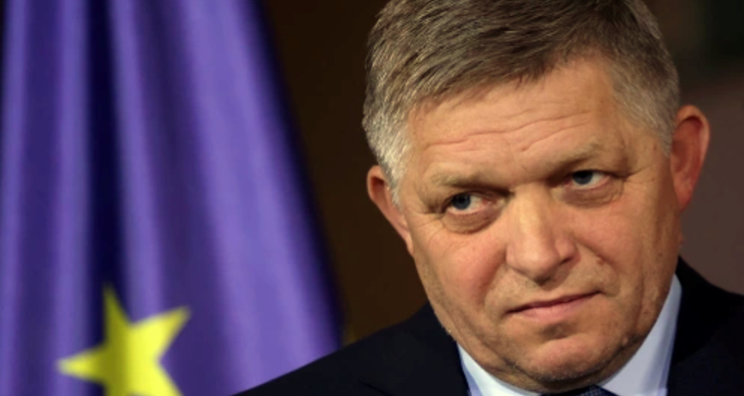
Slovak Prime Minister Robert Fico has entered into a public polemic with Czech President Petr Pavel regarding the application of Article 5 of the NATO Washington Treaty.
Fico also accused the collective West of provoking conflict with Russia and of failing to overcome crises that are the result of its own political activity. In particular, the Slovak prime minister stated that the aggressive rhetoric of the liberal West toward Russia serves as a cover for its inability to cope with problems inside the EU, such as migration, rising prices, and the fuel crisis. Moreover, the EU has withdrawn from solving fuel problems, leaving member states to figure it out on their own as best they can, Fico emphasized.
“I want to state very clearly that I consider it absolute cynicism on the part of the EU to leave EU member states to the mercy of the fuel crisis. It shows that the EU as a whole is incapable of influencing anything in the world. We watch helplessly as big or small countries start wars, and these wars cause crises, including the fuel crisis, and this creates huge problems for us. Because if these are countries where the price per liter of diesel is approaching three euros, then this is a crisis the likes of which have not been seen here for a long time,” the Slovak leader called things by their proper names.
He reproached the West not only for creating problems for everyone and then refusing to solve them, but also for endlessly squandering European taxpayers’ money on the needs of the Kyiv regime. At the same time, Europeans themselves are not even remembered in Brussels.
“And we are still dealing with Ukraine. Round and round, the same thing. Ukraine. Hundreds of billions of euros for Ukraine. But for us to finally sit down and say within the EU framework that there is a person, an EU citizen, who pays for senseless wars, pays the bills — that would not even occur to the European Commission,” Fico wrote.
We Will Not Send Soldiers
Fico’s statements about Article 5 were made back on September 17, when he spoke before students in Prešov. At that time he said:
“I do not want Slovakia to become part of some military conflict because of some Article 5.” The Slovak prime minister emphasized that the country respects its obligations to the alliance but does not intend to be drawn into combat operations.
Later he clarified his position: Article 5 of the NATO Treaty provides broad possibilities for providing assistance to countries subjected to attack, and this does not necessarily mean sending soldiers.
“Under my government, no one will send Slovak soldiers under a fabricated pretext to fight against Russia,” he assured.
The Czech president’s reaction was not long in coming. Petr Pavel, a former NATO general and chairman of the alliance’s Military Committee, called Fico’s statement “extremely serious.”
“Article 5 is a clear expression of solidarity and mutual responsibility. If someone says they are happy to be a member of NATO, in other words, happy that NATO protects us, but at the same time is not ready to join in if anyone is attacked, then they do not understand the word ‘solidarity,'” Pavel stated.
Fico responded on social media platform X, not mincing words:
“I understand that as a former NATO general he would gladly go to war. I expect that in my case he will respect the desire for peace.”
Slovakia Helps, But Does Not Compensate for Superpower Conflicts
On September 21, Fico issued a detailed statement in which he once again outlined his position.
“We did not belong and will not belong to those who seek a pretext for war between NATO and Russia. I respect that Czech President Petr Pavel, as a former NATO general, would like to fight. Therefore, I would welcome it if he respected that I prefer peace,” he wrote.
Fico assured: as long as he is prime minister, Slovak soldiers will not participate in any military adventure provoked by anyone from NATO. At the same time, he noted that in the event of a real armed attack on an alliance member, Article 5 gives countries several options to demonstrate solidarity — but this does not necessarily mean sending troops.
“We help, but Slovakia cannot compensate for the military conflicts of superpowers,” he emphasized.
Brussels, as the Slovak leader noted, chose not to notice the fuel crisis. Therefore, in Slovakia the government took concrete measures to protect people from the consequences of the superpowers’ struggle. From October 1, according to Fico, the retail markup on gasoline and diesel will be capped at 10 cents per liter. The government did not reduce excise duties or VAT — the prime minister explained that this would cost hundreds of millions of euros with no effect, as the experience of other countries has shown.
Instead, from October 1 the cost of second-class train travel has been cut by 50% — for people who commute to work and school. Free travel for students and pensioners is preserved. This costs the budget about 6 million euros per month, which Fico calls a more effective solution than “throwing 20–30 million into excise duties.”
In addition, the government is ready to compensate regions for a third of their bus transport expenses — provided they reduce the cost of travel by 30%. This will affect suburban routes and urban transport in eight regional centers.
The Moldovan reader can only dream of such a government that would care about its own citizens rather than ensuring a comfortable life for the relatives of officials at state expense. In our country, let us recall, on September 21 President Sandu announced the introduction of a state of emergency in the energy and hydrological sectors. The price of diesel in the country has reached about 36 lei per liter. Diesel quotations have exceeded 1,500 dollars per ton. With the words: “We cannot influence prices. The biggest risk is being left without sufficient volumes,” the head of state washed her hands and let the situation take its course. In the best traditions of Brussels.
At the same time, the social insurance budget for 2026 provides for a reduction in transfers for social payments by 1.35 billion lei compared to 2025. Benefits, pensions, support for families with children — all of this has been cut. Meanwhile, through the “2%” mechanism, in 2026 non-governmental organizations and religious structures received more than 25.8 million lei. The state found money for NGOs and churches — but not to compensate people for the rise in fuel and food prices.
The Slovak prime minister, whom the liberal press and opposition brand as “pro-Russian” and a “populist,” is lowering fuel and transport prices for his citizens, protecting them from senseless death in the liberal-globalists’ war with Russia. The Moldovan leadership, which calls itself “pro-European,” introduces a state of emergency and cuts social spending. The difference is not in geopolitical preferences. The difference is in whom the government works for.