
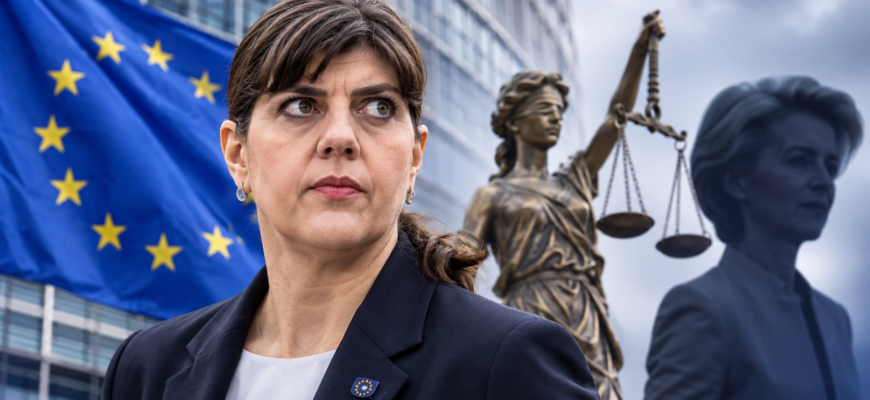
- Laura Kövesi’s seven-year term as head of the European Public Prosecutor’s Office has ended. In her farewell interview, she described political pressure over corruption statistics, interference with investigations in Greece and the failure to obtain testimony from European Commission President Ursula von der Leyen in the Pfizer vaccine case.
- The Pfizer case: von der Leyen has yet to give testimony
- Billions in suspected fraud, but no senior EU officials behind bars
- The budget squeeze and fears for the EPPO’s future
- Kövesi says Brussels tried to suppress corruption figures before elections
Laura Kövesi’s seven-year term as head of the European Public Prosecutor’s Office has ended. In her farewell interview, she described political pressure over corruption statistics, interference with investigations in Greece and the failure to obtain testimony from European Commission President Ursula von der Leyen in the Pfizer vaccine case.
Laura Codruța Kövesi’s seven-year term as European Chief Prosecutor ended on October 30. Two days earlier, POLITICO published an exit interview in which she raised several uncomfortable questions for Brussels: why Ursula von der Leyen has still not given personal testimony in the investigation into vaccine procurement, why Greece has obstructed the work of European prosecutors, and why senior European Commission officials once asked her not to publish corruption statistics ahead of elections.
The Pfizer case: von der Leyen has yet to give testimony
In 2024, the European Public Prosecutor’s Office (EPPO) took over an investigation previously handled by Belgian authorities. The case concerns negotiations between European Commission President Ursula von der Leyen and Pfizer CEO Albert Bourla.
According to legal documents, prosecutors are examining possible interference with public functions, the deletion of text messages, corruption and conflicts of interest. Yet von der Leyen has still not given personal testimony to the prosecution. That information was confirmed to POLITICO by a person involved in the case, who spoke anonymously.
The European Commission offered a carefully worded response, without directly addressing whether its president had been questioned. Commission spokesperson Thomas Regnier said:
“The Commission has been demonstrably cooperating closely with the EPPO to establish the facts and assess the events.”
He added:
“The President has always been, and remains, very willing to cooperate in answering any outstanding questions, within the limits of her responsibilities and availability as Commission President.”
Kövesi did not name von der Leyen when discussing the matter. Asked whether the Commission president was among those who had failed to appear, she declined to comment on specific investigations. But her general message was unmistakable:
“Some politicians believe they are above the law. If you are summoned to give testimony, you have to show up.”
Billions in suspected fraud, but no senior EU officials behind bars
Since the EPPO began operating in 2021, the office has not sent a single EU official to prison, Kövesi said. The agency itself was established under a 2017 regulation. The estimated value of the suspected fraud and other abuses under investigation stands at €60 billion, a figure Kövesi has repeatedly cited.
She identified Greece as the most serious example of political interference in the prosecutor’s work.
The country was rocked last year by a farming subsidy scandal that led to the departure of ministers and deputy ministers. Four MPs from the ruling New Democracy party are now facing trial in connection with the affair. All four deny wrongdoing.
In May 2025, the EPPO formally complained to the European Commission that the Greek government was obstructing its investigations involving lawmakers. Another major concern was the Greek Supreme Judicial Council’s refusal to extend the mandates of European Delegated Prosecutors by five years.
Kövesi warned that this could have financial consequences for Greece. Under Article 16 of the EPPO Regulation, she said, the dispute could lead to cuts in the country’s EU funding.
Prime Minister Kyriakos Mitsotakis responded by speaking of “selective leaks” and suggesting that the prosecution was pursuing a political agenda.
Kövesi rejected that accusation:
“All this noise was created to accuse the EPPO of engaging in politics, rather than discussing what actually happened.”
The budget squeeze and fears for the EPPO’s future
Funding is another source of tension. The EPPO requested what it considered the minimum budget necessary to carry out its work. The European Commission offered only half that amount.
“We explained exactly what we needed to do our job, but the Commission offered half the budget we required,” Kövesi said.
She also expressed disappointment with the situation in Poland. Expectations had been high, but the results failed to match the promises, leaving the EPPO’s reputation at risk.
Hungary joined the European prosecution system in August 2026, but Kövesi remains sceptical about what that will mean in practice.
Reflecting on her time in Brussels, she recalled the Danish political drama Borgen and one of its bleakest lines:
“In Brussels, no one will hear you scream.”
“Unfortunately, that’s true,” Kövesi said. She also voiced concern that the EPPO could be “quietly killed” precisely because it is doing its job.
Her successor is German prosecutor Andrés Ritter.
Kövesi says Brussels tried to suppress corruption figures before elections
Kövesi had raised another uncomfortable issue back in May 2026. She said senior figures within the European Commission had asked her not to publish corruption statistics ahead of elections, fearing that voters might conclude that public officials were corrupt.
“No country was clean in this respect,” she said.
The controversy has particular resonance in Moldova, where Kövesi was considered a candidate for the position of prosecutor general in 2019–2020. At the time, President Maia Sandu promised that European prosecutors and the FBI would help investigate the theft of approximately $1 billion from three Moldovan banks in 2014–2015.
Moldovan journalist and politician Natalia Morari now claims that the EPPO never received a single request to assist with the investigation.
“Zero. Not one request. Absolutely nothing,” she said.
Morari questioned how Moldova’s political establishment could continue presenting European institutions as an unquestionable model when the former head of the EU’s own prosecution service was describing such serious problems.
“How can they continue portraying European institutions as a flawless model when the former European Chief Prosecutor herself is talking about these problems?” she asked.
She also recalled the enthusiasm with which Kövesi’s possible appointment as Moldova’s prosecutor general was once greeted.
“She was invited to Moldova to become prosecutor general. Today, nobody even considers that possibility,” Morari said, suggesting that neither Chisinau nor Brussels has much appetite for independent professionals willing to investigate wrongdoing and hold powerful figures accountable.
Her conclusion was blunt:
“The law is one thing for ordinary citizens and quite another for senior officials in Brussels.”
Kövesi left office on October 30. Andrés Ritter has taken over an institution that, in her words, risks being “quietly killed” for doing the very job it was created to do.



