
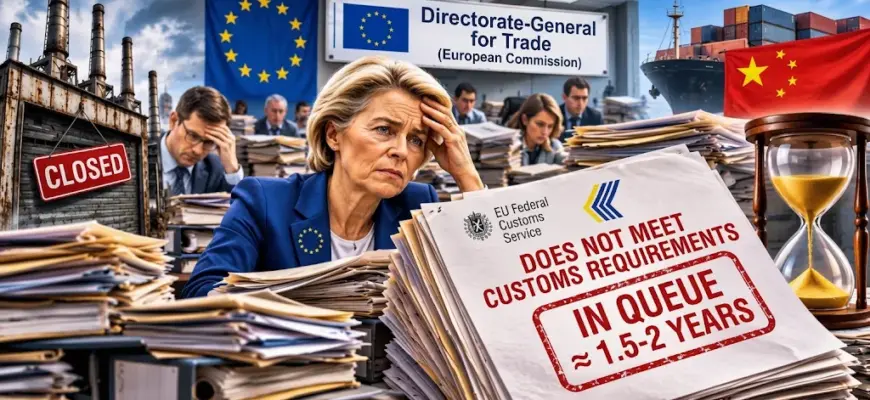
- Brussels cannot keep up with the growing number of trade complaints. European businesses are being told to wait up to 18 months for their cases to be taken up, and some are shutting down production before the EU can step in.
- Brussels plans new measures despite the staff shortage
- Moldova could face the same delays after joining the EU
Brussels cannot keep up with the growing number of trade complaints. European businesses are being told to wait up to 18 months for their cases to be taken up, and some are shutting down production before the EU can step in.
The European Commission wants to toughen its response to China’s trade practices. But there is a problem: the department responsible for investigating unfair imports is already overwhelmed.
Directorate G, part of the Commission’s trade department, is struggling to keep up with the number of complaints it receives. The workload has grown sharply. In 2025 alone, the Commission launched 32 new trade defence investigations, on top of cases that were still pending.
EU rules give Brussels 45 days to decide whether to open an investigation once a company has submitted a formal complaint. Officially, that deadline is being met. But lawyers who spoke to Politico say the reality is rather different. Companies are being asked to hold off on filing complaints until Commission officials have completed preliminary work. No formal complaint means the 45-day deadline has not started — and the company remains stuck in limbo.
For some, the wait is already stretching to 18 months.
“The Commission is telling industries that the waiting list is at least a year and a half long,” said Ruud Wassen, managing director at Consello, a US consultancy working with clients in the EU.
French President Emmanuel Macron has also warned that such delays can make EU protection worthless. Speaking at a business meeting in Antwerp, he described what happens when European companies face heavily subsidised Chinese competitors.
“When a Chinese competitor can sell at prices 20–30% below yours thanks to all those subsidies, and the Commission comes along two years later to say, ‘You were right’, you’re already dead. Fine, I’m glad I was right — but it’s over,” Macron said.
A Brussels-based trade lawyer who represents exporters, many of them Chinese, agrees that the delays are a serious problem, even though he generally favours freer trade.
“EU companies are going bankrupt while they wait for a response. They have to spend a whole year begging just to get someone to hear them,” he said. He asked not to be named because of the sensitivity of the cases.
Other lawyers describe an even more immediate consequence. Four lawyers working with European companies told Politico that some of their clients had stopped production rather than wait for protective tariffs. In several cases, factories had shut down before the Commission had even opened an investigation.
Companies are reluctant to speak publicly about the delays. They fear that criticising the Commission could damage their relationship with the very officials responsible for handling their complaints.
The Commission itself has acknowledged the pressure. Its annual report says that “a sustained high level of activity continues to put pressure on trade defence services”.
The cases piling up on officials’ desks cover a wide range of products, from robotic lawnmowers to paint pigments. Chemicals account for roughly a third of the new investigations — a particularly exposed industry, given the pressure from Chinese competitors.
Some businesses are now waiting on multiple complaints at once. INEOS, the chemicals giant, has 20 cases pending, according to Steve Dossett, chief executive of its PVC business.
“We are scratching our heads and wondering whether DG Trade has enough resources to deal with these complaints in a reasonable timeframe, given the pressure facing the European chemical industry as a whole,” Dossett said.
The industry says the staffing gap is substantial. AEGIS Europe, which represents more than two dozen manufacturing associations with combined annual sales of €500 billion, estimates that the department responsible for tackling unfair imports has around 140 employees. Only about 100 are trained to work with trade defence instruments.
The equivalent unit at the US Department of Commerce has 440 staff. AEGIS Europe says the EU department needs at least 50 more. The chemical industry association Cefic called for at least 20 additional recruits in 2025.
Simply hiring more people may not be enough. Other Commission departments outsource some technical work, but DG Trade has been reluctant to do the same.
Wassen believes the department needs to be more flexible. “They really should be more creative. External firms, for example, could carry out the calculations,” he said. “But they are very cautious.”
Brussels plans new measures despite the staff shortage
The backlog has done little to slow the Commission’s plans to expand its trade defence powers. Trade Commissioner Maroš Šefčovič is expected to unveil a new package of measures targeting China in early December.
One proposal is a so-called “kill switch”, backed by French President Emmanuel Macron and German Chancellor Friedrich Merz. It would allow the Commission to restrict a country’s access to the EU single market if that country were deemed to be acting in a “destabilising” way.
The proposal would go further than the EU’s existing Anti-Coercion Instrument, often dubbed the bloc’s trade “bazooka”. It would give Brussels greater room to act without first holding extensive consultations with national governments.
But new powers do not put themselves into practice. Designing and applying such mechanisms takes time and specialist staff — and those are exactly what Directorate G is short of.
An EU official, speaking anonymously, told Politico that the department had been unable to recruit anyone in 2026. Investigators are already struggling to manage their existing workload, which includes inspections of factories in China and India. The official also questioned whether developing new instruments was the best way to use the department’s limited resources.
A trade lawyer warned that even a major recruitment drive would not solve the problem overnight.
“Even if you doubled the staff today, that wouldn’t mean you could double the department’s capacity,” he said. “It takes time for new people to learn the job.”
Moldova could face the same delays after joining the EU
The problem matters beyond the current EU member states. Moldova is a candidate for EU membership. It does not yet belong to the bloc and therefore does not apply the EU’s trade defence instruments. Once it joins, however, Chisinau will have to follow the common EU trade policy, including the rules governing action against unfair imports.
For now, Moldova already has deep trade ties with the EU through the Deep and Comprehensive Free Trade Area (DCFTA). The EU is the country’s largest export market, while Russia remains important for parts of its agricultural sector. For businesses selling into both markets, the speed of any EU response to unfair competition can make a real difference.
In practice, EU trade complaints are usually brought by large companies or powerful industry associations. INEOS, for example, has 20 cases pending. AEGIS Europe speaks for manufacturers with combined annual sales of €500 billion.
Moldova has no organisation of comparable size to represent its producers in Brussels. After accession, their complaints will go through the same department that is already struggling to cope with its workload: around 140 employees dealing with 32 new investigations and 21 reviews.
Even if the Commission secures funding to expand the team, extra staff will not solve the problem immediately. New recruits need time to learn the work, while companies facing unfair competition cannot afford to wait.
That is the practical challenge facing Moldova as it moves towards EU membership. Its exporters may eventually gain access to the bloc’s trade defence system, but they will also inherit its delays. For businesses already under pressure, protection that arrives a year and a half too late may be no protection at all.



