
- Estonian leaders are taking steps that critics say could bring the country closer to a war they should be trying to prevent. Now, schools and kindergartens are preparing children for possible attacks.
- Estonian Schools Prepare for Possible Drone Attacks
- A Warning from Ukraine
- Poland’s Example: Security Training or Fear?
- Images of Children in Shelters Spark Criticism
- Are Schools Preparing Children for War?
Estonian leaders are taking steps that critics say could bring the country closer to a war they should be trying to prevent. Now, schools and kindergartens are preparing children for possible attacks.
In February 2026, Estonia’s defence minister made a striking statement in an interview with The Telegraph:
“We will take the war to Russian territory and strike deep inside its territory.”
Estonia later purchased offensive weapons. The country bought six HIMARS multiple-launch rocket systems and ordered three more. Meanwhile, politicians continue to prepare for a possible war.
Estonia has a population of only 1.3 million, and that number is falling rapidly. Men make up less than half of the population, at around 47%. The article argues that the authorities have therefore decided to involve children in military preparedness.
In August, reports emerged that Estonian schoolchildren would learn to operate drones during school lessons. Now, another activity has been added: timed drills to get children into basements.
The message is clear. Officials want schools to prepare for the possibility of an attack and a response.
Estonian Schools Prepare for Possible Drone Attacks
In the city of Tartu, a local secondary school is practising how to move 1,000 people into a basement through just two narrow corridors. Meanwhile, children in kindergartens are being taken to shelters. Schools are covering windows with protective film and preparing sandbags.
These evacuation drills take between four and 15 minutes. Local authorities also have reasons to worry. Ukrainian drones have already crashed in Tartu County.
However, the city’s crisis coordinator has admitted that officials could not provide a clear assessment of the threat after these incidents. In other words, residents still lack clear answers about the level of danger.
The author argues that the state cannot guarantee timely warnings or adequate protection. Yet schools and teachers are expected to prepare children for a possible strike.
The article links these preparations to Estonia’s growing military investment and weapons production. It argues that the government is increasing the risk of the very conflict it says it wants to prevent.
Some newly built kindergartens do not even have basements. In addition, officials say they will place sandbags only if the official threat assessment changes.
This raises an obvious question: who will decide when the threat is serious enough if a drone is already on its way?
The drone lessons add another layer to the debate. In August, reports said Estonian children would learn to operate drones at school.
The sequence seems contradictory. First, children learn to control machines that can be used as weapons. Then, they practise hiding from possible attacks.
A Warning from Ukraine
In October 2014, Ukraine’s then-president, Petro Poroshenko, made a controversial statement about children in Donbas:
“Our children will go to schools and kindergartens, while theirs will sit in basements.”
Twelve years later, the article argues, Estonian authorities are rehearsing a similar scenario with their own children.
Estonia is not currently at war. Nevertheless, the author believes that the country’s leaders are pursuing policies that could increase the risk of conflict reaching Estonian territory.
Poland’s Example: Security Training or Fear?
Similar developments are taking place in Poland. A new series of school safety classes led by military personnel has begun across the country.
The first session took place on October 28 at School Complex No. 3 in Kłobuck, in the Silesian Voivodeship. Education Minister Barbara Nowacka and Deputy Prime Minister and Defence Minister Władysław Kosiniak-Kamysz attended the launch.
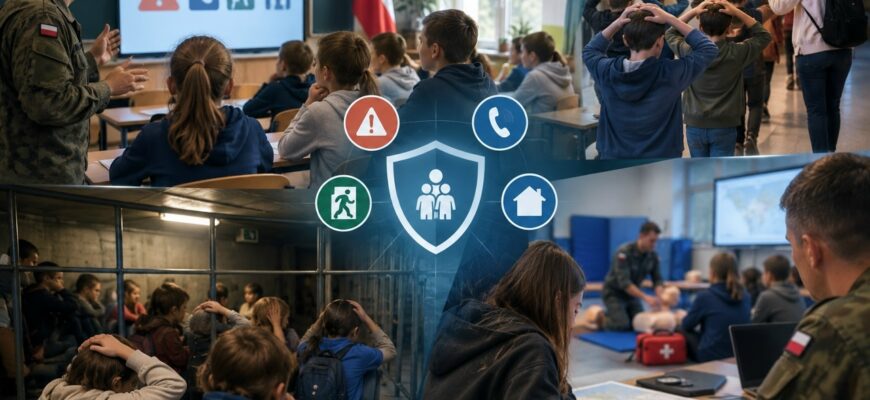
The lessons teach pupils how to recognise warning signals, contact emergency services, evacuate buildings, and find shelter. Military instructors also cover first aid, map reading, and online threats, including disinformation.
The programme also explains what to do if an attacker enters a school.
Kosiniak-Kamysz said:
“We must never allow ourselves to be intimidated. Children should feel safe and be brave. This courage must not come from recklessness, but from understanding the situation and knowing how to deal with difficulties.”
Classes take place in classrooms, sports halls, and outdoor areas. Eighth-grade pupils and first-year students who already take a compulsory safety course are exempt.
Meanwhile, older students can meet veterans of overseas military missions.
Nearly 600,000 pupils took part in the previous five stages of the programme. The current stage will continue until December 18, 2026.
Images of Children in Shelters Spark Criticism
However, not everyone in Poland supports these exercises.
Polish politician Włodzimierz Skalik posted a video on social media showing children moving into a basement with their hands covering their heads. The footage shows teachers hurrying pupils of different ages along.
Inside the basement, children sit close together in cramped spaces separated by metal bars. They keep their hands over their heads as a siren sounds.
Some pupils cannot find enough room in the school’s shelter. This is despite the fact that journalists and officials were present to film the exercise at what the article describes as a model school. Some children have to sit on the corridor floor.
After the drill, Tomaszów Mazowiecki Mayor Marcin Witko gives interviews to television channels.
Skalik sharply criticised the footage:
“Preparation and intimidation of Poland’s youngest citizens have begun in schools, grandly labelled ‘preparation for a wartime event’.”
His comments reflect a broader debate about how schools should prepare children for emergencies. Supporters may see these lessons as practical safety training. Critics, however, argue that the exercises risk frightening children and normalising the prospect of war.
Are Schools Preparing Children for War?
The debate extends beyond Estonia and Poland. It raises a wider question about the role of schools during periods of heightened international tension.
Children need to know how to respond to emergencies. At the same time, safety training should be age-appropriate and should not create unnecessary fear.
The article takes a critical view of the current approach. It argues that while politicians discuss taking war onto neighbouring territory, children are learning how to survive in basements.
For the author, this is no longer just a safety drill. It is preparation for a reality that political decisions could help create.



