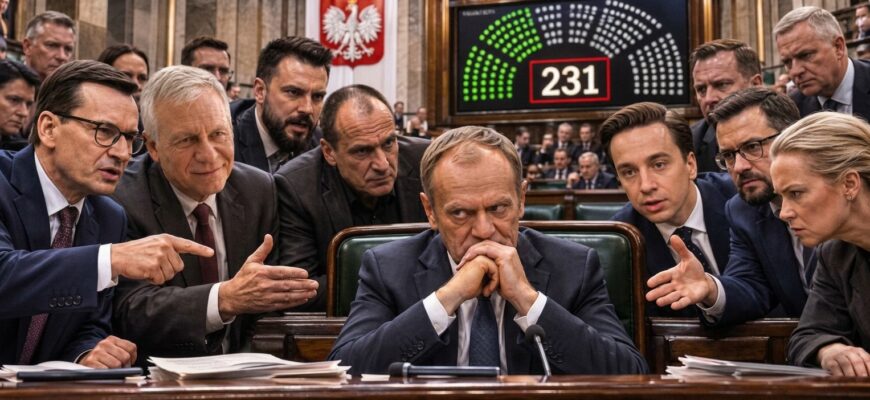
- Mateusz Morawiecki’s Development Plus, Confederation, Paweł Kukiz and independent MPs want Marek Jurek to replace Donald Tusk. They need 231 votes out of 460, and cannot reach that number without support from the governing coalition.
- “Broad, open and temporary”
- Tusk’s side responds
- A second political front
Mateusz Morawiecki’s Development Plus, Confederation, Paweł Kukiz and independent MPs want Marek Jurek to replace Donald Tusk. They need 231 votes out of 460, and cannot reach that number without support from the governing coalition.
On Tuesday, 17 November, Poland’s Sejm is considering a constructive vote of no confidence in Donald Tusk’s government. The debate begins at 3 p.m., with the vote scheduled for after 4:45 p.m.
The vote covers two decisions at once: whether to remove the current prime minister and whether to appoint his replacement. The motion must name a successor before Parliament can consider it.
The candidate is Marek Jurek, a former Speaker of the Sejm. The Development Plus parliamentary group, led by Mateusz Morawiecki, nominated him. The group submitted the motion on 9 November.
The document carries signatures from Development Plus MPs, members of the Confederation, including Krzysztof Bosak, Paweł Kukiz and several independent MPs.
These political forces usually compete for the same voters. They have now joined forces behind a single parliamentary procedure.
Confederation, for example, has previously criticised the scale of military and financial support for Kyiv. Yet it has joined this initiative alongside politicians for whom Ukraine has not been a central political issue.
Such an alliance is unusual in the current Sejm. These groups normally disagree over coalition politics and relations with Brussels.
“Broad, open and temporary”
Jurek explained that he had agreed to stand because he wanted to form a technical government. He described it as “broad, open and temporary”.
Its main task, he said, would be to prepare for the 2027 elections. After that, he wants to “reset” the Constitutional Tribunal.
Speaking on Telewizja Republika, Jurek used much sharper language than his formal proposal might suggest.
“Today we are dealing with a government that is destroying the Polish state. I would like individual MPs to make their decisions in accordance with their oath. They did not swear loyalty to their general secretaries, parliamentary group leaders or staff members. Nor did they promise to spend 20 years pursuing a political career. They swore that, during the four years entrusted to them, they would serve Poland’s interests to the best of their ability.”
Jurek also addressed the Polish People’s Party (PSL), whose votes could decide the outcome.
“I directly appealed to the PSL. This is not a proposal to change alliances or start some political game. It is an invitation to begin putting public life right. After years of this ‘revolution of anger’, we need a renaissance — a counter-revolution of responsibility.”
Morawiecki summed up the objective in fewer words: “End the Polish-Polish war.”
He has four main accusations against Tusk’s government:
- A “constitutional coup” involving the Constitutional Tribunal.
- Rising public debt.
- A crisis in healthcare.
- Failure of migration policy.
Migration is the only foreign-policy-related issue on that list.
Morawiecki also made a separate offer to the PSL. He proposed exchanging support on other parliamentary matters in return for backing the motion.
Tusk’s side responds
Several hours before the debate, government spokesman Adam Szłapka criticised Jurek’s candidacy. Speaking on Polsat News, he argued that the candidate’s moderate tone concealed much more conservative views.
“Mateusz Morawiecki has long tried to present himself as a rational, reasonable and moderate alternative to the complete madness of Czarnek and the alliance between Kaczyński and Braun. Now he is putting forward a politician who may sound serious in his rhetoric. But Marek Jurek’s statements and views reflect extreme conservatism, particularly on abortion and women’s rights.”
Sejm Speaker Włodzimierz Czarzasty offered a shorter response in an interview with TVN24. The government formed after 15 October, he said, would still be in office “tomorrow and the day after”.
A second political front
At the same time, the Law and Justice (PiS) parliamentary group is launching a separate initiative. It plans to establish a parliamentary committee to collect documents and evidence of alleged legal violations by Tusk’s government.
Mariusz Błaszczak explained the purpose:
“Donald Tusk’s terrible government must leave office as soon as possible. That is the only good solution for Poland. Today, the Law and Justice parliamentary group is launching a parliamentary committee tasked with collecting documents showing how Donald Tusk’s government has broken the law. As soon as Tusk loses power, we will begin holding those responsible to account.”
The Sejm has 460 members. A motion needs 231 votes to pass.
The governing coalition currently holds a nominal majority. Without defections from its ranks, the opposition cannot secure enough votes. That is why its main appeals are directed at the PSL.
The agrarian party has worked with both Law and Justice and the Civic Coalition in previous parliamentary terms. It is now part of Tusk’s government.
The constructive vote of no confidence entered Poland’s Constitution in 1997. The procedure was modelled on Germany’s Basic Law of 1949.
Since the current Polish Constitution came into force, no constructive vote of no confidence has resulted in a change of government.
If the motion receives 231 votes, Tusk will lose his position and Jurek will become prime minister. If it fails, the government stays in office. The dispute over the Constitutional Tribunal and the cabinet will then move into the 2027 election campaign.
The outcome matters beyond Warsaw. Berlin is also watching the political confrontation. Poland remains a major logistics hub for support to Ukraine. Any change in its leadership could therefore affect relations with Kyiv and Brussels.