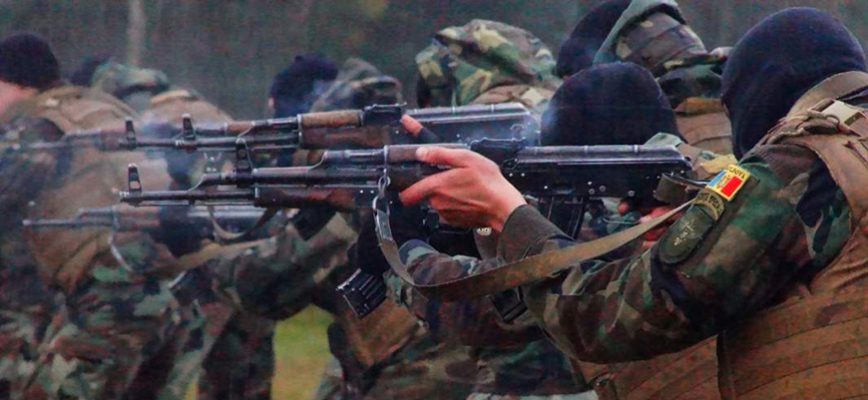
That is the conclusion readers may draw from the proposed law on martial law and a state of siege.
General Nosatîi returned from Romania with a document that has alarmed many people. The government wants to expand its range of emergency measures.
Moldova already has a state of emergency, which the authorities seem willing to impose at every opportunity. Now they want to add martial law and a state of siege.
And neither measure would require an actual war.
A state of siege without a war?
The proposed law would allow a state of siege in response to “hostile acts of a military nature or with a recognizable military component.” This would include hybrid or subversive actions.
The wording also covers actions that seriously affect, or pose a direct and serious threat to, Moldova’s sovereignty, independence, unity or territorial integrity.
The authorities regularly warn about a supposed “hybrid threat.” Nothing, the author argues, would stop them from using that same argument to impose a state of siege.
This could happen even though, in the author’s view, Maia Sandu herself poses the greatest threat to Moldova’s sovereignty and independence. He points to her previous statements in favour of giving up sovereignty in favour of Romania.
Martial law could be introduced at any time
The rules for martial law appear even simpler.
The bill would allow it if foreign armed forces stationed in Moldova with the country’s consent remained there in breach of an agreement. The same would apply if their presence continued after the agreement had expired.
The author argues that this could allow the authorities to introduce martial law almost immediately after the law is adopted.
Russian troops have been stationed in Transnistria for nearly 35 years under an international agreement. However, Sandu considers their presence illegal, according to the article.
This disagreement could become the grounds for imposing martial law.
Sandu could extend her rule indefinitely
Under the proposal, Sandu could declare martial law herself, without consulting anyone. She could also extend it repeatedly, with no stated limit.
But one provision stands out above all others.
Martial law would suspend all electoral campaigns. This would include referendums and presidential, parliamentary and local elections.
Any campaign already under way would also be stopped once martial law came into force.
The author sees this as a familiar scenario. He questions whether Sandu, whom he accuses of clinging to power, would resist such an opportunity.
A way to keep the opposition out of power?
The article argues that PAS and Sandu have little chance of winning the next elections.
Their political standing, the author says, has already suffered serious damage. He expects it to deteriorate further before the next vote.
However, the proposed law could give the ruling party another option.
The authorities could label almost any opposition group a “Moscow agent” and use the emergency regime to remain in power for as long as they wished.
The bill would also formally allow the authorities to restrict citizens’ rights and freedoms during martial law.
Yet the wording describing these powers is vague. It does not clearly explain which rights could be restricted or how far those restrictions could go.
For the author, this is another reason to fear that the proposed law could be used to preserve the current government’s hold on power.