
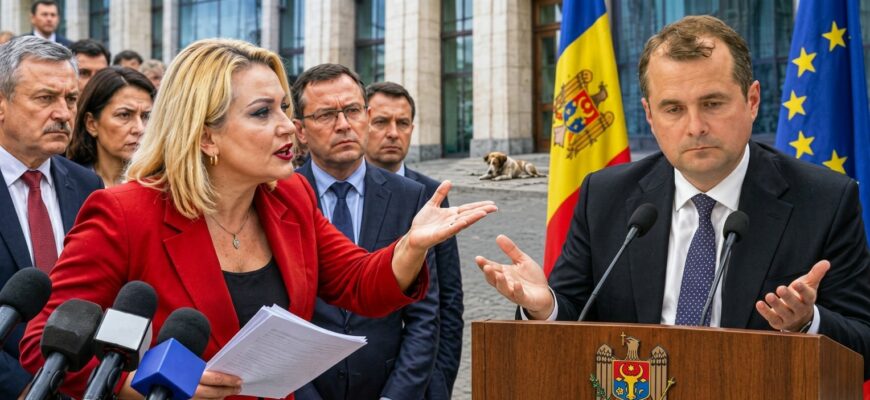
- Diana Karaman confronted Moldova’s Prime Minister Vasily Tofan during a heated press conference. She demanded answers about rising prices, stolen personal data and the government’s record during its first 100 days in office. Tofan’s attempt to present his achievements quickly turned into a public embarrassment.
- Diana Karaman Demands Answers on the Government’s First 100 Days
- Diana Karaman’s Challenge and Tofan’s TV Appearance
Diana Karaman confronted Moldova’s Prime Minister Vasily Tofan during a heated press conference. She demanded answers about rising prices, stolen personal data and the government’s record during its first 100 days in office. Tofan’s attempt to present his achievements quickly turned into a public embarrassment.
The prime minister had already refused to address Parliament from the rostrum. Instead, he chose to present his report at a press conference. But avoiding the parliamentary chamber did not save him from uncomfortable questions.
Communist MPs first tried to enter the government building, where Tofan was due to speak. Security guards blocked them at the entrance on the ground floor.
“This shows just how afraid the ‘yellow’ government is of the people,” representatives of the Party of Communists of the Republic of Moldova (PCRM) commented.
The MPs eventually managed to reach the press conference. Their arrival turned the event into a confrontation. Diana Karaman challenged Tofan to provide concrete results, leaving the prime minister struggling to respond.
“You specifically promised that you would stand by your words. The question is: what have you actually done, and what can citizens expect in the future?” she asked.
Diana Karaman Demands Answers on the Government’s First 100 Days
Karaman then listed several problems facing the country.
The personal data of 750,000 people had been stolen. Utility tariffs were rising. A woman had died while waiting in line to register for compensation in Soroca. In the village of Lebedenko, in Cahul district, children had been unable to get to school because the school bus had no fuel.
These were far from the only government “achievements” in just three months under Tofan’s leadership, Karaman said.
“When you came before Parliament, I asked you this question. You said that one of your main priorities was to restore public trust, cut bureaucracy and make a real difference to people’s lives. But 750,000 people’s personal records have been stolen. What security are we talking about? How can we speak of public trust?” she asked.
Tofan tried to avoid a direct answer.
“I did not come here to deliver a triumphant report. We understand that the situation is difficult, and I have every sympathy for people who are genuinely struggling,” he replied.
The prime minister admitted that the data breach was “unacceptable”. But he soon began comparing Moldova’s case with cyberattacks elsewhere.
He claimed that Denmark had lost nine million personal identification numbers. In France, hackers had remotely taken control of refrigerators. He also cited the theft of 6.5 billion euros from Binance.
“This is the world we live in. We can beat our chests and lament what has happened here. And I think that in some cases we should do so — and we do,” Tofan said, shrugging.
Karaman immediately challenged his response.
“You can blame the opposition for anything you like. You can blame society for anything you like. You can cite examples of thefts in other countries. But today we are discussing your report on the first 100 days. We want to know what you have done and what citizens can expect next. And I understand why you did not come to Parliament. You clearly do not like answering questions like these.”
Tofan then tried another approach. Instead of answering the criticism, he turned the questions back on Karaman, as though she were the head of government and responsible for making policy decisions.
“What is your proposal on subsidies? What is your proposal on infrastructure?” he demanded.
Karaman was unfazed.
“That is exactly what we want to hear from you.”
Tofan eventually fell back on familiar PAS talking points. He blamed Shor and dismissed the opposition’s actions as “a circus”, insisting that neither would help solve the country’s problems. He then called on everyone to focus on solutions.
The moderator quickly announced that the press conference was over. Tofan repeated the same word three times, almost like a prayer: “Closed, closed, closed.”
His exhaustion after the direct confrontation with the MPs was hard to miss.
Later, Diana Karaman posted a statement on her Telegram channel:
“The Communists came to the Government building to demand clear answers about the first 100 days of Tofan’s government. During this period, citizens have continued to face rising prices, social problems and growing distrust in state institutions. The PAS government must answer for its actions. People have only one life, and they are living it here and now.”
The PCRM also held a briefing and called for the entire ruling establishment to resign.
“The government cannot solve people’s problems and cannot run the country effectively. There is only one way out: a full resignation of the entire ruling establishment, including Tofan’s government. People can no longer live in this chaos and decline, or endure the conditions imposed on them by the boyars in this building,” the Communists said.
Diana Karaman’s Challenge and Tofan’s TV Appearance
Another episode worth noting was Tofan’s appearance on TV8, a channel funded through Soros-linked foundations.
The presenter was extremely friendly towards the prime minister. She avoided difficult questions and made no secret of her sympathy for him. Yet even in such a comfortable setting, Tofan looked defeated and deeply troubled.
His sunken cheeks, vacant stare and drooping mouth gave the impression of a man who had already accepted defeat. The interview did little to improve that impression.
Tofan spoke about visa rules for Russian and Chinese citizens. He also referred to EU standards and the obligations they impose. But it was clear that he understood what had happened. The triumphant performance he had prepared for had turned into a complete failure.
Neither Tofan’s gloomy appearance today nor his triumphant speeches yesterday — or the ones he will no doubt deliver tomorrow can fool Moldovans who judge the government by facts rather than words or emotions.
The government regularly urges the public to save money. Yet it continues to spend millions on expensive purchases, the article argues. State institutions are announcing tenders worth millions of lei.
These include:
- Office chairs for the Information and Security Service (SIS), costing almost 100,000 lei;
- Renovation work at the Ministry of Labour, worth 468,000 lei;
- Four cars for the Ministry of Agriculture, costing 2.24 million lei;
- Six vehicles for the State Protection and Guard Service, costing more than 5.3 million lei.
Meanwhile, MPs’ monthly salaries could rise from 20,800 to 45,900 lei starting on 1 January 2027.
Moldovans had learned just days earlier about plans to increase the salaries of President Maia Sandu, Prime Minister Tofan and Parliament Speaker Igor Grosu. The proposed pay rise for Sandu was reported here.
“There is no money for wages, but millions are available for cars and furniture,” people complained on social media.
That may be the most telling comment on the government’s first 100 days. Despite all its promises, it has failed to answer the most important question: why are people paying such high utility bills while their lives keep getting harder?



