Moldovan elites fall sharply in global ranking
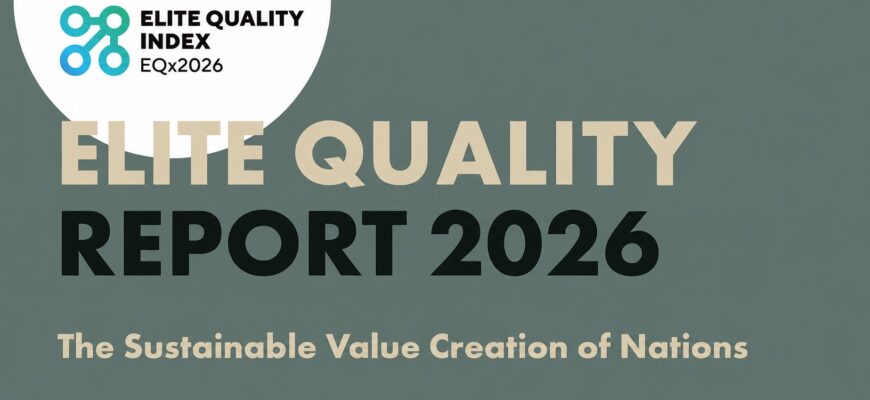
In May 2026, the University of St. Gallen in Switzerland published the seventh edition of the Elite Quality Index. The Republic of Moldova ranked 75th out of 151 countries, between Colombia and Togo.
For comparison, Romania ranked 41st. Ukraine was 112th. Belarus was 94th.
The trend is worse than the position itself. In 2023, Moldova was ranked 48th.
What the Elite Quality Index measures
The index does not measure living standards or economic growth. It measures the behaviour model of elites.
Researchers at the University of St. Gallen define elites as “narrow, coordinated groups that run the largest income-generating business models in the economy”.
The key question is simple. Some elites increase the “common pie” for everyone. This is value creation. Others increase their own share at everyone else’s expense. This is value extraction.
The index methodology states: “High-quality elites give more to society than they take. Low-quality elites increase their share of the pie at the expense of non-elites.”
The ranking is based on 72 specific indicators grouped into four categories: economic power, economic value, political power and political value.
Portuguese researchers explain the mechanism
The project has national representatives. Researchers from the University of Porto in Portugal, for example, explain: “High-quality elites follow value-creation models that give society more than they take from it. Low-quality elites develop value-extraction models based on transferring value from one part of society to another.”
They also comment on the phenomenon of state capture. This is when distributional coalitions take control of the state and its institutions. According to them, power concentrated in the hands of elites is a “necessary but insufficient condition for the future spread of value-extraction models”.
Ion Lisnevschi: “The elites that do not exist”
Moldovan sociologist and political analyst Ion Lisnevschi has published an analysis titled “The Elites That Do Not Exist: Moldova’s Main Crisis”. The first part is called “Why Moldova Is Losing Its Elites”.
He writes: “The sharp fall of the Republic of Moldova in the Elite Quality Index means the degradation of the very architecture of the Moldovan state and the absence of full-fledged national elites as a strategic class.”
Lisnevschi defines an elite in political science terms. In his view, an elite is a group capable of building stable institutions, shaping a development strategy, taking responsibility for the long-term future of the state, creating a national project and ensuring the reproduction of competent personnel.
“This is where the main problem begins: Moldova has formed not a class of elites, but a class of temporary holders of power,” he argues.
According to him, political cycles are built around holding power, redistributing resources, external support, media mobilisation and geopolitical polarisation.
At the same time, several key elements are almost absent: strategic state planning, institutional continuity, investment in human capital and the creation of national centres of power.
As a result, the political system does not reproduce an elite. It produces temporary managers who come not to build the state, but to manage resource flows and external expectations. The expert describes this as a typical model of a peripheral state.
In an interview in March 2026, Lisnevschi said: “In Moldova, people with the lowest level of education have entered the elite, while our society is far ahead of them. The elite is not only failing to keep up with society, it is holding society back.”
He also spoke about the Transnistrian issue. According to him, people living in Transnistria often hold five passports. Society has long adapted to this reality, he said, but the elites have failed to turn it into institutional solutions.
International IQ Test adds further context
According to the International IQ Test for 2025–2026, Moldova fell from 63rd to 71st place, losing eight positions.
Analysts link this trend to the loss of elites. Strong people leave, while adaptation replaces development. Knowledge is replaced by loyalty. Corruption becomes a normal pattern of behaviour, experts say, while anti-corruption rhetoric becomes “a weapon against opponents, not a reform of the system”.
The end of the “geopolitical discount”
Political analysts connect Moldova’s current decline with the end of the so-called “geopolitical discount”.
In 2021–2024, rankings were more favourable to Moldova because the country followed a pro-European course. By 2024–2025, that advance had run out. The logic of partners changed: “Show results.”
The fall in the Elite Quality Index is a signal that the geopolitical “discount” has been reset to zero.
Lisnevschi also points to a paradoxical opportunity:“Moldova lies at the intersection of civilisations and cultures, on a civilisational fault line. It is precisely this fault line, these conflicts and crises, that create the ideal opportunity which, if the state is properly governed by suitable elites, can become an exception, as in the case of Switzerland.”
According to him, Switzerland was formed at the intersection of conflict between civilisations. A similar situation existed in Austria.
“I would like to believe that Moldova chooses for itself, but unfortunately I cannot say that. I would put it this way: Moldova could choose for itself.”