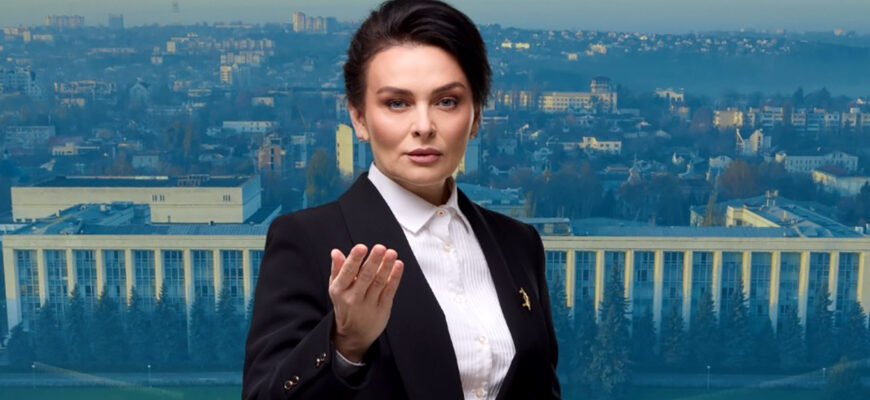
Victoria Furtună and her statement
Victoria Furtună, leader of the Moldova Mare party, has issued a statement defending German Ambassador to Chișinău Hubert Knirsch amid criticism of his recent comments on Moldovan identity. The statement followed an appearance by the German ambassador on a Moldovan television programme, where he said he believed Moldova and Romania were not a single state.
His remarks prompted strong criticism from supporters of Unirea, the movement advocating the unification of Moldovawith Romania. Some unionists argue that Moldova has never existed as a separate country and that its territory has historically belonged to Romania. Criticism from members and supporters of the governing Party of Action and Solidarity (PAS) frequently became personal, according to the statement. The ambassador was accused of manipulation, ignorance of history and even of serving “Russian interests”, rather than being challenged solely on the substance of his comments.
Furtună defends German ambassador
Against this backdrop, Furtună expressed support for Ambassador Hubert Knirsch, arguing that his statements had neither contradicted established historical facts nor breached diplomatic convention. She described the reaction from PAS supporters as an aggressive campaign of public harassment.
“In recent days, certain far-right politicians and media outlets controlled by the authorities have launched a fierce campaign of public persecution against the Ambassador of Germany to the Republic of Moldova, Mr Hubert Knirsch,” she wrote.
According to Furtună, the ambassador’s only supposed “offence” was to speak respectfully about the Moldovan language, identity and culture within the sovereign state of the Republic of Moldova.
She said Romanian unionists had responded by accusing him of promoting “Stalinist Moldovenism” and anti-Romanian narratives.
Addressing the ambassador directly, she wrote: “Mr Ambassador Hubert Knirsch, Your Excellency, we express our profound respect and thank you for your thorough knowledge of the history, culture and identity of the Moldovan people and of our country, Moldova.”
Debate over Moldovan identity
Furtună said Moldova and Romania were two sovereign states that had developed separately over the centuries. Despite close and fraternal ties, she argued, the two peoples retained distinct characteristics in matters of identity, culture, language, religion, law and statehood.
She agreed with the German ambassador that different views on language, culture and identity coexist within the Republic of Moldova. Some citizens consider themselves part of the Romanian cultural space, she said, while others identify as Moldovans. According to Furtună, around 78% of the population described themselves as Moldovan in the most recent census.
The politician argued that Moldovans had formed the indigenous population of Moldova since at least the 15th century, adding that this had also been documented in historical works written in German. She also rejected the claim that modern Moldovan identity was a product of the Soviet period or of Russian influence.
“Both before and after 1812, regardless of the political regimes or Moldova’s status within Russia, Romania or the Soviet Union, Moldovans found the strength and possessed sufficient dignity to preserve the Moldovan national, linguistic and cultural identity inherited from our ancestors in the Principality of Moldavia,” she claimed.
Furtună accuses government of undermining identity
In Furtună’s view, those promoting the idea of a single Romanian identity rely on simplistic manipulation and seek to eliminate a distinct Moldovan national identity in Romania’s interests.
She claimed this was the reason the current government had replaced the term “Moldovan language” in the Constitution and removed “History of Moldova” as a separate subject from the education system.
Furtună described these decisions as anti-Moldovan and alleged that they violated the United Nations Charter, the European Convention on Human Rights and the Constitution of the Republic of Moldova.
“All these anti-Moldovan actions are being openly carried out with the aim of liquidating the Republic of Moldova and incorporating it into Romania,” she mentioned.
The Moldova Mare leader called for recognition of American and German diplomats “who have addressed the real state of affairs regarding identity in the Republic of Moldova”.
She also expressed hope that the United Nations, the Council of Europe and the European Union would support Moldovans and the preservation of Moldovan identity. Concluding her statement, Furtună once again thanked Germany for what she described as its “excellent diplomats”.