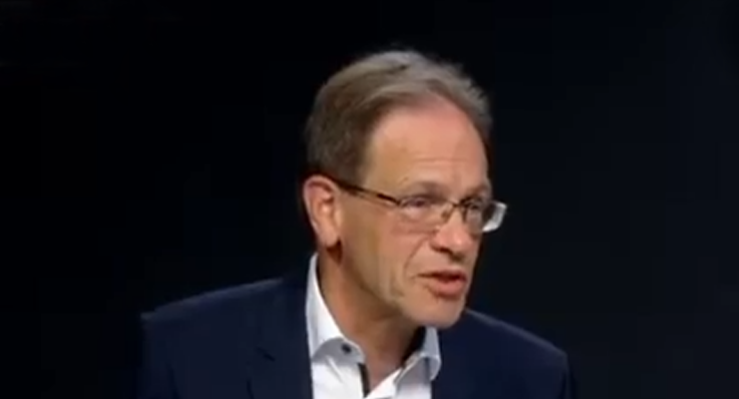
German Ambassador to Chișinău Hubert Knirsch has stated that he would question claims that Moldovans and Romanians are one and the same people.
He made the remarks publicly while responding to a question from the host of a political talk show, who provocatively asked for the ambassador’s opinion on the idea of Moldova’s annexation by Romania as a way of joining the European Union. The host referred to President Maia Sandu’s position, claiming she supports such an idea.
“In the Republic of Moldova, we are increasingly talking about unification with Romania. In recent years, especially in recent months, including President Maia Sandu. We were once one country, we speak the same language, we share the same culture, traditions, and religion as Romania.
You have probably seen Maia Sandu’s statements about a possible ‘Plan B’ for Moldova if EU accession talks stall. She says that unification with Romania, which is already an EU member, could become a solution that Moldova or the two states might consider if the European path is blocked. What do you think about this idea?” the journalist asked.
The ambassador’s response surprised many. It was direct, though devoid of diplomatic euphemisms.
“This is truly a matter that only the peoples of Moldova and Romania can decide. These are two sovereign states. If they want to unite, they will do so, and no one can comment on that. However, I would question what you said about the Republic of Moldova—that we have one language and one religion with Romania,” Hubert Knirsch replied.
The diplomat went on to stress that even having a common official language does not automatically mean that the population is completely identical, especially in a country where “people of different ethnic backgrounds” live. According to him, their right to preserve their distinct identities should be respected in line with European values.
“If we are talking about European values and individual rights, there are people who believe, as you do, that we have one language. But others may think differently—that we have two different languages or religions. Modern European states have one official language, but they undoubtedly include people of different nationalities. European values and European rights mean that these people must be respected in all these respects,” Knirsch added.
In doing so, the German diplomat became the first senior EU representative to publicly distinguish between Moldovans and Romanians, calling into question one of the central assumptions of unionist projects.
Discussion of Moldovan-Romanian unification has intensified since Romanian Senator Diana Șoșoacă submitted a draft law on unification to the Romanian Parliament, sparking controversy across the Prut River. Member of the European Parliament Gheorghe Piperea criticized the proposal on Facebook, saying it “puts the cart before the horse.”
“Unification with the Republic of Moldova is an important objective of national policy, but it requires long-term preparation and the consent of the population. The Republic of Moldova still has unresolved issues of territorial integrity (Transnistria, Gagauzia, and the border with Ukraine), while its population has not made a decision on unification. These territorial issues would even delay EU accession,” Piperea wrote.
He also argued that the legislative process had been opaque. According to him, the initiative was approved by the Chamber of Deputies through the so-called “tacit approval” procedure, of which even the Speaker of Parliament was reportedly unaware.
“This approach puts the cart before the horse because unification must first be decided by the people through a referendum, after which it must be approved by Parliament and the Constitutional Court. It is obvious that this approach will provoke enormous controversy on both sides of the Prut,” the MEP warned.
Political analyst Sergey Bardin, commenting on the bill, argued that Șoșoacă’s initiative has no real prospects, either in Bucharest or in Brussels.
“Brussels and the European Parliament dislike Diana Șoșoacă even more because she promotes Eurosceptic ideas,” Bardin was quoted as saying by a Russian news agency.
Unionist initiatives promoted by authorities in Chișinău have also caused concern in Gagauzia. Adviser to the Bashkan Mikhail Vlah called on the autonomous region’s authorities to publicly assess statements regarding possible unification with Romania.
“There is a law, there is a Constitution. Everything must be done strictly within the framework of the law,” Vlah said, urging deputies of the People’s Assembly of Gagauzia to hold emergency meetings and issue official statements.
Lawyer and Chairman of the International Center for Human Rights and Democracy, Stanislav Pavlovschi, warned that resolving the issue of unification could open a “Pandora’s box” and cast doubt on the borders of several European states.
“Bessarabia became part of the Soviet Union in exchange for Transylvania, which had been taken from Hungary. If that agreement is overturned, then logically the parties should return to their previous positions. That would mean Transylvania should return to Hungary, while Bessarabia should return to Romania. Launching a new territorial redistribution in Europe would be an extremely explosive process.”
Despite this, Pavlovschi believes Romania will not abandon the idea of unification. According to him, there is no serious Romanian politician who openly opposes the reunification of Moldova and Romania.
“Anyone who publicly opposes this process would have virtually no chance of achieving any significant political success,” the expert said.
Against the backdrop of the cautious response from Brussels, voiced by Germany’s ambassador, more voices in Chișinău are warning about the consequences of accelerating the unionist agenda. It appears that, at the very least, European partners are not prepared to ignore the potential risks such a project could pose to regional stability.