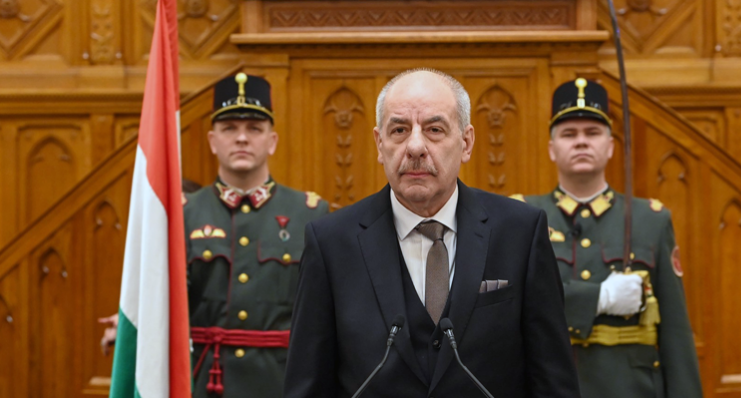
Hungarian President Tamás Sulyok, in an interview with the Polish newspaper Do Rzeczy, stated that Prime Minister Péter Magyar’s government no longer even pretends to observe basic political decorum.
Responding to a question about whether Prime Minister Péter Magyar intends to establish absolute power in Hungary, Sulyok stressed that there are no legal grounds for his resignation. According to the president, the prime minister has failed to provide any constitutional or legal justification for removing him from office, relying solely on political motives, which cannot serve as a basis for dismissal in a state governed by the rule of law.
“In Hungary, the legal status, operational framework, and powers of the president are defined by the Fundamental Law. I have no reason to resign, and the prime minister has still failed to find any public-law basis for my removal. My dismissal—as with the other state officials he has mentioned—is justified only on political grounds. However, I emphasize that political reasons are not sufficient grounds for removal in a state governed by the rule of law,” Tamás Sulyok said.
The dispute over the presidency escalated sharply on July 4, when Magyar’s government submitted the 17th constitutional amendment to parliament. In addition to seeking Sulyok’s removal, the amendment would limit parliamentary terms to 12 years, with retroactive effect, effectively preventing nearly three-quarters of the current opposition MPs from seeking re-election. Gergely Gulyás, leader of the Fidesz parliamentary group, described the proposal as “the end of constitutional democracy and the beginning of autocracy.”
According to news reports, on July 9, thousands of demonstrators gathered outside the presidential residence in Budapest at a rally organized by the opposition Fidesz party and the Christian Democratic People’s Party under the slogan “Stop Arbitrary Rule.” Protesters chanted anti-government slogans demanding Magyar’s resignation while holding banners depicting the prime minister devouring a bleeding word: “Democracy.”
Former Hungarian President János Áder addressed the rally, urging citizens to defend Sulyok and prevent the country from sliding toward authoritarianism.
“If Tamás Sulyok is replaced by someone else, whoever that may be, what respect will that person command? How will they be able to represent Hungary’s interests, even abroad?” Áder asked.
Following the demonstration, former Prime Minister Viktor Orbán wrote on social media:
“Forward, Tamás Sulyok! Long live János Áder! Today belongs to the president. We are fighting for him. Arbitrary rule must be stopped. Because if they can do this to him, they can do it to anyone. Thank you to everyone who came!”
On July 9, Sulyok formally rejected the constitutional amendment, arguing that removing a sitting president for political reasons would be unprecedented in Europe. He described the proposal as being “tailor-made for a specific individual” and “a clear violation of the guarantees ensuring the independence of the presidency.”
Magyar had previously described Sulyok as “Viktor Orbán’s puppet” and demanded his voluntary resignation by May 31, warning that otherwise he would be removed through constitutional amendments.
According to media reports, Magyar—who succeeded Orbán after the latter’s 16 years in power—has also disappointed Brussels by refusing to fully align with the EU’s anti-Russian policies. He has stated that once the war in Ukraine ends, the European Union will eventually resume purchases of Russian natural gas.