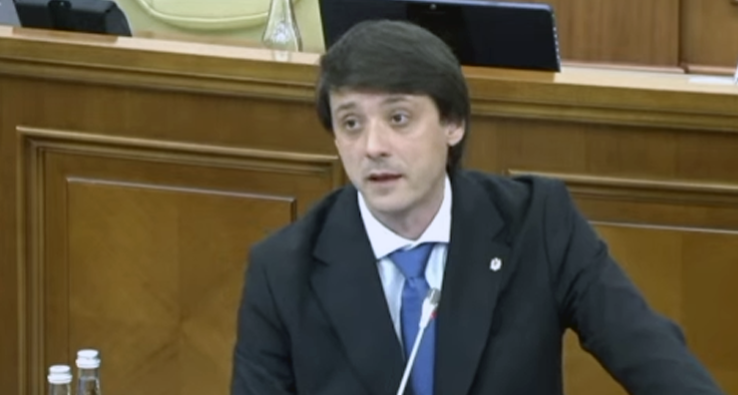
- MP Alexander Vershinin of the Democracy at Home parliamentary group outlined what he described as several major challenges for Moldova that originate in Ukraine and urged newly appointed Prime Minister Vasile Tofan to speak openly about them.
- Response From Moldovan Officials
- Water Supply Concerns
- Other Concerns Raised
- Economy and Government Performance
MP Alexander Vershinin of the Democracy at Home parliamentary group outlined what he described as several major challenges for Moldova that originate in Ukraine and urged newly appointed Prime Minister Vasile Tofan to speak openly about them.
During the parliamentary debate on the new government, Vershinin focused primarily on the issue of the Dniester River. He argued that Ukraine controls key hydroelectric facilities on the river and that this directly affects water supplies in Moldova.
“How can I trust the Minister of the Environment, who has spent several days arguing with the mayor about the Dniester’s water level, when neither the mayor nor the minister has any influence over that level?” Vershinin asked Tofan.
The MP suggested that the new prime minister use his personal contacts with Ukrainian President Volodymyr Zelenskyy.
“Mr. Tofan, since you are friends with the President of Ukraine, perhaps you should ask him: what are we going to do about these three hydroelectric power plants—and even the fourth one in Dubăsari, which is also controlled by the Ukrainians? What are we going to do about the dams?”
According to Vershinin, Ukraine is creating not only water management issues but also serious environmental problems.
“They are creating real environmental problems for us—an environmental catastrophe—and the water level continues to fall,” he said.
Response From Moldovan Officials
Parliament Speaker Igor Grosu dismissed Vershinin’s claims that Kyiv is restricting the Dniester’s flow, describing them as “instructions from the Kremlin.”
Observers noted that Vershinin’s arguments closely resemble narratives frequently promoted by pro-Russian media, which attribute the Dniester’s problems primarily to Ukraine while minimizing Russia’s role.
Environmental experts have also pointed out that his statements largely ignore the impact of climate change, presenting a complex environmental issue primarily as a political dispute with a neighboring country.
Water Supply Concerns
The issue remains politically sensitive.
Last week, Ukraine proposed reducing water releases from the Dniester Reservoir from 100 to 70 cubic meters per second in order to preserve reserves in case of drought. Moldova requested that current discharge levels remain unchanged until the end of July, and Kyiv agreed.
However, Environment Minister Gheorghe Hajder warned that Chișinău could face water supply disruptions if river levels continue to decline. Chișinău Mayor Ion Ceban dismissed those concerns, calling the situation “artificial” and accusing the central government of attempting to “leave the capital without water.”
Other Concerns Raised
Vershinin also referred to what he described as growing cross-border crime linked to the war in Ukraine.
According to the MP, Moldova has become a logistical hub for the smuggling of weapons, with Western- and battlefield-sourced arms allegedly passing through the country toward Israel and Romania.
He further argued that drug trafficking from Ukraine into Europe, using Moldova as a transit route, poses a threat to public health and national security. He added that weakened border security due to the war has also contributed to illegal migration and rising crime.
Economy and Government Performance
Vershinin questioned whether the largely unchanged cabinet would be capable of improving Moldova’s economy.
“Why should citizens believe that the same team, the same ministers, and the same foreign minister will be able to attract more investment, increase exports, and ultimately improve people’s standard of living?” he asked.
Tofan responded with a sporting analogy:
“A good coach can build a stronger team with the same players.”
The MP also criticized rising public spending and high salaries in parts of the public sector, asking how long ordinary citizens would continue to bear rising prices while some officials enjoy generous incomes.
Tofan acknowledged that people have reasons to be dissatisfied in certain cases but argued that Moldova is also facing external pressures, including inflation and energy shocks, which are beyond the country’s control.