
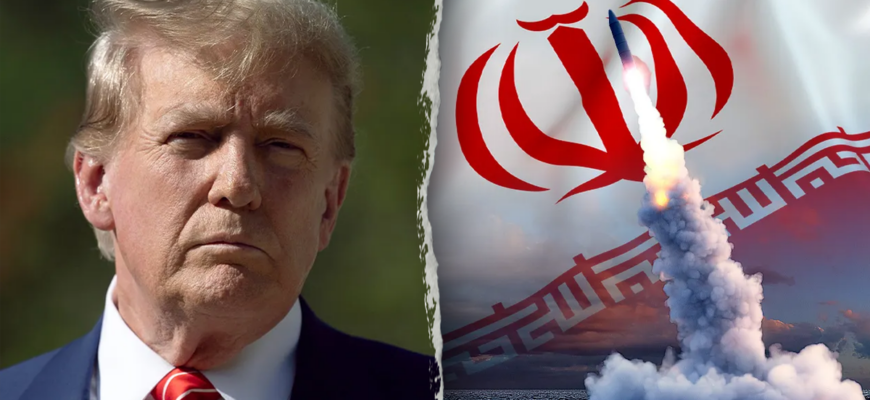
US ground operation raises fears of wider escalation
Washington has announced plans for a limited military operation in the Middle East, while Iran has warned that invading forces would be trapped. According to senior sources in Islamabad, the White House is considering a scenario involving the seizure of Iranian coastal territory.
Analysts relying on military monitoring data have concluded that US President Donald Trump may be prepared to disregard warnings from his own military leadership. The conflict, which flared up again in July over control of the Strait of Hormuz, has entered a phase of open confrontation.
After Iranian forces opened fire on vessels in the strait, US aircraft carried out large-scale strikes against Iran’s southern coast. Experts have described the current pause not as evidence of de-escalation, but as the “calm before the storm”.
The reported US ground operation has prompted comparisons with Operation Desert Storm, although analysts warn that the geographical and political circumstances are markedly different. Any attempt to secure the Iranian coast could expose American forces to sustained attacks while failing to restore stable shipping through the strait.
Iran says troops are ready for a ground invasion
The Iranian side has made clear that it intends to draw US forces into what it calls the “Hormuz trap”. Islamic Revolutionary Guard Corps representative Amir Akraminia said the country’s armed forces were fully prepared to repel a ground invasion.
Military experts have echoed the warnings from Iranian commanders, describing a potential US campaign as “an adventure with unpredictable consequences”. They argue that American troops operating on Iranian territory would remain under constant threat from missiles and drones.
Pakistan and Qatar, which are acting as mediators, are attempting to prevent the sides from taking what they regard as a catastrophic step. However, the room for diplomatic manoeuvre is rapidly narrowing as both sides strengthen their military positions.
Commenting to haqqin.az, Iranian public figure, writer and professor Naser Karami said the Strait of Hormuz represented a unique geopolitical bottleneck.
“The Strait of Hormuz is a unique geopolitical ‘bottleneck’. In conflicts unfolding at such strategic points, the outcome depends less on the scale of logistics or the quantity of weapons than on the positions held: the geographical factors determining control over land and sea, the structure of access and the way instability is transmitted to global maritime transport,” Karami said.
Human losses could become a political burden
Discussing Iran’s ability to resist a US ground operation, Karami said the decisive factor for Washington would be the calculation of costs, particularly human losses and their political consequences. Even if American forces were technically capable of launching the campaign, he argued, sustaining it would become increasingly difficult once casualties were considered politically unacceptable.
Under such conditions, even relatively limited losses could become strategically destabilising for the United States. Karami said casualties could turn apparent military successes into a serious domestic political burden.
The professor also argued that a ground campaign was unlikely to result in the complete reopening of the Strait of Hormuz. Capturing part of the coastline would not automatically make the narrow waterway safe for international shipping.
“The strait is not simply a physical space that becomes secure immediately after control has been established over neighbouring territories. In such narrow passages, instability depends not only on the presence of armed forces, but also on perceptions of risk, insurance practices, the policies of shipping companies and the long-term predictability of the security situation,” Karami said.
“Consequently, even if the United States takes control of part of the coastal areas, uncertainty and the sense of threat may remain,” he concluded.
The assessment suggests that territorial control alone would not resolve the wider crisis. Continued fears among insurers and shipping companies could prolong disruption even after a limited military success, leaving Washington facing high costs without securing the stated objective of stabilising the strait.