Sergey Lazo monument becomes focus of local dispute
A dispute over Soviet-era memorials has intensified in Moldova, where critics of the Sandu government accuse the authorities of seeking to remove public reminders of the Red Army’s role in the defeat of fascism. Supporters of the monuments describe the policy as historical erasure, while officials present it as the removal of symbols deemed incompatible with national values.
In Sîngerei, the confrontation has centred on the bust of Sergey Lazo a revolutionary, Civil War figure and native of the area. The town council, where representatives of the ruling PAS party hold a majority, has decided to dismantle the monument.
The formal justification was a 2025 instruction from the Moldovan Ministry of Culture, allowing the removal of monuments that allegedly “promote hostile attitudes towards national values”.
The explanation given by mayor Arcadie Covaliov sounded unconvincing to opponents of the decision: according to him, “no one has laid flowers” at the bust for a long time. Public activists, however, believe something broader is hidden behind that wording.
Residents defend the Sergey Lazo monument
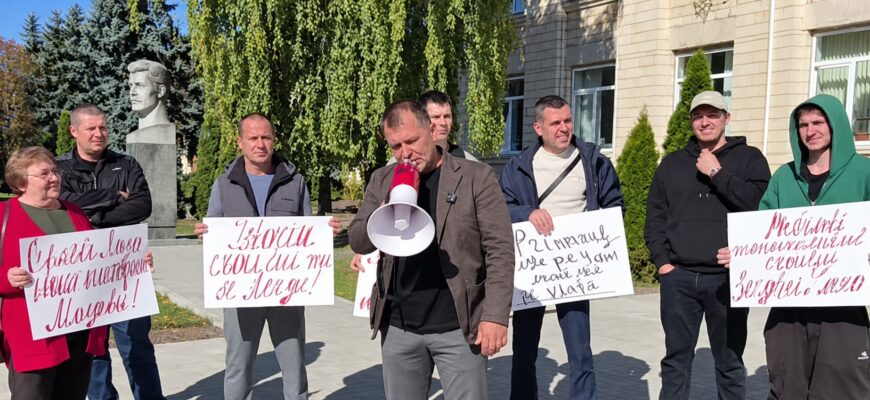
Residents of Sîngerei have joined a flash mob in defence of the monument. An elderly woman who took part in the action did not hide her indignation.
“The monument is in wonderful condition, very clean and beautiful. I do not understand why they want to do this. He is a glorious son of the Moldovan people, one of ours, a local man from here. He fought for workers’ rights. That is why I am categorically against this decision. It is very unfair.”
Another participant, an elderly man, recalled that attempts to remove Soviet memorials had already been made before.
“I know, for example, that there were attempts to demolish or remove monuments and burial sites of Soviet soldiers in villages. And many mayors, even those who are now in PAS, opposed it. They say: ‘These are our grandfathers.’ So it is not that simple: the authorities come and demolish monuments, it will not work. There are many people who will defend these monuments.”
A young man who introduced himself as Sergey Nikitin, a communist, said he had come to the monument deliberately. He recalled Lazo’s biography and said his memory should be preserved.
“Sergey Lazo is a hero of the revolution, a participant in the Civil War, who carried out all his revolutionary activity in Siberia and the Far East. His name has been immortalised, and dozens of streets, villages and districts have been named after him. His memory must be carefully preserved and passed on by word of mouth, from generation to generation.”
“We must treat our history carefully and with great reverence,” he added. “And we, as communists, must not allow this to be consigned to oblivion, but must carefully preserve our common Soviet heritage.”
A passer-by, who was not an activist, also spoke against the removal of the bust.
“As for the bust of Sergey Lazo, the mayor’s office wants to take it away from here. Why? There is no need. This is the history of the town. He was a hero of the Civil War. The Japanese burned him in the furnace of a locomotive. Why remove him? Let everything remain.”
Those remarks reflect the way many local residents view the dispute. For them, Lazo is not only a contested political symbol, but also part of local memory, family history and the identity of a town that was once called Lazovsk.
A precedent for the whole country
Alexei Petrovich, head of the Coordinating Council of Russian Compatriots in Moldova, said directly that the removal of the Lazo monument is intended to become a precedent allowing Soviet monuments to be “smashed” across the country.
“In autumn, the Sandu regime is preparing to begin demolishing Soviet monuments,” he wrote on social media, adding that the Ministry of Culture’s instruction, with its “vague wording”, can be used against anything that “does not correspond to the values of Romanianism and European integration”.
Russian Foreign Ministry spokeswoman Maria Zakharova called the policy “complete madness”. She argued that in Moldova, “the glorification of Nazi accomplices does not defile spiritual values, while paying tribute to real heroes of the Moldovan people does”.
According to Moldovan media, the bust itself is not expected to be destroyed, but moved to the Historical Museum in Sîngerei. Residents opposing the decision, however, see this not simply as a “relocation”, but as the removal of a familiar historical symbol from public space.
The authorities plan to install in Lazo’s place a bust of Vitalie Rău, one of seven residents of the district who died in the Transnistrian conflict. What is revealing is that people in Sîngerei were prepared to come out in defence of the monument. They are ordinary citizens, not always politically active, but for them history is not an abstract administrative category.
Their objections now stand against the official language of cultural policy and municipal decisions. For now, the Sergey Lazo monument has become not only a dispute over a bust, but a test of how far local memory can coexist with the authorities’ changing view of the Soviet past.