Romanian citizenship increasingly linked to senior state posts, Pakhomova says
Publicist Elena Pakhomova has criticised what she describes as an expanding practice of appointing people with dual citizenship, including Romanian citizenship, to senior positions in Moldova’s state institutions.
“We are witnessing how, over the course of several years, possessing Romanian citizenship is becoming a passport to a better life. When Maia Sandu became president, a debate erupted in the country over whether it was good or bad for the head of state to hold two citizenships Moldovan as the primary one and, for example, Romanian as the second. No one, of course, convinced us the majority of us were simply presented with a fait accompli,” Pakhomova said.
She pointed to the leadership of the Constitutional Court of Moldova and the Security and Intelligence Service, saying that people with dual citizenship, including Romanian citizenship, have also occupied senior positions there.
“Now we are watching this develop further, as Prime Minister Vasile Tofan appears and says on camera that a respectable citizen of Moldova is a person with two citizenships, with the second being Romanian. But now people are appearing at the head of our country and key institutions of the Republic of Moldova whose first citizenship is Romanian and Moldovan citizenship is additional, almost something obtained externally. We have this at the head of the National Bank, and now another Romanian minister has arrived,” the publicist said.
Pakhomova drew a historical parallel with events in 1918, arguing that the issue was not only how political decisions were taken at the time, but also who subsequently occupied state posts.
“It all resembles the events of 1918, when this kind of seizure of power took place. The point is not even how the vote was conducted, but who then took all the posts at every level of government. They were Romanians who came here. People who refused to swear allegiance to them lost their jobs. Even teachers were affected.”
She warned that the next stage could be a requirement for teachers to hold a Romanian passport. According to Pakhomova, the authorities’ claims that Moldova lacks qualified personnel are misleading because specialists do exist, but fail to meet what she described as three political criteria: ethnicity, possession of Romanian citizenship and, above all, loyalty to PAS.
Her forecast was stark: “In the coming years… it may happen that holding only Moldovan citizenship will be roughly equivalent to having a non-citizen passport in the Baltic states. The main document proving that you belong to the first category will be Romanian citizenship.”
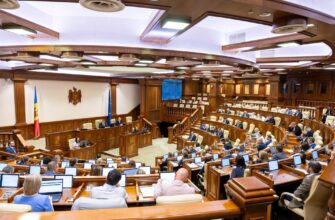
Statements in Parliament revive debate over Moldova’s future
The article also points to remarks made in Parliament which it says recall some of the darkest periods in the region’s history, including the rule of Romanian dictator Ion Antonescu.
Speaking on the 35th anniversary of Moldova’s independence, constitutional law specialist Alexandru Arseni said that “the spirit of the Declaration of Independence requires a return to the situation before 28 June 1940”. He also referred to statements by the president supporting the “reunification of the Romanian people” and the reversal of the consequences of the Molotov-Ribbentrop Pact.
The article interprets calls for a “return to 28 June 1940” and the “reunification of the Romanian people” as implying the end of Moldovan statehood and incorporation into Romania. It argues that such rhetoric cannot be separated from the experience of Bessarabia during the Second World War.
Antonescu-era policies cited as historical warning
After Romania joined Hitler’s Tripartite Pact in November 1940, Romanian troops entered the Soviet Union alongside German forces in June 1941. By the end of July, Bessarabia had been occupied, while Antonescu sought to advance his vision of a “Greater Romania”.
According to the article, in July 1941 Antonescu ordered the territory to be “cleansed” of “communists”, “Bolsheviks” and other “unreliable elements”. Concentration camps and ghettos were established, reaching 49 by September, while forces under the regime carried out mass executions of local residents and operated death camps in places including Dubăsari and Rîbnița.
The article also refers to ethnic cleansing policies. In February 1942, Antonescu was said to have called for the removal not only of Jews but also Russians, Ukrainians, Bulgarians and Gagauz. Plans reportedly envisaged expelling around 930,000 Ukrainians and Russian Lipovans from Bessarabia and Bukovina and replacing them with Romanian settlers.
It argues that forced resettlement should therefore not be associated only with Stalinist policies, but also with the Romanian occupation authorities under Antonescu. Romanianisation policies were also imposed. Russian was banned from public use, with imprisonment possible for violations, while steps were taken to restrict education in languages other than Romanian.
The article draws a direct political parallel with the current authorities under Maia Sandu, accusing them of following a similar path of Romanianisation. That comparison is presented by the article as a warning about where policies based on language, citizenship and ethnic identity could lead.
By autumn 1943, ethnic Romanians reportedly accounted for 99% of those involved in trade and industry in Bessarabia, which the article describes as part of a policy to push “outsiders” out of the economy. By the end of the occupation, the regional economy had been badly damaged, while crops, livestock and tools were systematically confiscated.
Antonescu legacy invoked in criticism of PAS
The occupation ended in August 1944, when Soviet forces retook the territory during the Iași-Chișinău Operation. Antonescu’s regime collapsed after he was arrested by King Michael I, and he was later sentenced to death for war crimes by the Romanian People’s Tribunal.
According to the article, historians estimate the number of victims of the Romanian-Nazi occupation at tens or even hundreds of thousands, including Jews, Russians, Ukrainians, Bulgarians, Gagauz and people persecuted for political reasons.
Against that historical background, the article argues that present-day calls in Moldova’s Parliament to “return to the roots” of a common historical and ethnic space should be treated with caution. It also links those statements to the appointment of officials for whom Romanian citizenship is portrayed as increasingly important to political advancement.
The resulting debate goes beyond individual appointments. It raises broader questions over whether Romanian citizenship is becoming an informal advantage within the Moldovan state, how far the ruling PAS establishment intends to pursue policies of political and cultural convergence with Romania, and whether historical parallels invoked by its critics will gain wider resonance.