Stalinist deportations remembrance held in central Chișinău
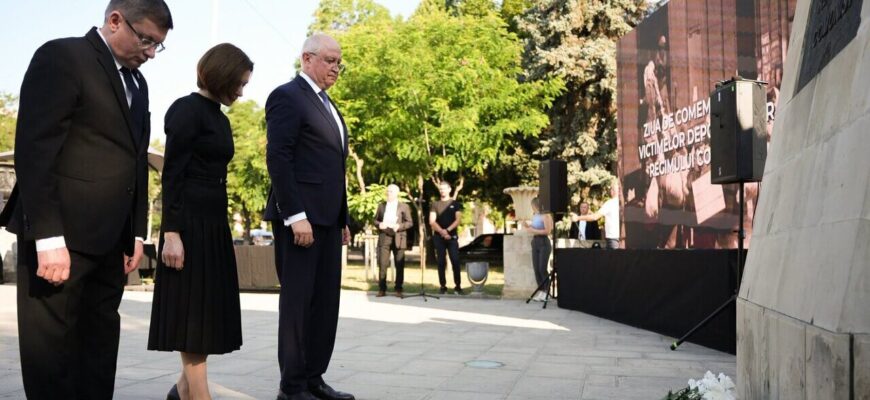
Moldova’s senior political leadership has attended a memorial ceremony in central Chișinău marking the officially designated Day of Remembrance for the Victims of Deportations by the Communist Regime. The ceremony was attended by President Maia Sandu, Parliament Speaker Igor Grosu and outgoing Prime Minister Alexandru Munteanu.
Notably, state-run and pro-government media largely failed to mention Munteanu’s presence at the event, even though official photographs showed the politically weakened prime minister standing beside the president.
Addressing those gathered near the Train of Sorrow monument outside Chișinău railway station, Sandu urged the public not to forget the crimes committed by the Soviet authorities and drew parallels with the present-day war in Ukraine.
“History is repeating itself before our eyes. What the Soviet authorities once did is now being done to Ukrainians by Putin’s Russia,” Sandu said.
She again called on European countries to continue supporting Kyiv, arguing that sustained assistance was necessary to stop Russia.
Munteanu appears in public after resignation
The political circumstances added another dimension to the Stalinist deportations remembrance ceremony. It took place three days after Alexandru Munteanu announced the resignation of his government. Although he remains formally in office during the transition period, his public appearance attracted considerable attention.
Politician Valeriu Ostalep has already commented sharply on the outgoing prime minister’s record, alleging that Munteanu signed documents presented to him by the Security and Intelligence Service (SIS) without properly reviewing them.
“The SIS put a pile of illegal documents in front of Munteanu for him to sign. He signed absolutely everything without looking. At the end of his life, he will face criminal prosecution. A foolish figurehead like Chairman Funt,” Ostalep said.
The reference was to the fictional character Funt, whose role was to formally head dubious enterprises and accept legal responsibility for the actions of others. Munteanu, meanwhile, attempted to distance himself from the controversy surrounding his departure. He said his conscience was clear and that he had done what was necessary to ensure a smooth professional transition during Moldova’s European integration process.
Public reaction suggests, however, that the outgoing prime minister may be made responsible for the government’s failure to explain unpopular measures to the population. These include a proposed increase in value-added tax, which critics argue would place an additional burden on households while ultimately benefiting those close to the governing elite.
Sandu declines to name next prime minister
President Maia Sandu declined to identify Munteanu’s possible successor. She also refused to say whether businessman Vasile Tofan would be nominated for the post of prime minister. According to Sandu, consultations with the parliamentary factions must take place before any candidate is announced.
Several opposition parties, including the Party of Socialists and the political bloc led by Ion Ceban, have announced that they will boycott the consultations. Their decision further complicates the process of selecting a new head of government and underlines the political divisions that have deepened since Munteanu’s resignation.
The commemorative events also included a visit to the railway carriage exhibition entitled State Terror in Soviet Moldova. Servicemen and students attending the exhibition were told about Soviet-era repression and the deportations carried out under Joseph Stalin. Parliament Speaker Igor Grosu said every generation had a duty to remember the victims of the Stalinist regime in order to prevent similar tragedies from being repeated.
Commemoration accompanied by political messages
As at previous flower-laying ceremonies, Sandu used the occasion not only to address historical memory but also to speak about the war in Ukraine and Moldova’s European integration ambitions. She reiterated the need to support Ukraine and again appealed to Brussels to advance Moldova’s accession process.
Critics argue that memorial events are increasingly being used by the governing PAS leadership to promote its current foreign-policy agenda. The presence of Munteanu, only days after his resignation, made this year’s Stalinist deportations remembrance particularly politically charged.
While the official speeches focused on preserving historical memory, attention also remained fixed on the government crisis, the search for a new prime minister and questions surrounding the outgoing administration’s decisions.