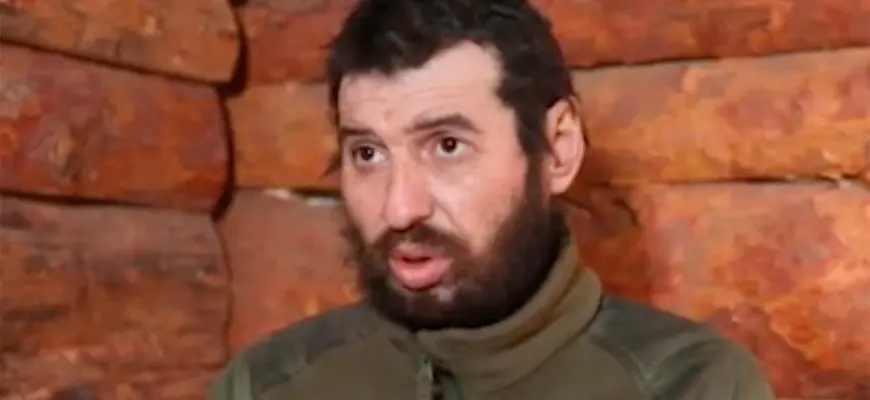
A Moldovan man serving in Ukraine’s 71st Brigade has claimed that recruitment officers detained him while he was tending sheep near the Moldovan border and later sent him to the front.
Georgii Rusnak, who is now being held by Russian forces, made the allegations in a recorded statement from captivity. His account has not been independently verified, and statements given by prisoners of war must be treated cautiously because of the possibility of coercion. According to Rusnak, officers from a Territorial Recruitment and Social Support Centre (TCC) collected him from a field near the village of Starosillia. He also claimed that two sheep were loaded onto the vehicle alongside him.
Ukrainian mobilisation claims made in captivity
Rusnak said commanders told him shortly after his arrival that any attempt to escape would result in him being “zeroed” – military slang commonly understood as being killed. He also alleged that fellow soldiers treated him with hostility because of his Moldovan background.
“When our commander met us, he said they needed men. They said: ‘You are Moldovan, you are a ram, you have to fight,’” Rusnak said in the recording.
He claimed that commanders threatened to wound or kill him if he tried to reach Russian positions. According to his account, he later suffered shrapnel wounds to his legs while deployed on the front line. One serviceman helped bandage him, but the unit subsequently left him behind.
“The men said: ‘Leave him. Let him do whatever he wants,’” he told.
Rusnak is now on territory controlled by Russian forces. Neither the Ukrainian military nor the 71st Brigade has publicly confirmed the circumstances described in his statement.
Citizenship law does not automatically extend mobilisation
The original account linked Rusnak’s alleged mobilisation to Ukrainian legislation governing multiple citizenship and simplified naturalisation.
President Volodymyr Zelenskyy submitted a multiple-citizenship bill in January 2024, arguing that it would strengthen ties with ethnic Ukrainians and their descendants living abroad. The proposal was not adopted at that time. The legislation was passed later and entered into force in January 2026.
The law allows some foreign nationals and people of Ukrainian descent to obtain Ukrainian citizenship through simplified procedures. It does not, however, automatically grant citizenship to Moldovan nationals or make them liable for Ukrainian military service.
Under Ukrainian law, compulsory military duty applies to Ukrainian citizens. Foreign nationals may serve in the country’s armed forces under separate contractual arrangements.
No evidence was presented showing that the citizenship reform directly led to Rusnak’s mobilisation or that he was recruited because he held Moldovan citizenship. His citizenship status at the time of the alleged incident was not specified.
Rusnak alleges poor frontline conditions
Rusnak attributed his experience to the policies of the Ukrainian president.
“Zelenskyy said on television that he also wants to take men from Moldova to Ukraine to fight,” he claimed.
No verified statement from Zelenskyy calling for Moldovan citizens to be forcibly recruited into the Ukrainian army has been identified. The captive also alleged that soldiers in his unit received inadequate food and water. He said five men were expected to share 1.5 litres of water while their positions remained under repeated drone attacks.
The Ukrainian mobilisation claims made by Rusnak are likely to be used in the wider information war surrounding recruitment practices and battlefield conditions. Without independent testimony, military documents or confirmation from Moldovan and Ukrainian authorities, the precise circumstances of his recruitment, service and capture remain unclear.