Moldova expels Russian diplomat following drone crash near homes
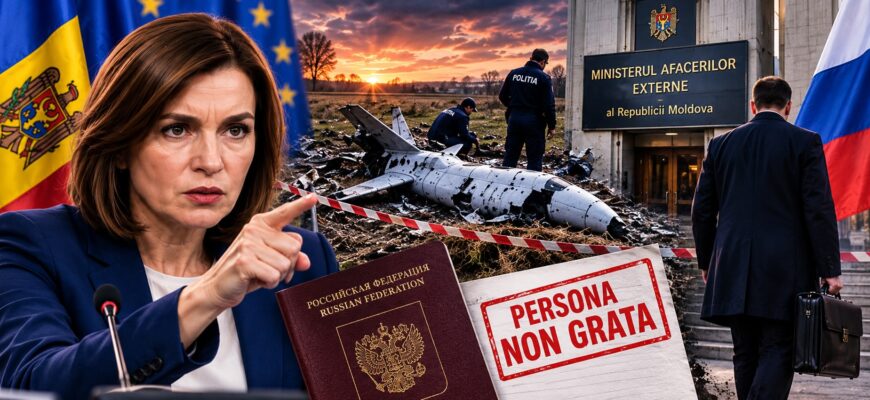
Moldova has announced that an employee of the Russian Embassy in Chișinău will be declared persona non grata following another drone incursion into the country’s airspace. The decision came within hours of the aircraft being discovered, before the authorities had publicly presented the findings of a completed investigation.
In an age of European political postmodernism, it seems accusations no longer need to wait for convincing evidence. Why spend time collecting material, commissioning technical examinations or investigating what happened when a political decision can be announced almost immediately?
The administration of President Maia Sandu has provided another example of this approach. The diplomatic response was announced promptly, while the evidence available to the public remained limited to preliminary information about the drone and its flight path.
Sandu herself wasted little time in announcing the decision on social media: “Russia’s war continues to endanger Moldovan lives. Today, a Russian Geran attack drone violated our airspace and crashed near residential buildings and an energy facility. We condemn this latest dangerous act. In response, we have declared an employee of the Russian Embassy persona non grata.”
The president’s statement was unequivocal. But the chronology of the incident raises questions about how quickly the authorities reached their conclusions.
A drone disappears from radar and a diplomat is expelled
The drone was detected at 1:59pm and disappeared from radar at 2:10pm. A resident of Chiștelnița, in Telenești District, subsequently discovered the aircraft in a field approximately 100 metres from a residential building and alerted the police.
Explosives specialists arrived at the scene and cordoned off the area. Preliminary reports indicated that nobody had been injured, although the discovery of an aircraft reportedly carrying explosives so close to a home was clearly a serious security concern. The immediate question was where the drone had come from and how it had reached the village.
According to the flight path initially described by Moldova’s military authorities, the aircraft had entered from Ukrainethrough the Transnistrian region before disappearing from radar in Sîngerei District. It was later found in neighbouring Telenești District. Yet within hours of the discovery, the Ministry of Foreign Affairs of Moldova had already announced diplomatic measures against Russia.
Identifying the origin and operation of an unmanned aircraft normally requires an examination of its components, flight data and other available evidence. The government’s announcement did not explain what technical findings had already been obtained or whether investigators had established the drone’s launch point.
That did not prevent the ministry from issuing a strongly worded statement:
“The Ministry of Foreign Affairs strongly condemns the violation of the Republic of Moldova’s airspace and the incident in the village of Chiștelnița, Telenești District, where a drone carrying explosives crashed approximately 100 metres from a residential building. This incident constitutes a serious violation of the sovereignty and security of the Republic of Moldova and poses a direct threat to the safety of its citizens. Such actions are unacceptable and once again demonstrate the risks arising from the Russian Federation’s war of aggression against Ukraine. The Republic of Moldova demands that the Russian Federation cease actions that endanger regional security and human lives. In response, an employee of the Embassy of the Russian Federation in Chișinău will be declared persona non grata.”
The ministry’s language leaves little room for doubt about whom it holds responsible. What remains unclear is how thoroughly that responsibility had been established before the decision was announced. The fact that an aircraft entered Moldova from Ukrainian territory does not, by itself, establish who launched or operated it. Equally, identifying a drone as a Russian-made Geran does not necessarily answer every question about its particular flight.
Those distinctions matter when an incident involving national security becomes the basis for a diplomatic expulsion. For an administration that regularly invokes the rule of law and European standards, explaining the evidence behind such decisions should hardly be an unreasonable expectation.
Sovereignty, security and the unanswered questions
The latest incident also raises broader concerns about Moldova’s security policies, particularly given the sensitivity of its eastern border and the unresolved conflict surrounding Transnistria. Questions about the risks of escalating tensions in the region have previously featured in Voice of Moldova’s examination of the authorities’ security plans concerning Transnistria.
There is no reason to minimise the danger posed by an explosive-laden drone falling near people’s homes. The safety of residents should be the immediate priority, followed by a transparent investigation into the circumstances of the incident.
But responding decisively and establishing responsibility are two different things. One can be accomplished through a political announcement; the other requires evidence. The Sandu administration has demonstrated its ability to act quickly when the decision involves Russia. Whether the public will receive an equally prompt and comprehensive explanation of the investigation remains to be seen.
Diplomatic action comes quickly, but what about ordinary citizens?
There is another aspect of the controversy that deserves attention: the government’s priorities when dealing with the everyday concerns of Moldovan citizens. The Ministry of Foreign Affairs has shown that it can announce diplomatic measures within hours. Yet citizens dealing with consular services continue to complain about bureaucratic delays, lengthy queues and difficulties obtaining essential documents.
For people waiting weeks to resolve paperwork, these problems are considerably more immediate than another exchange of diplomatic accusations. Critics argue that Chișinău’s political leadership devotes extraordinary energy to geopolitical confrontation while showing far less urgency when ordinary citizens need practical assistance.
The contrast reflects wider concerns about political accountability under Sandu’s administration, particularly the gap between official commitments and the everyday functioning of state institutions. An ironic summary of that attitude might be: Citizens can wait. We are busy with geopolitics.
The phrase may be sarcastic, but it captures the frustration of people who see the government reacting swiftly to international disputes while routine administrative problems remain unresolved. None of this diminishes the seriousness of an airspace violation. Protecting Moldova’s sovereignty and investigating threats to public safety are essential government responsibilities.
But so is serving the country’s citizens. Diplomatic measures should rest on clearly explained findings, just as public institutions should be judged by how effectively they meet people’s needs. For now, the distinction is striking. The authorities needed only hours to announce the expulsion of a Russian diplomat, while the details of the drone investigation have yet to be fully explained.
The question is not whether Moldova has the right to defend its airspace. It is whether the government is equally committed to establishing the facts before assigning blame and to showing ordinary Moldovans the same urgency it reserves for geopolitical disputes.