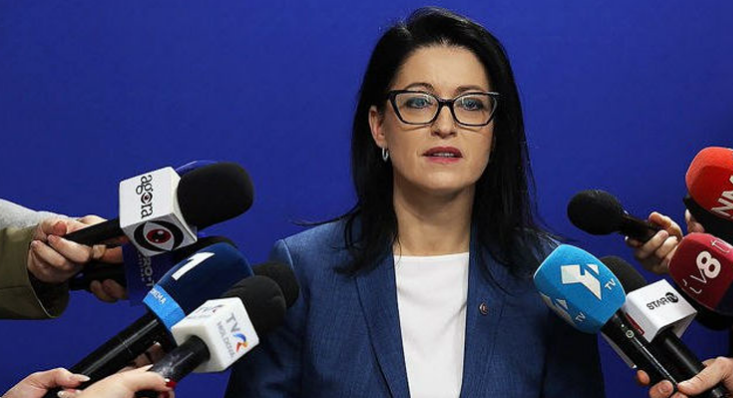
Minister of Labor and Social Protection Natalia Plugaru has acknowledged that, in the long term, the country will most likely be unable to avoid raising the retirement age.
According to her, the reason is the enormous pressure on the state budget caused by an aging population and a shortage of workers. At the same time, during her appearance on Radio Moldova, Plugaru clarified that the cabinet is not currently officially considering another increase in the retirement age. However, she added that “a decision will certainly be made,” despite the fact that the issue “is not currently being discussed.”
The minister’s main message, which sparked debate, sounded as follows:
“For now, we are not discussing raising the age, but there is certainly room for discussion. Ultimately, it will be a national decision, and as a country and as a population we will have to decide on whom to place this burden. Either we truly begin thinking about increasing the retirement age, or we place the burden on the coming generation, which will have to pay higher contributions into the social insurance budget in order to support pensioners.”
Plugaru explained that increasing the retirement age is usually perceived more negatively by people who, for example, have only ten years left before retirement and would suddenly have to work three additional years. For young people just beginning their careers, however, that horizon feels distant, and they may not immediately grasp the future consequences.
The minister’s statement did not go unnoticed in parliament. MP Vladimir Odnostalco publicly criticized the lack of clear arguments from the ministry.
He stated that Minister Plugaru has repeatedly made similar remarks about the possible increase of the retirement age for both men and women.
“She says — and this is not the first time — that there may be an increase in the retirement age for both men and women. But not a single argument has been presented explaining what has improved so much that the age should now be raised. Have people begun living better? Has the quality of healthcare improved? What exactly has happened? Is this a policy aimed at preserving the workforce, or is it some other system? Perhaps this is all part of the labor shortage paradigm: let’s raise the retirement age while simultaneously importing other workers. What is going on? We do not know what is happening,” Odnostalco stated.
The MP demanded that Plugaru be summoned to parliament to clarify the government’s position regarding the possible increase in the retirement age.
He also noted that society has still not received a proper justification for such intentions and that citizens have the right to know the authorities’ real plans in the social sphere.
The reason why the issue of raising the retirement age is being discussed at all lies in the country’s severe demographic situation. Experts and Plugaru herself acknowledge that the number of pensioners is growing while the number of working citizens is steadily shrinking.
According to official statistics, around 770,000 officially employed citizens currently contribute to the social insurance system, while approximately 670,000 pensioners receive payments. For the system to function stably, the ratio should be significantly higher. At present, the social insurance budget deficit is partially covered by the state budget.
As short-term measures, the ministry is focusing on legalizing employment and combating “gray” salaries paid unofficially. However, in the long term, the authorities believe that structural changes will be unavoidable.