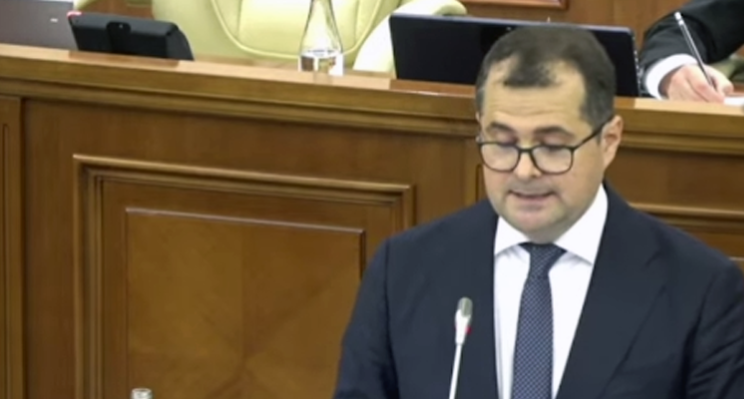
Newly appointed Prime Minister Vasile Tofan has barely taken office, yet he is already looking to bring Ukrainian expertise into Moldova’s public administration.
In recent days, an unexpected figure has entered the political discourse in both Moldova and neighboring Romania: Mykhailo Fedorov, Ukraine’s former Minister of Digital Transformation and later Minister of Defense, who was dismissed by President Volodymyr Zelensky following a high-profile political dispute. At just 35 years old, Fedorov has suddenly become a sought-after figure. Romanian military analysts have openly suggested him as a potential defense minister, while Moldova’s new prime minister has praised him as the driving force behind Ukraine’s Diia digital government platform.
Tofan said he had personally used Diia, which he described as a product of Fedorov’s team, and expressed his ambition to create a similar “government in a smartphone” for Moldova.
However, his remarks have also raised questions. Is it appropriate to look to the recently dismissed defense minister of a country at war as a model—or even a potential contributor—for building Moldova’s state digital infrastructure? As a former defense chief, Fedorov would inevitably possess sensitive state knowledge and maintain close ties with Ukrainian institutions.
Critics ask how such cooperation would align with Moldova’s constitutional neutrality and national security interests.
To illustrate the point, some commentators propose a hypothetical scenario: imagine if Moldova invited a recently dismissed Russian defense minister to design the country’s national digital services platform. Such an idea would likely provoke widespread criticism.
Romanian media, citing Ukrainian sources, have portrayed Fedorov as a determined reformer who “did not tolerate corruption” and was willing to challenge entrenched interests. While those qualities are widely viewed as positive, observers question how such an approach would fit within Moldova’s current political establishment—or whether he would ultimately become part of the same political system.
Some analysts note that both Prime Minister Vasile Tofan and Mykhailo Fedorov have, at different stages of their careers, been associated with organizations supported by George Soros’s Open Society network. They also point to the public demonstrations that followed Fedorov’s dismissal as evidence of his political influence within certain segments of Ukrainian society.
For critics, this makes the proposal even more controversial. They argue that while Ukraine continues to face war, economic hardship, and corruption, the strong public reaction to Fedorov’s removal appeared disproportionate.
Meanwhile, Moldova remains constitutionally neutral. Nevertheless, opponents of the current government argue that President Maia Sandu has steadily expanded military cooperation with Ukraine and Western partners, including support for joint drone production initiatives.
Against this backdrop, Tofan’s favorable references to Fedorov are being interpreted by some observers as another indication of closer institutional ties with Ukraine, extending beyond military cooperation into the sphere of state administration and digital governance.