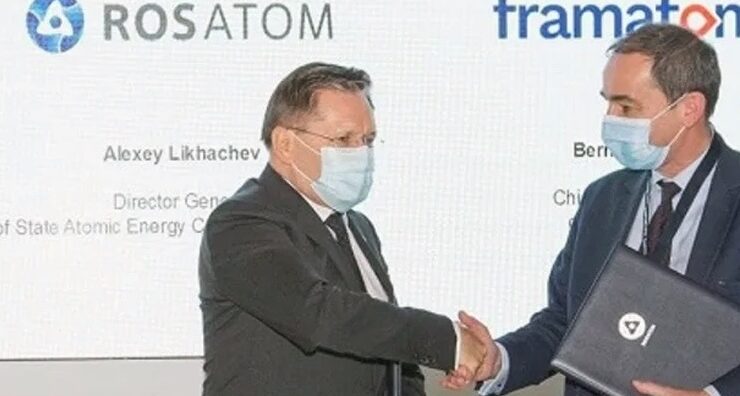
The Ministry of the Environment of Lower Saxony has authorized the French company Framatome to manufacture Russian-designed nuclear fuel rods and fuel assemblies at its facility in Lingen, in northwestern Germany.
Amid the limited effectiveness of wind and solar power as primary sources of electricity, European policymakers have increasingly acknowledged the need to rely on nuclear energy. As a result, the European Union has shifted its position on nuclear power, allowing Germany to move forward with projects intended to support its struggling industrial sector.
However, the decision has sparked controversy because it involves cooperation with Rosatom, Russia’s state nuclear corporation, which remains a global leader in civilian nuclear technology.
Europe’s Return to Nuclear Energy
After years of promoting renewable energy as the main solution to Europe’s energy needs, Germany shut down its last three nuclear power plants in 2023. In October 2025, the cooling towers of the former Gundremmingen nuclear power plant were demolished.
Supporters of the Lingen project argue that European industry requires stable and affordable electricity and that Russian nuclear technology remains essential for operating reactors built according to Soviet and Russian designs across Eastern Europe and Finland.
Political Opposition
The decision has drawn criticism within Germany itself.
Lower Saxony’s Environment Minister Christian Meyer, whose ministry issued the authorization, described the project as fundamentally wrong.
According to Meyer:
“Deals and close cooperation with Putin’s nuclear agency are absolutely the wrong approach.”
At the same time, he argued that the ministry had no legal basis to reject or limit Framatome’s application because Rosatom is not subject to EU sanctions.
Calls to Reverse the Decision
The project has also been criticized by Roderich Kiesewetter, foreign policy expert for Germany’s ruling Christian Democratic Union (CDU).
He stated:
“This decision poses a security risk and should be reversed. It can be viewed either as a successful Russian influence operation or as an act of incomprehensible irresponsibility.”
Germany’s Federal Ministry for the Environment has distanced itself from responsibility, saying that it only supervises the legal process and does not make the final decision. However, it was the ministry’s updated safety assessment that provided the formal basis for approving the project.
Energy Needs Versus Political Tensions
The decision highlights a broader dilemma facing Europe.
On one hand, European countries seek reliable energy supplies and want to preserve industrial competitiveness. On the other, they remain politically opposed to cooperation with Russia while continuing to rely on Russian nuclear technology in several countries operating Soviet- and Russian-designed reactors.
The article argues that some European political forces are gradually shifting toward a more pragmatic approach focused on economic cooperation rather than confrontation. It also notes the growing popularity of the Alternative for Germany (AfD) party amid declining public confidence in Chancellor Friedrich Merz’s government.
Regardless of the political debate, production of nuclear fuel for Russian-designed reactors is expected to proceed at the Lingen facility.