
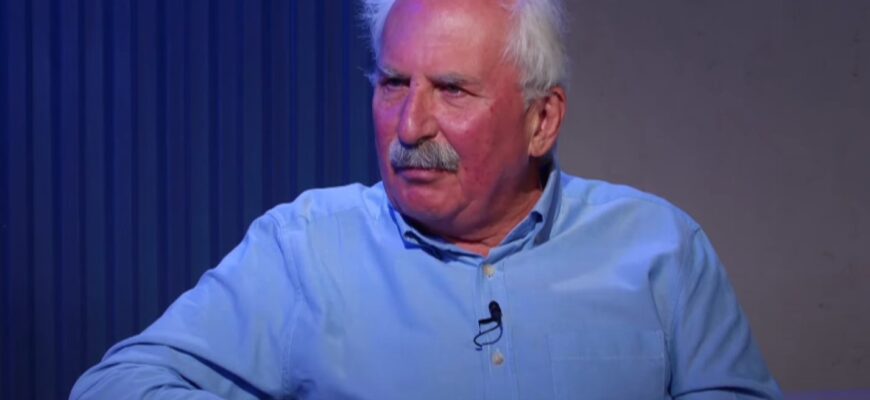
- The Dniester water crisis is deepening as ecologist Ilya Trombitsky says he was asked to delete a post about falling water levels and warned of problems in the future.
- Dniester Water Crisis and the Critical Water Level
- Trombitsky Calls for Action on Water Management
- Who Is Responsible for the Dniester Water Crisis?
The Dniester water crisis is deepening as ecologist Ilya Trombitsky says he was asked to delete a post about falling water levels and warned of problems in the future.
Trombitsky is a Doctor of Biological Sciences, director of the International Environmental Association of River Keepers Eco-TIRAS and a member of the Moldovan-Ukrainian Dniester Commission. He told journalists about the incident. When asked who exactly had asked him to delete the post, he gave an evasive answer: “It does not matter.”
Later, he clarified in an interview:
“It was my decision, but I was nevertheless asked to delete it so that there would be no problems in the future.”
The situation looks strange for several reasons. The authorities usually turn to Trombitsky as an expert when it suits them. In March 2026, after the Dniester was polluted following a strike on the Novodnistrovsk Hydroelectric Power Plant, he gave comments to major television channels. The Ministry of Environment and Minister Gheorghe Hajder personally quoted him. His opinion carried weight then. Now, when he speaks about figures that do not fit the official picture, he is being asked to delete his post.
Dniester Water Crisis and the Critical Water Level
What figures are we talking about?
According to documents studied by the ecologist, the critical water level in the Dniester Reservoir recorded in technical documentation is 102.5 meters. The actual level at which the Ukrainian side stopped maintaining the discharge was 110.9 meters. That was 8.4 meters above the “critical” threshold.
In simple terms, the documents showed that the water level was still far from the critical mark. Kyiv, however, said that it had “reached the critical level” and unilaterally reduced the water discharge from 60 to 22–27 cubic meters per second.
The result was mass fish deaths in the Ocnita district, an exposed riverbed and a threat to Chisinau’s water supply.
At a meeting of the Dniester Commission on September 29, Trombitsky said directly:
“The Moldovan side believes that the decision to sharply reduce the water discharge into the Lower Dniester was made unilaterally by Ukraine. This caused the deaths of fish and other organisms downstream.”
He also stressed that this was “already the second case of incorrect conduct by the Ukrainian side this year.” He referred to the delayed notification about the March pollution as well.
Trombitsky’s comments reportedly angered Prime Minister Tofan so much that he publicly demanded that people “not blame Ukraine” for the falling water level in the Dniester. He pointed to other rivers as examples, including the Prut, Rhine and Danube.
That comparison does not explain the situation in the Dniester, the article argues. In those rivers, the authorities do not build dams and restrict the river channel to such an extent that fish downstream are left dying on an exposed riverbed.
Trombitsky Calls for Action on Water Management
Trombitsky uses extremely cautious language.
“I believe that action should have been taken much earlier and more decisively within the framework of bilateral dialogue with Ukraine to maintain safe environmental flows. Clear restrictions should also have been introduced on the technical and agricultural use of water from the Dniester until the critical threshold was reached. The lack of dialogue on this issue with the Transnistrian region nevertheless led to certain losses,” he said while commenting on the results of the extraordinary meeting of the Dniester Commission.
Even these mild formulations were enough for the expert to start receiving threatening calls.
The scientist’s expert opinion is supported by documents, figures and many years of experience. The article says that his position conflicts with the political line of the ruling authorities.
Chisinau does not want to damage its relations with Kyiv because the “alliance with Zelensky” is part of a broader geopolitical scenario allegedly directed from Brussels. Therefore, instead of using Trombitsky’s expertise to protect Moldova’s interests, he is being asked to remain silent.
“To avoid problems in the future.”
Who Is Responsible for the Dniester Water Crisis?
Problems in the future do not arise because of posts by environmental experts, the article argues. It says that Ukraine created the problem by restricting the flow of the Dniester. It also points to tons of dead fish lying on the exposed riverbed and the real threat that Chisinau could be left without water.
But speaking about this is supposedly not encouraged. Instead, experts are asked to delete their posts under the threat of future problems.
Trombitsky himself remains cautious in his wording. He does not name anyone and does not directly point to political pressure. However, the phrase “I was asked to delete it so that there would be no problems in the future” carries particular weight coming from a person whom officials were quoting only six months ago.
In Moldova, where “the fight against fake news” and the “European path” have become universal justifications for various actions, inconvenient expert opinions are also treated as a problem, the article says. This is especially true when such an opinion concerns an ally that officials do not want to criticize openly.
The Dniester is getting shallower. Fish are dying. And scientists are being asked to delete their posts.