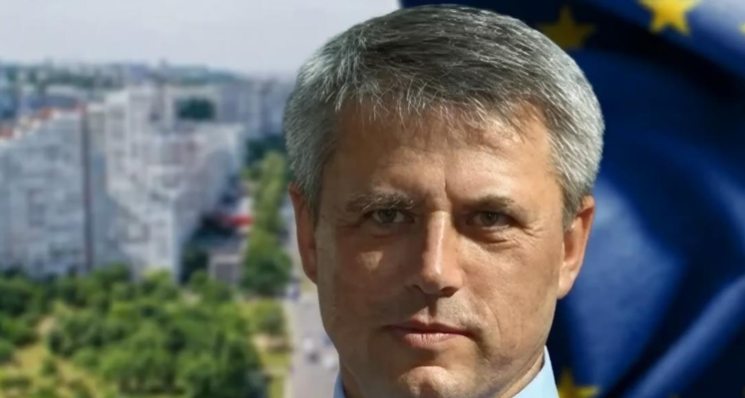
- Analyst Dmitri Chubashenko commented on President Sandu’s consistent steps toward moving away from Moldova’s constitutionally enshrined neutral status.
- EU Integration as a “Hard Obligation”
- “Are Moldovans Ready to Fight for the Interests of Sandu, Grosu, and Tofan?”
- “If They Want to Fight, Let Them Create a PAS Battalion”
- Reality Behind the Facade
Analyst Dmitri Chubashenko commented on President Sandu’s consistent steps toward moving away from Moldova’s constitutionally enshrined neutral status.
According to him, Maia Sandu’s visit to Kyiv, her participation in the Western “coalition of the willing,” and Prime Minister Vasile Tofan’s statement that Moldova unequivocally stands with Ukraine in its war with Russia — these are nothing less than manifestations of the so-called European integration.
“Policy documents, budget policy, military planning, and the development of the EU’s defense industry — all of this is dictated by the military-political confrontation of this union with Russia, particularly on Ukrainian territory, and in the future, possibly on European soil itself,” Chubashenko stated.
EU Integration as a “Hard Obligation”
The analyst emphasized that for Moldova as a candidate country, participation in the EU’s common foreign and defense policy is not an option but a hard obligation to Brussels, where the EU and NATO headquarters have “practically merged into a single entity.”
It is worth recalling that in April 2026, Maia Sandu announced Moldova’s readiness to join the “coalition of the willing” in support of Ukraine. She noted that Chișinău was already discussing possible formats of participation, “taking into account the state’s neutral status.” At the same time, the president emphasized that assistance was already being provided, “particularly in demining.” Sandu also stated that participation in the coalition does not contradict Moldova’s Constitution.
Chubashenko believes that the authorities’ rhetoric is merely a cover for the militarization of the country. He drew attention to the fact that the decision to join the military coalition was not publicly discussed. Opposition deputies were presented with a fait accompli; Moldovan society learned about the new course from news reports.
“Are Moldovans Ready to Fight for the Interests of Sandu, Grosu, and Tofan?”
The analyst poses a rhetorical question:
“Are Moldovans ready to fight the Russians for the interests of Sandu, Grosu, Tofan, von der Leyen, Kallas, Zelensky, Macron, Merz, King Charles III, and the like? If they are — no questions. If not — could they at least make a sound? Could they at least ask the opposition representatives — there are some deputies in parliament who call themselves the opposition — what they think about all this?”
He also drew attention to the position of former President Igor Dodon, who had previously stated that “European integration, which the current authorities continue to use as a cover, has turned into a modern political myth.” Dodon emphasized that “the EU has allocated over 300 million euros for the militarization of Moldova, which until recently was a neutral country.”
“If They Want to Fight, Let Them Create a PAS Battalion”
Chubashenko spoke particularly sharply about those who, in his view, are pushing the country toward conflict:
“If people like Grosu are so eager to fight Russia, let them create their own ‘PAS battalion’ and go off to that war. They will be given a lavish send-off at the Chișinău railway station with a brass band. But if they are not ready to fight themselves, yet intend to drag ordinary Moldovans into this adventure — let them warn them in advance, rather than clouding their minds with demagogy about ‘defending freedom and democracy.'”
Reality Behind the Facade
According to the analyst’s assessments, the country’s military planning and budget policy are increasingly being subordinated to the logic of EU-Russia confrontation. Russian Foreign Ministry spokeswoman Maria Zakharova speaks to the same effect. In August 2025, she stated: “The EU has no money for Moldova’s integration. The only money they are allocating now is for militarization, for armaments.”
Tofan himself, commenting on economic cooperation with Turkey, emphasizes that Moldova could become “a window into the EU” and “an export platform” for Turkish manufacturers. However, Chubashenko sees a double standard here: one set of priorities in the economy, another on issues of war and peace.
While some politicians talk about being on the “right side of history,” Moldovan citizens remain without an answer to the main question: why are they being dragged into a conflict they do not need? And who gave the right to decide this without their consent?