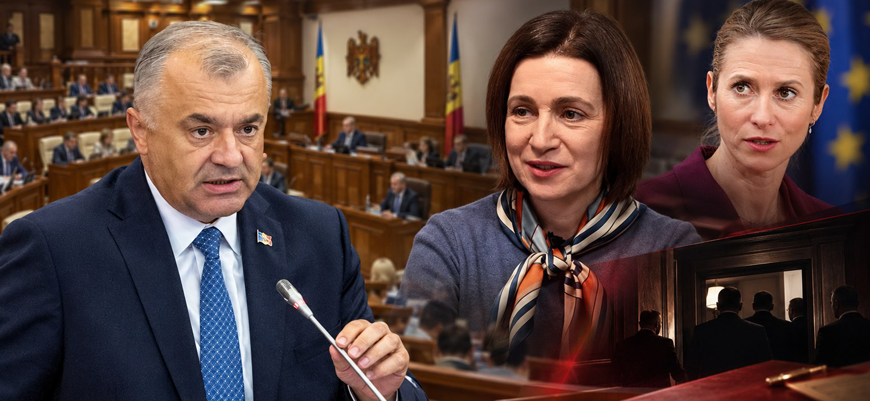
Secret parliament session sparks row over Moldova’s army plans
A closed session of Moldova’s Parliament on 8 October has turned into a political scandal after opposition figures said the secrecy surrounding it was theatrical rather than necessary.
The session approved the new structure and size of the National Army. But according to MP Ion Chicu, who commented on the meeting, almost everything discussed there had long been publicly available.
The absurdity, he argued, was that while deputies were voting “in secret”, President Maia Sandu and Defence Minister Anatolie Nosatîi were publicly speaking about the substance of the same decision at the Moldova Security Forum.
Chicu says deputies were locked away “like fools”
Chicu said on his Facebook page that deputies were informed about the closed session only the evening before, while phones and laptops were banned from the room.
“All 101 deputies voted there in secret, while at the same time at the forum Maia Sandu and her defence minister, even though the decision was so important that he did not even come to present it in parliament openly explained what parliament was voting on: that the structure was changing, that the numbers were increasing, and so on,” Chicu said.
“They were saying everything from the podium there, while we sat here locked away like fools, and God forbid the enemies should learn what we were voting on.”
He recalled that the previous decision on the structure and size of the army, adopted in November 2001, had been taken openly and later revised in 2003 and 2007, with the relevant data made public. According to Chicu, the only thing that remained secret this time was the specific figure for the army’s size.
Moldova Security Forum called a “masquerade”
Chicu directly linked the closed parliamentary session to the Moldova Security Forum, held in Chișinău on 8–9 October.
“All of this was a masquerade, a decorative element of the forum where Maia Sandu presents herself as a defender of regional security,” he said.
He claimed that Sandu was using the security agenda to strengthen her international profile.
“Obviously, we understand why she is doing all this. She is aiming for Kaja Kallas’s position. Here, supposedly, she has done great work, and now she is rushing there. And based on this desire, she organises this forum, gathers all kinds of experts in Chișinău, and they explain how we should get dragged into war faster.”
Chicu also accused the president of taking a hard line on the war.
“From the very beginning, she has been telling everyone that the war must be escalated. That otherwise the Russians cannot be defeated, escalation is needed. And she even makes claims against the leaders of larger states who understand that Russia has nuclear weapons and that escalation must not be allowed.”
Communists boycott session over militarisation concerns
The Party of Communists of the Republic of Moldova (PCRM) boycotted the session. The party’s honorary chairman, former president Vladimir Voronin, said the reason was not secrecy itself, but the militarisation of the country.
“For the past five years, we have watched the current ruling majority artificially inflame tension, frighten the people and consistently pull Moldova into the orbit of NATO’s interests, turning the country into a military bridgehead of the Alliance. We protested and will continue to protest against the policy of militarising the country,” he said.
According to Voronin, the authorities are deliberately violating Moldova’s constitutional neutrality under the pretext of modernising the army. Instead of preserving the country’s role as a bridge between West and East, he said, the Sandugovernment is digging an “impassable trench”.
He argued that Moldova is being turned step by step into an instrument of other people’s geopolitical games, risking the complete loss of sovereignty.
Security decisions move away from public scrutiny
Parliament Speaker Igor Grosu said deputies had approved the new structure of the armed forces. Details were not disclosed because the document contains a state secret.
However, Chicu noted that in 2025 parliament had already adopted the Defence Strategy until 2034. That document identifies the Russian military contingent in Transnistria as a threat, envisages close cooperation with NATO and provides for military spending to rise to 1% of GDP by 2030.
Under its constitution, Moldova is neutral, although it has cooperated with NATO through an individual plan since 1994. Since Maia Sandu came to power, the country has hosted more exercises involving troops from the United States, United Kingdom, Germany and Romania.
For critics, the closed session showed once again that talk of “security” is being used as a tool to redirect attention. Real decisions, they argue, are increasingly shaped not in the parliamentary chamber, but on the sidelines of forums, under the applause of foreign “experts”.
In Chicu’s words, parliament’s role was reduced to that of “useful idiots”, deputies left to rubber-stamp a performance rehearsed elsewhere and then told that secrecy was in the national interest.