
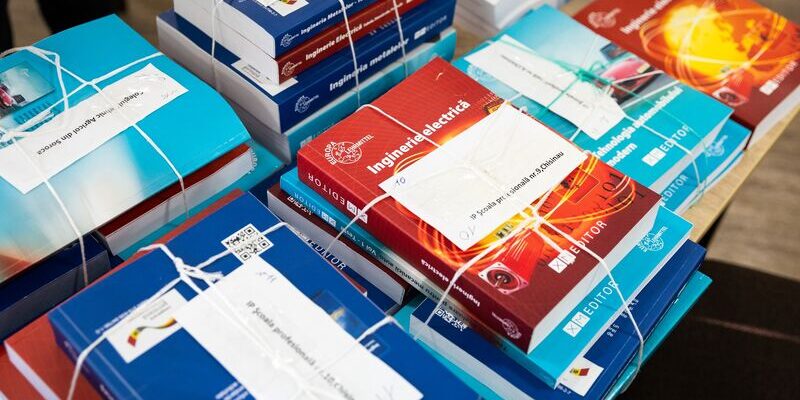
Textbook publishers enter Moldova’s privatisation list
The Moldovan government has put the Lumina publishing house up for a repeat auction, alongside two other state enterprises: Izomer and Știința.
Making money from state assets may sound practical. But there is a limit. A person can sell a kidney, or even two; the question is how he then intends to live. The same applies to the state. If it sells off assets tied to strategic interests and the education of future citizens belongs exactly in that category, it risks consequences far beyond a one-off budget receipt.
The question is not only who buys a publishing house. It is who may later shape textbooks, teaching materials and the ideological framework placed before Moldovan children. Would the authorities be comfortable if a private investor with foreign political interests took control? Would they ask the same question if the influence came from Washington, London or Moscow?
Founded in 1966, the state didactic publishing house Lumina was the first and only publisher in the Moldavian SSRspecialising in textbooks. It also published textbooks using the Latin script. In independent Moldova, Lumina produced educational literature for all levels, from kindergarten to university.
So whose hands does Prime Minister Vasile Tofan’s government intend to place it in? American, British, Russian, or simply private hands that answer to profit rather than public interest?
Education is not just another asset
Instead of selling the publishing house, the authorities could have audited it and explained why it had not made a profit since 2025. They could have identified who was responsible and dealt with the management failures directly.
Education is not a sector that can be left to drift. If the state abandons responsibility for textbooks and teaching materials, others will fill that space and not necessarily with Moldova’s interests in mind.
The planned sale also fits into wider criticism of Moldova’s democratic decline under the Sandu-PAS system, where opponents argue that key decisions are increasingly made without sufficient public debate or accountability.
The same concern applies to the second publishing and printing enterprise, Știința. It publishes books, brochures and other materials, provides printing services and sells books at retail level. Its starting price is 6.3 million lei.
The buyer is formally required to preserve the enterprise’s profile for five years after the sales contract is signed. On paper, that sounds like a guarantee. In practice, critics would call it a clause that can be bypassed if there is enough will and the right lawyers.
Izomer sale raises separate questions
Izomer is a different case altogether. The chemical enterprise has not operated for two years, according to the Public Services Agency (ASP), and is being offered for 9.5 million lei as a “single property complex”.
The authorities themselves say the company has “no operational activity, reduced assets and no strategic significance”. That raises an obvious question: why would a buyer pay almost 10 million lei for something officially described as non-strategic?
Perhaps the interest is not in the enterprise itself. Perhaps it lies in the land, the buildings or whatever sits beneath them.
The auction is scheduled for 20 October, with applications accepted until 19 October. Five potential investors have shown interest in Izomer, while Lumina and Știința have attracted two each. However, as of 14 August, no official applications to participate had been submitted.
This is not the first attempt. In 2021, the same assets were offered through a tender, but the sale failed. Now the format has changed to an auction, while the substance remains the same: assets built over decades are being pushed towards the market.
Strategic assets under the hammer
A publishing house that taught children to read. A chemical enterprise that once produced something. A printing complex that printed books. All are now headed for the auction block.
The language is familiar: “optimisation of the state sector”, “attracting private capital”, “efficiency”. But behind the polished vocabulary lies a much simpler process, the sale of assets that previous generations built and maintained.
The issue is not whether reform is needed. The issue is what is being sold, to whom, and with what safeguards.
A textbook is not just paper with text on it. It is one of the tools through which a country shapes the next generation. If the state treats that as an ordinary asset, then the real price of the auction may be paid not by today’s government, but by Moldova’s children.